
Exemption Form Guide: State-by-state
 by Nida Hammad
 Last updated:
Medically reviewed by:
Dr. Matthew Reynolds, MD


A medical window tint exemption form allows eligible drivers to use darker window tint than their state’s standard legal limit when a medical condition makes reduced light exposure necessary. Each state has its own rules for qualifying conditions, tint limits, forms, medical documentation, and approval requirements. Conditions such as lupus, albinism, porphyria, and other photosensitive disorders may qualify in some states, but eligibility is not the same across the country.
This state-by-state exemption forms guide explains how to apply for a medical window tint exemption in all 50 states. You will learn which states offer medical exemptions, what forms or applications are required, what your doctor needs to provide, where to submit your paperwork, and how dark your window tint can be with an approved exemption. The guide starts with detailed information for Florida, Ohio, California, Texas, and New York, then covers the remaining states. It also explains common reasons applications are rejected, how to keep your exemption valid, and what to know when driving with a medical tint exemption..
Understanding Medical Window Tint Exemption Form: Legal Framework and Medical Necessity
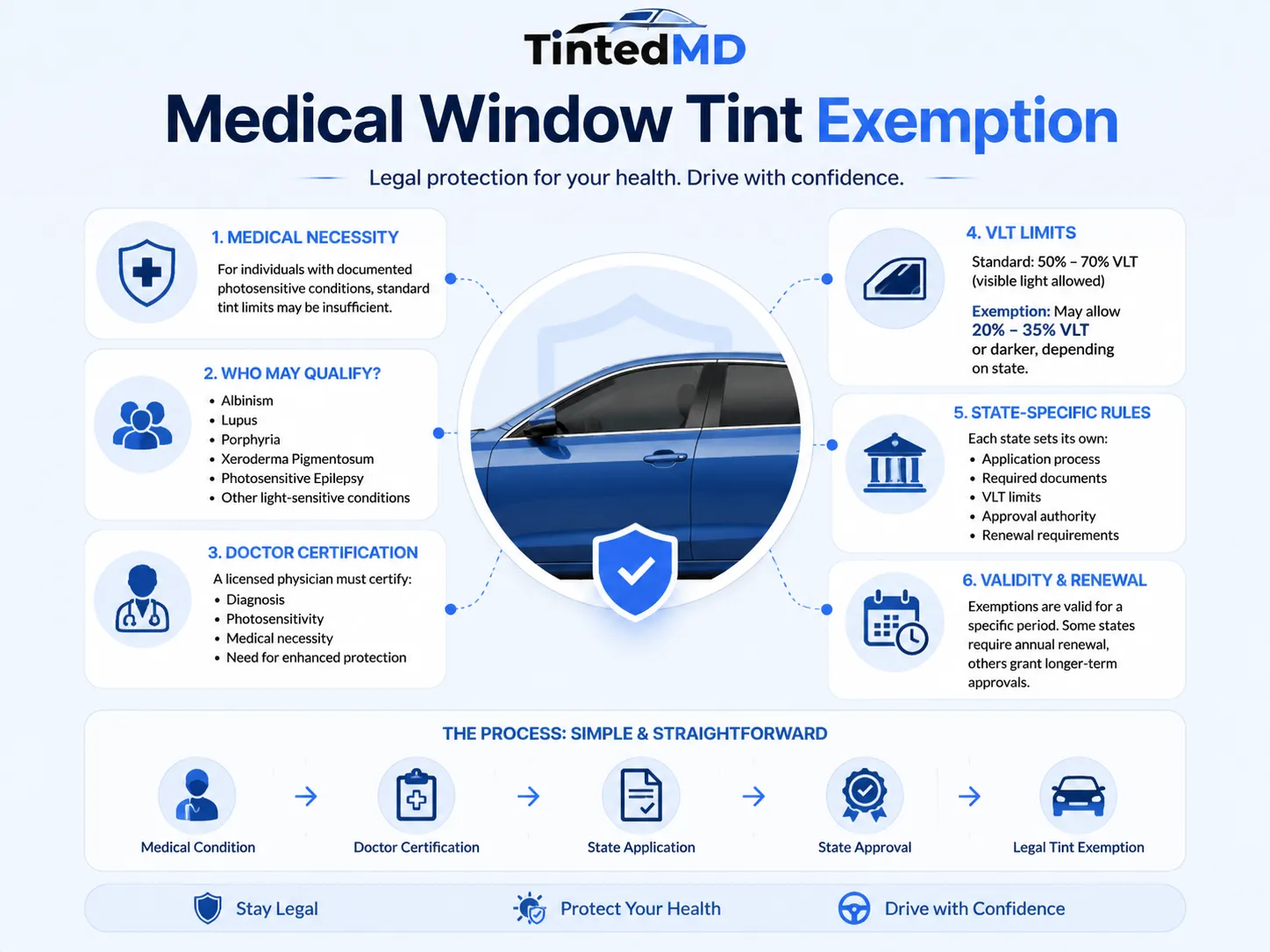
A medical window tint exemption form grants legal permission to exceed standard visible light transmission (VLT) limits. This authorization is based on documented photosensitive medical conditions. The form allows individuals with specific health needs to install darker window tinting than state law typically permits.
Standard automotive glass blocks most UVB radiation. However, it allows significant UVA penetration. This creates cumulative skin damage and triggers photophobia symptoms in affected individuals. For people with light-sensitive conditions, standard glass protection is not enough.
What Medical Window Tint Exemption Forms Authorize
These forms authorize VLT percentages between 20-35% on front side windows. Standard legal limits in most states range from 50-70%. The difference is substantial for people who need enhanced UV protection.
The exemption process requires medical exemption certification from licensed physicians who can document diagnosis and treatment recommendations. Physicians must verify that the condition creates genuine medical necessity for enhanced UV protection. This certification is not cosmetic or preference-based.
Once approved, the exemption typically remains valid for a specific period. Some states require annual renewal. Others grant longer-term authorizations based on the permanent nature of the condition.
Federal ADA Protections and State-Level Implementation
The Americans with Disabilities Act supports reasonable accommodations for individuals with light-sensitive conditions. However, specific exemption processes are administered at the state level. This creates variation in how window tint exemption by state requirements are structured.
Federal law establishes the framework for disability accommodations. Each state then develops its own application process, documentation standards, and approval procedures. Some states process exemptions through the Department of Motor Vehicles. Others use health departments or specialized licensing agencies.
The variation means you must understand your state’s specific requirements. What works in one jurisdiction may not apply in another. Research your local regulations before starting the application process.
Medical Conditions That Qualify for Tint Exemptions
Qualifying conditions include albinism, lupus, porphyria, and xeroderma pigmentosum. Photosensitive epilepsy also qualifies in most states. Other dermatological or ophthalmological disorders that create medical necessity for enhanced UV protection may be eligible.
Each condition must be documented by a licensed physician. The documentation should explain how the condition causes photosensitivity. It must also demonstrate why standard window tinting limits are insufficient for the patient’s health needs.
Dermatologists, ophthalmologists, and rheumatologists commonly provide these certifications. The physician must hold an active license in the state where the exemption is requested. Their certification carries legal weight in the approval process.
Medical Window Tint Exemption Form: State-by State Process
Alabama Tint Exemption Form
Alabama’s medical window tint exemption is covered under Ala. Code § 32-5C-4. Alabama does not use a specific form number for this exemption. Instead, eligible drivers must submit Medical Exemption Application as part of the approval process. To apply, you generally need a completed application, a statement from your physician, and certification from an Alabama-licensed physician confirming the medical need for darker window tint. Alabama does not establish a specific VLT limit for approved medical exemptions. The Alabama Law Enforcement Agency (ALEA) reviews exemption requests individually and may approve tint darker than the standard 32% VLT requirement when medically justified.
Alaska Tint Exemption Form
Alaska’s window tint exemption is governed by 13 AAC 04.223 and AS 28.35.271. The state does not provide a specific tint exemption form. Instead, drivers need a certification letter from an Alaska-licensed physician that confirms the medical need for additional protection from sunlight. This letter should be kept in the vehicle and presented if requested by law enforcement. The physician determines the level of tint needed based on the driver’s medical condition. This means an approved medical exemption may allow darker tint than the standard legal limit. However, windshield tint restrictions still apply. Drivers should also be aware that the medical certification must be renewed annually to remain valid.
Arizona Tint Exemption Form
Arizona’s medical window tint exemption is governed by A.R.S. § 28-959.01. If you qualify for a medical exemption, you may need to complete Form 40-1511 and provide medical certification from a qualified healthcare professional. The application may also require a valid ID and vehicle details, including the VIN, year, make, and model. Once approved, the exemption can allow darker tint on the side and rear windows than Arizona’s standard 33% VLT requirement. However, the exemption does not remove windshield restrictions. Tint on the windshield must still comply with Arizona law and cannot extend below the AS-1 line.
Arkansas Tint Exemption Form
Arkansas allows medical window tint exemptions under Ark. Code § 27-37-306(e). The state does not use a numbered exemption form. Instead, you need a certification from an Arkansas-licensed physician confirming your medical condition and the need for darker window tint. The certification should explain your diagnosis and medical need. After the tint is installed, the vehicle must also have the required installer label. Even with a medical exemption, Arkansas sets specific tint limits. Approved vehicles may have 20% VLT on side windows and 10% VLT on the rear window. This means the exemption does not allow completely unrestricted tint. You must still follow the state’s approved VLT limits and documentation requirements.
California Tint Exemption Form
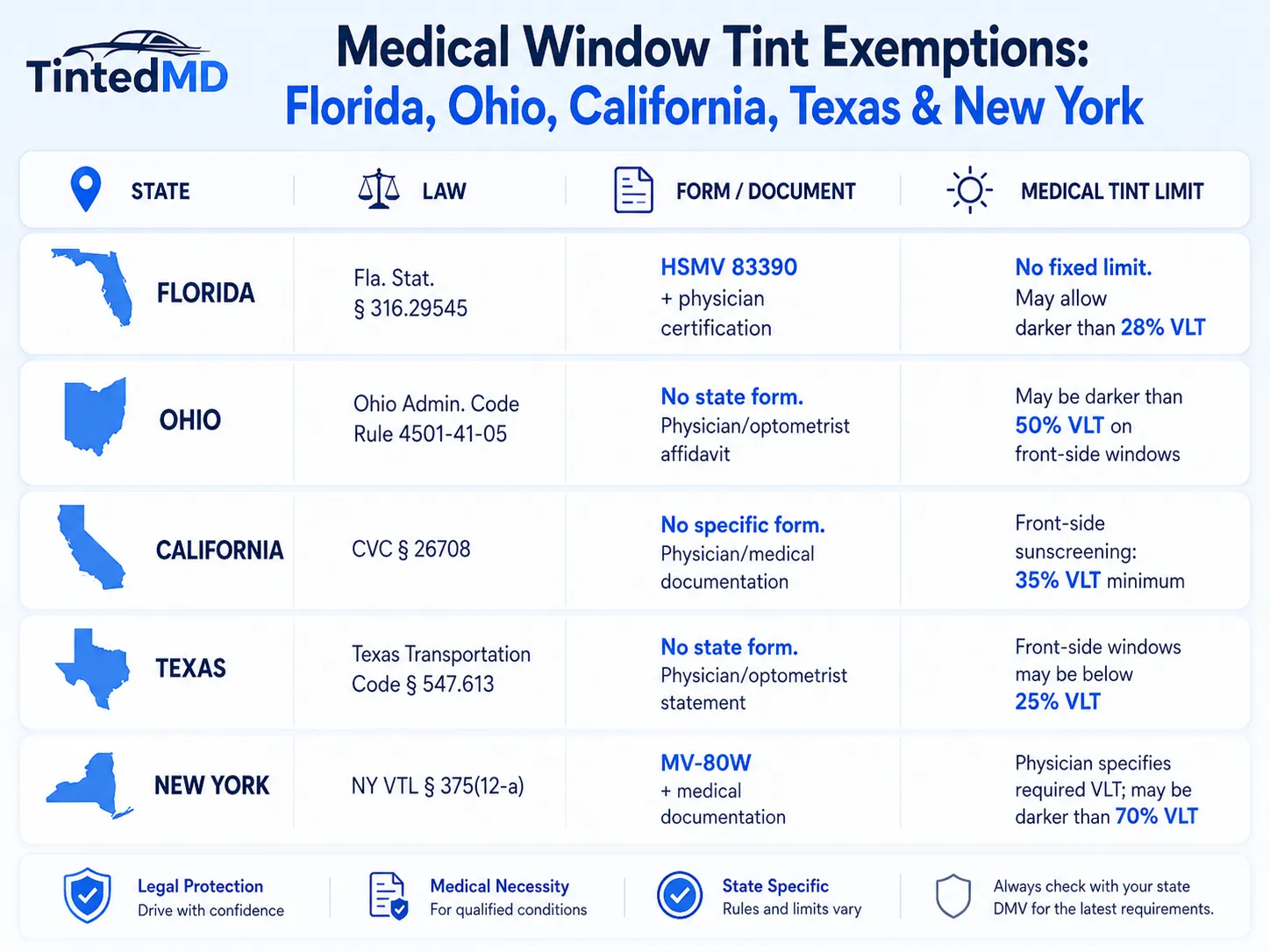
California’s window tint rules are covered under California Vehicle Code (CVC) § 26708. California law does not prescribe a specific DMV form for medical tint exemptions instead, drivers must carry a signed letter or written documentation from a licensed physician, surgeon, dermatologist, or optometrist inside the vehicle. If you are requesting an exemption for a UV-blocking film, certification from a dermatologist may be required. Under California law, an approved sun-screening device on the front side windows must allow at least 35% visible light transmission (VLT). For clear UV-blocking film, the film must have at least 88% VLT, or the combined film and glass must allow at least 70% VLT. Drivers should keep the required medical documentation available to show that the tint meets California’s exemption requirements.
Colorado Tint Exemption Form
Colorado’s window tint law is governed by C.R.S. § 42-4-227. Unlike some states, Colorado does not currently provide a medical exemption form or a process for getting darker window tint due to a medical condition. For drivers with medical needs, the standard 27% VLT limit for front-side windows still applies. In other words, a medical condition does not currently provide a legal pathway to install darker tint on these windows in Colorado.
Connecticut Tint Exemption Form
Connecticut drivers can apply for a window tint exemption using Form E-220 under Conn. Gen. Stat. § 14-99g. The form must be completed and signed by a Connecticut-licensed physician or optometrist. The vehicle may also need to pass an inspection or validation process before the exemption is approved. Once approved, exempted side and rear windows may have a VLT between 20% and 32%. Tint darker than 20% VLT will not pass the required validation. Drivers should keep the approved exemption documentation with them while operating the vehicle.
Delaware Tint Exemption Form
Delaware’s medical tint exemption is covered under 21 Del. C. § 4313. The state does not provide a specific tint exemption form number. Instead, eligible drivers apply directly through the Delaware DMV and provide the required medical documentation. Applicants generally need a valid Delaware driver’s license or ID, vehicle registration, VIN and vehicle information, along with a physician’s certification confirming the medical need for darker window tint. If approved, the vehicle may have front side windows darker than Delaware’s standard 70% VLT requirement. Delaware does not specify one fixed VLT limit for approved medical exemptions, so the permitted level depends on the exemption approval.
Florida Tint Exemption Form
Florida’s medical window tint exemption is governed by Fla. Stat. § 316.29545. To apply, you need HSMV 83390, along with the required physician certification and a copy of your Florida driver’s license or state ID. The form helps document your medical need for darker window tint. Florida does not set one specific tint darkness level for every medical exemption. Instead, the approved tint level is based on your medical condition and your physician’s certification. A medical exemption may allow tint darker than the standard 28% VLT limit when medically necessary and approved under Florida law.
Georgia Tint Exemption Form
Georgia’s window tint exemption law is covered under O.C.G.A. § 40-8-73.1. To apply for a medical tint exemption, you must complete DPS-431 and provide a letter from a licensed physician or optometrist on official letterhead. The application also requires vehicle information, including the VIN, license plate number, and other required details. With an approved medical exemption, Georgia allows side and rear windows to have a VLT as low as 23%. However, the exemption does not apply to the windshield, so windshield tint must still follow Georgia’s standard legal requirements.
Hawaii Tint Exemption Form
Hawaii’s window tint law is governed by HRS § 291-21.5. Unlike some states, Hawaii does not provide a medical exemption application for darker window tint. Drivers with a medical condition cannot use a special exemption to install tint below the state’s standard limit. Hawaii generally allows front-side window tint that permits at least 35% visible light transmission (VLT). This limit applies regardless of whether the driver has a medical need for additional protection from sunlight. If you are looking for a Hawaii tint exemption form, there is currently no dedicated medical form available for obtaining darker tint based on a medical condition.
Idaho Tint Exemption Form
Idaho’s window tint law is covered under Idaho Code § 49-944(4). The state does not require a specific medical tint exemption form. Instead, drivers must have written verification from a physician stating that protection from sunlight or heat is medically necessary. Under Idaho’s standard rules, most vehicle windows must allow at least 20% VLT, while the windshield must maintain a 70% VLT minimum. A medical exemption may allow qualifying drivers to use darker tint where medically necessary, but the windshield requirement still applies.
Illinois Tint Exemption Form
Illinois follows 625 ILCS 5/12-503 for medical window tint exemptions. Eligible drivers must submit Form VSD 704, which requires physician certification and vehicle information. Approved vehicles may also receive special Tinted Window license plates. With an approved medical exemption, the front side windows may use darker tint than normally permitted under Illinois law. Rear windows already have more flexible tint limits, so the exemption mainly provides additional protection for the front side windows. Drivers should keep the required medical documentation and exemption approval with the vehicle as proof of compliance.
Indiana Tint Exemption Form
Indiana’s medical window tint exemption is covered under Ind. Code § 9-19-19-4. Unlike some states, Indiana does not require drivers to complete a specific state exemption form. Instead, you need certification from a licensed physician or optometrist that explains your medical need for protection from sunlight. Indiana does not set one specific VLT limit for vehicles with a medical exemption. The level of tint should provide the protection recommended by your physician or optometrist. The medical exemption must also be renewed annually to remain valid.
Iowa Tint Exemption Form
Iowa’s window tint law is governed by Iowa Code § 321.438. Iowa previously allowed medical tint exemptions through Form 432020, but the state is no longer accepting new applications for this exemption. According to updated rules from the Iowa Department of Transportation, all medical tint exemptions including older forms issued prior to July 4, 2012 are no longer valid and recognized. Drivers operating vehicles in Iowa must maintain at least 70% light transmittance on the front windshield and front side windows without exception.
Kansas Tint Exemption Form
Kansas law is covered under K.S.A. § 8-1749a(c). Unlike states that allow darker window tint for medical reasons, Kansas does not provide a darker-tint medical exemption. Instead, drivers with a qualifying medical need may use a clear, colorless UV-blocking film. The film must allow at least 78% visible light transmission (VLT) on its own or 70% VLT when combined with the vehicle’s glass. Kansas does not require a specific state exemption form. Instead, the driver needs a signed statement from a licensed physician or optometrist confirming the medical need for the UV-blocking material.
Kentucky Tint Exemption Form
Kentucky’s window tint law is covered under KRS § 189.110. Unlike some states, Kentucky does not provide a medical exemption process that allows drivers to use darker window tint because of a medical condition. There is no dedicated medical tint exemption form or physician documentation process for obtaining a darker tint exemption. For standard vehicles, Kentucky generally requires the front-side windows to allow at least 35% visible light transmission (VLT). Drivers who need darker tint for medical reasons should not assume that a doctor’s letter or medical condition creates an exemption. Unless Kentucky law provides a specific exception for the vehicle or window type, the standard tint requirements still apply.
Louisiana Tint Exemption Form
Louisiana’s medical window tint exemption is governed by La. R.S. § 32:361.2, with DPSSP 1060 used to apply for the exemption. Applicants generally need the completed form, physician certification, a copy of their driver’s license, vehicle information including the VIN, and notarization. The exemption may allow darker window tint than the standard legal limit when medically necessary and supported by a physician. Drivers with qualifying porphyria may also receive a special windshield exemption under Louisiana law.
Maine Tint Exemption Form
Maine follows 29-A MRSA § 1916 and provides an official Window Tint Medical Exemption Application. The state does not assign a specific form number to this application. To apply, you must provide the vehicle owner’s information, vehicle details including the VIN, and certification from a qualified physician. The medical exemption allows qualifying drivers to use window tint that does not meet Maine’s standard 35% VLT requirement for side and rear windows. Maine does not specify a separate medical VLT limit for approved exemptions. The exemption is based on documented medical need and the required physician certification.
Maryland Tint Exemption Form
Maryland’s medical tint exemption is governed by Md. Transportation Art. § 22-406(i)(4). To apply, you must complete MSP ASED 23-04B and provide certification from a licensed physician or optometrist. The application also requires key vehicle details, including the vehicle identification number (VIN).
If approved, the exemption allows window tint darker than Maryland’s standard 35% VLT requirement. The medical certification must support the need for increased protection from sunlight or other light exposure.
Massachusetts Tint Exemption Form
Massachusetts follows M.G.L. Ch. 90 § 9D and requires an Application for Tinted Glass Waiver. There is no specific form number. Applicants typically need the original waiver application, vehicle and owner information, and a physician’s certification explaining the medical need for the exemption. The physician or the Massachusetts RMV determines the approved tint level based on the medical condition. However, the windshield cannot be tinted below the AS-1 line or within the top six inches of the windshield.
Michigan Tint Exemption Form
Michigan’s medical window tint exemption is covered under MCL 257.709(3)(e). The state does not require a specific exemption form. Instead, the driver must have a letter from a licensed physician or optometrist confirming that darker window tint is medically necessary. Michigan does not set a specific VLT limit for approved medical exemptions. This means darker tint, including full front-side window tint, may be permitted when medically justified. However, window tint reflectivity must remain below 35% even when a medical exemption applies.
Minnesota Tint Exemption Form
Minnesota follows Minn. Stat. § 169.71 Subd. 4a for medical window tint exemptions. No state exemption form is required. Instead, you must provide a physician’s prescription or written statement that explains your medical condition and the minimum amount of light transmission needed for your vehicle windows. The physician must also state whether the exemption is temporary or permanent and specify the minimum allowable light transmission. For drivers without a medical exemption, Minnesota generally requires front-side windows to allow at least 50% VLT. If you qualify for a medical exemption, your physician’s documentation determines the lower light transmission level permitted.
Mississippi Tint Exemption Form
Mississippi’s medical window tint exemption is governed by Miss. Code § 63-7-59(4). To request an exemption, you need a Tint Waiver Affidavit signed by a licensed physician. You must also submit a copy of your Mississippi driver’s license or state-issued ID with the affidavit. After completing the required documents, file them with your county tax collector. Mississippi does not set one specific medical VLT limit for approved exemptions. Instead, the physician determines the level of tint needed for the medical condition. This means tint darker than the standard 28% VLT may be allowed when medically necessary and properly approved.
Missouri Tint Exemption Form
Missouri’s window tint exemption law is covered under RSMo § 307.173 and 11 CSR 30-7.010. To qualify for a medical tint exemption, you need an SHP-524 permit and a prescription from a licensed physician. The prescription must have been issued within the past year. Your tinted vehicle must also pass the required inspection. With an approved medical exemption, the front side windows may have a VLT below 35%, based on the level of tint specified by your physician.
Montana Tint Exemption Form
Montana’s medical tint exemption is governed by MCA § 61-9-428. The state does not provide a standard tint exemption form. Instead, you must obtain an affidavit from a licensed physician, physician assistant, or advanced practice registered nurse. You will also need your vehicle identification number (VIN), registration information, and a law enforcement waiver. The exemption allows darker window tint than Montana’s standard limits of 24% VLT for front windows and 14% VLT for rear windows, as permitted under the approved waiver. Make sure you carry the required documentation in your vehicle to show that your darker tint is legally exempt.
Nebraska Tint Exemption Form
Nebraska’s window tint laws are governed by Neb. Rev. Stat. § 60-6,257. Standard limits require front-side windows to allow at least 35% VLT. Rear-side and back windows on standard passenger vehicles must allow at least 20% VLT. Nebraska also provides a medical waiver process under Neb. Rev. Stat. § 60-6,260. Drivers who need darker window tint because of a medical condition may apply for a written waiver through the Nebraska State Patrol or a local law enforcement agency. The application requires a signed affidavit from a licensed physician explaining the medical need for darker tint.
Nevada Tint Exemption Form
Nevada’s window tint exemption rules are covered under NRS 484D.440 and NAC 484D.280 through 484D.290. To apply for a medical tint exemption, you must complete Form DO-200 and provide certification from a licensed Nevada physician. Your application should include the completed DO-200 form, your vehicle information, medical certification, and the VLT level recommended by your doctor. Nevada limits medical window tint to 20% VLT, so the tint cannot be darker than 20% VLT even when a physician recommends darker tint.
New Hampshire Tint Exemption Form
New Hampshire’s window tint exemption rules are covered under RSA 266:58-a and RSA 266:61-a. To apply, you must submit the physician-signed DSMV 603 and obtain the required permit, DSMV 473. You will also need a copy of the vehicle registration and proof of guardianship, if applicable. Under the medical exemption, the windshield and front side windows may have tint as dark as 35% VLT. Make sure all required forms are completed and signed by the appropriate medical professional before submitting your application.
New Jersey Tint Exemption Form
New Jersey regulates medical window tint exemptions under N.J.S.A. § 39:3-75.1. Drivers who qualify for a medical exemption must submit MVC Sunscreening 1 to apply and receive MVC Sunscreening 4 as the approved identification card. The application requires a physician’s prescription, vehicle information, and the vehicle identification number (VIN). The New Jersey Motor Vehicle Commission (NJMVC) must review and approve the request. With an approved medical exemption, front side windows may have tint not reduced below 35% VLT. Approved sunscreening may also be used on the windshield above the AS-1 line. Drivers should keep the approved ID card with them and follow all NJMVC requirements when using the exemption.
New Mexico Tint Exemption Form
New Mexico’s medical window tint exemption is covered under NMSA § 66-3-846.1(E). The state does not require a specific tint exemption form. Instead, applicants need an affidavit from a licensed physician or optometrist confirming the medical need for darker window tint. The vehicle must be registered to the applicant or the applicant’s legal guardian. The exemption allows window tint darker than the standard 20% VLT requirement. However, New Mexico law does not specify a minimum VLT level for vehicles approved under the medical exemption.
New York Tint Exemption Form
New York’s window tint exemption law is covered under NY VTL § 375(12-a) and applicants use MV-80W to request a medical tint exemption. The application requires a completed MV-80W, a copy of the medical provider’s license, the vehicle registration, and a medical examination completed within the past 60 days. Your physician must specify the minimum Visible Light Transmission (VLT) level needed for your medical condition. Once approved, the exemption allows window tint darker than New York’s standard 70% VLT requirement, based on the level authorized by the medical certification.
New Carolina Tint Exemption Form
North Carolina’s window tint exemption law is covered under N.C.G.S. § 20-127(f). Drivers who qualify for a medical exemption must complete a Tinted Window Waiver Application and provide a waiver signed by a licensed physician. You will also need to submit your vehicle information for review by the NC DMV Medical Review Unit. If approved, the DMV permit will state the specific tint level allowed for your vehicle. This means the permitted VLT may vary based on your medical need and approval. For drivers without an exemption, the standard front-side window limit is about 35% VLT
New Dakota Tint Exemption Form
North Dakota’s window tint exemption rules are governed by N.D.C.C. § 39-21-39. At this time, the state does not have a medical tint exemption form available for new applications. North Dakota is also not accepting new medical exemption applications, so drivers cannot currently request darker window tint based on a medical condition. As a result, standard North Dakota window tint limits apply to all drivers, including those with medical conditions that may cause light sensitivity. Before installing darker tint, check the current state requirements to make sure your vehicle remains compliant.
Ohio Tint Exemption Form
Ohio’s window tint exemption rule is covered under Ohio Admin. Code Rule 4501-41-05. Ohio does not require a separate state exemption form. Instead, a physician or optometrist must provide a signed affidavit stating that the person’s physical condition requires darker window tint. This medical affidavit serves as the documentation for the exemption. If approved, it may allow window tint darker than Ohio’s standard 50% VLT requirement for front-side windows. Drivers should keep the required medical documentation in the vehicle and follow any additional requirements under Ohio law.
Oklahoma Tint Exemption Form
Oklahoma’s medical window tint exemption is governed by 47 O.S. § 12-422. To apply, you must complete the Tinted Window Exemption Application. Oklahoma does not assign a specific form number to this application. Applicants must provide the completed application, a physician’s attestation, and vehicle and driver information. This includes the VIN, vehicle year, make, model, tag number, and driver’s license number. With an approved medical exemption, Standard Oklahoma law requires at least 25% VLT on side and rear windows. Check the specific conditions on your approved exemption before driving with darker tint.
Oregon Tint Exemption Form
Oregon follows ORS § 815.221 for medical window tint exemptions, and the state does not require a specific exemption form. To qualify, you may need a notarized physician affidavit, prescription, or medical letter that confirms the need for increased protection from sunlight. An installer’s VLT certificate may also be required to verify the tint level. The exemption allows qualifying vehicles to use window tint darker than the standard 35% VLT limit on eligible side and rear windows. Make sure your medical documentation and tint certification meet Oregon’s requirements before installing darker tint.
Pennsylvania Tint Exemption Form
Pennsylvania’s window tint exemption is governed by 75 Pa.C.S. § 4524 and requires Form MV-402. To apply, you will need a completed MV-402 with certification from a licensed physician or optometrist, along with your vehicle information and VIN. Unlike many medical tint exemptions, Pennsylvania’s provision is limited to clear or colorless UV-filtering material. This means the exemption is intended mainly for UV protection and does not generally allow darker window tint.
Rhode Island Tint Exemption Form
Rhode Island’s window tint exemption law is covered under R.I. Gen. Laws § 31-23.3-4. Drivers seeking a medical exemption must submit an Application for Medical Exemption from Maximum Window Tint Limits. The application requires a physician or optometrist to complete the medical certification and affidavit. You may also need to provide proof of Rhode Island residency, vehicle registration, and lease authorization if the vehicle is leased. The Rhode Island DMV reviews the application and determines the specific window tint level, or VLT, permitted under the exemption. However, the medical exemption does not allow tint on the windshield, which remains prohibited.
South Caroline Tint Exemption Form
South Carolina’s medical tint exemption is covered under S.C. Code § 56-5-5015(G). The state does not require a separate exemption form. Instead, you need an affidavit from a licensed physician or optometrist that explains your medical condition and recommends the appropriate window tint level. South Carolina does not specify a fixed VLT minimum for approved medical exemptions. The physician or optometrist determines the tint level needed based on the person’s medical condition and light sensitivity. Keep the medical affidavit in the vehicle and follow any other requirements that apply under state law.
South Dakota Tint Exemption Form
South Dakota’s window tint laws are outlined in SDCL §§ 32-15-2.4 through 32-15-5. Unlike some states, South Dakota does not offer a medical exemption for darker window tint. Drivers with medical conditions cannot use a special exemption to install tint that is darker than the standard legal limit. For front-side windows, South Dakota generally requires at least 35% VLT. This limit applies to all drivers, including those with medical conditions. If you need darker tint for health reasons, South Dakota does not provide a medical tint exemption process or a dedicated medical exemption form.
Tennessee Tint Exemption Form
Tennessee’s window tint exemption law is covered under Tenn. Code § 55-9-107. To apply for a medical tint exemption, you generally need a statement from a licensed physician or an application approved through the Medical Review Board. Tennessee does not list a specific form number for this exemption. Applicants may need to provide a physician’s letter, vehicle registration, and driver’s license number. The Medical Review Board determines the approved level of tint exemption based on your medical need. For drivers without an exemption, Tennessee generally requires side and rear windows to allow at least 35% visible light transmission (VLT).
Texas Tint Exemption Form
Texas law on window tint is covered under Texas Transportation Code § 547.613. Texas does not require a separate state exemption form or medical certificate. Instead, drivers can use a signed statement from a licensed physician or optometrist confirming the medical need for darker window tint. With an approved medical exemption, the front side windows may have a VLT below 25% when medically necessary. Texas also places no VLT restriction on rear windows under the standard tint rules, although other vehicle and safety requirements may still apply.
Utah Tint Exemption Form
Utah’s window tint law is governed by Utah Code § 41-6a-1635. Unlike some states, Utah does not provide a formal medical exemption process for drivers who need darker window tint for health reasons. Under Utah law, the standard front-side window requirement is 35% VLT. Utah does not currently offer a formal medical tint exemption that allows drivers to install darker tint below this limit. Because there is no dedicated medical exemption form or documentation process, drivers should follow the standard state tint requirements.
Vermont Tint Exemption Form
Vermont’s window tint exemption law is covered under 23 V.S.A. § 1125. To apply for a medical tint exemption, you must complete VN-022 and provide certification from a licensed physician or optometrist. The application should include the recommended VLT percentage and your vehicle information. The front-side window tint must meet the VLT percentage approved by the Vermont DMV based on your medical need. The windshield cannot be tinted under the medical exemption. Make sure all required information is complete before submitting the form to avoid delays in processing.
Virginia Tint Exemption Form
Virginia’s window tint exemption law is covered under Va. Code § 46.2-1053 and requires the MED-20 form. To apply, you will need a completed MED-20, your vehicle information, and a statement from your medical provider explaining the medical need for the exemption. The exemption allows window tint of up to 35% VLT on qualifying windows. For the windshield, Virginia provides two options: a 35% VLT tint strip along the upper portion or 70% VLT across the full windshield. Make sure your medical documentation and vehicle details are complete before submitting the exemption request.
Washington Tint Exemption Form
Washington’s window tint exemption law is covered under RCW 46.37.430. The state does not require a specific tint exemption form. Instead, drivers must have a physician’s verification letter confirming that darker window tint is medically necessary due to a qualifying condition. Washington does not set a specific VLT limit for this medical exemption. The amount of tint allowed is based on the documented medical need. Drivers should keep the physician’s verification with them while operating the vehicle in case proof of the exemption is requested.
West Virginia Tint Exemption Form
West Virginia’s medical tint exemption is governed by W. Va. Code § 17C-15-36a. No state-specific exemption form is required. Instead, you need an affidavit from a licensed physician or optometrist that explains your medical condition and why darker window tint is medically necessary. The affidavit should include your medical condition, the reason you need additional protection from sunlight, and information about the vehicle. If approved, you may use tint darker than the standard 35% VLT requirement. The affidavit should support the level of tint needed for your medical condition.
Wisconsin Tint Exemption Form
Wisconsin’s medical tint exemption is covered under Wis. Admin. Code Trans 305.32(4)(b)3. The state does not require a specific exemption form. Instead, you must provide a statement from your treating physician that explains your medical condition and states whether it is temporary or permanent. The statement should also include your vehicle information and VIN. Under this exemption, the front side windows may have tint as dark as 35% VLT. The tint cannot be darker than 35% VLT. The medical exemption applies only to the front side windows and does not allow darker tint on the windshield or rear windows.
Wyoming Tint Exemption Form
Wyoming’s window tint exemption is governed by Wyo. Stat. § 31-5-962(m). The state does not require a specific exemption form at the initial stage. Instead, you must submit a statement from a licensed physician or optometrist to the Wyoming Department of Transportation (WYDOT). If approved, WYDOT issues a certificate that serves as proof of the medical tint exemption. The certificate controls the exemption and should be kept in the vehicle as required. Drivers who qualify may use window tint darker than Wyoming’s standard 28% VLT limit, subject to the terms of the certificate.
| State | Medical Exemption Law | Form Number | Medical Exemption Tint Limit |
|---|---|---|---|
| Alabama | Ala. Code § 32-5C-4 | Medical Exemption Application; no specific form number | No fixed VLT limit. ALEA reviews the medical need and may approve darker tint than the standard 32% VLT |
| Alaska | 13 AAC 04.223; AS 28.35.271 | No specific form. Physician certification letter | No fixed VLT limit. Physician determines the medically necessary level. Windshield restrictions still apply |
| Arizona | A.R.S. § 28-959.01 | Form 40-1511 | May allow darker tint than the standard 33% VLT on side and rear windows. Windshield restrictions remain |
| Arkansas | Ark. Code § 27-37-306(e) | No numbered form. Physician certification | Up to 20% VLT on side windows and 10% VLT on the rear window |
| California | CVC § 26708 | No specific DMV form. Physician, surgeon, dermatologist, or optometrist documentation | Front-side sunscreening devices must allow at least 35% VLT. Clear UV film must meet the required VLT standards |
| Colorado | C.R.S. § 42-4-227 | No medical exemption form | No darker medical exemption. Standard 27% VLT front-side requirement applies |
| Connecticut | Conn. Gen. Stat. § 14-99g | Form E-220 | Approved side and rear windows may have 20% to 32% VLT |
| Delaware | 21 Del. C. § 4313 | No specific form number. DMV medical waiver/application | No fixed medical VLT limit. The approved level depends on the medical exemption |
| Florida | Fla. Stat. § 316.29545 | HSMV 83390 | No fixed medical VLT limit. Approved exemptions may allow darker than the standard 28% VLT |
| Georgia | O.C.G.A. § 40-8-73.1 | DPS-431 | Side and rear windows may be as low as 23% VLT. The exemption does not apply to the windshield |
| Hawaii | HRS § 291-21.5 | No medical exemption form | No darker medical exemption. Standard 35% VLT front-side requirement applies |
| Idaho | Idaho Code § 49-944(4) | No specific form. Physician written verification | May allow darker tint when medically necessary. Windshield must remain at 70% VLT minimum |
| Illinois | 625 ILCS 5/12-503 | Form VSD 704 | Allows darker tint on front-side windows than normally permitted when the medical exemption is approved |
| Indiana | Ind. Code § 9-19-19-4 | No specific state form. Physician or optometrist certification | No fixed VLT limit. The medical provider documents the level of protection needed |
| Iowa | Iowa Code § 321.438 | Former Form 432020; no longer accepted | No current medical exemption. Front windshield and front-side windows must meet the standard 70% VLT requirement |
| Kansas | K.S.A. § 8-1749a(c) | No specific form. Physician or optometrist statement | No darker tint exemption. Clear UV film must allow 78% VLT by itself or 70% combined VLT with the glass |
| Kentucky | KRS § 189.110 | No medical exemption form | No darker medical exemption. Standard front-side requirement is 35% VLT |
| Louisiana | La. R.S. § 32:361.2 | DPSSP 1060 | May allow darker tint when medically approved. A special windshield exemption may apply for qualifying porphyria |
| Maine | 29-A MRSA § 1916 | Window Tint Medical Exemption Application; no form number | No separate medical VLT limit. Approved tint may be darker than the standard 35% VLT |
| Maryland | Md. Transportation Art. § 22-406(i)(4) | MSP ASED 23-04B | May allow tint darker than the standard 35% VLT when medically approved |
| Massachusetts | M.G.L. Ch. 90 § 9D | Application for Tinted Glass Waiver; no form number | Approved level is based on the medical condition and RMV approval. Windshield restrictions still apply |
| Michigan | MCL 257.709(3)(e) | No specific form. Physician or optometrist letter | No specific medical VLT limit stated. Tint reflectivity must remain below 35% |
| Minnesota | Minn. Stat. § 169.71 Subd. 4a | No state form. Physician prescription or written statement | Physician must specify the minimum allowable light transmission |
| Mississippi | Miss. Code § 63-7-59(4) | Tint Waiver Affidavit | No fixed medical VLT limit. Physician determines the tint level needed for the medical condition |
| Missouri | RSMo § 307.173; 11 CSR 30-7.010 | SHP-524 permit | Front-side windows may be below 35% VLT based on the physician’s prescription |
| Montana | MCA § 61-9-428 | No standard form. Physician, PA, or APRN affidavit | May allow darker than the standard 24% VLT front and 14% VLT rear limits under the approved waiver |
| Nebraska | Neb. Rev. Stat. §§ 60-6,257; 60-6,260 | Written medical waiver; no specific form number | The medical waiver determines the permitted tint level |
| Nevada | NRS 484D.440; NAC 484D.280-484D.290 | Form DO-200 | Medical tint cannot be darker than 20% VLT |
| New Hampshire | RSA 266:58-a; RSA 266:61-a | DSMV 603 and DSMV 473 permit | Windshield and front-side windows may have tint as dark as 35% VLT |
| New Jersey | N.J.S.A. § 39:3-75.1 | MVC Sunscreening 1; approved card MVC Sunscreening 4 | Front-side windows cannot be reduced below 35% VLT |
| New Mexico | NMSA § 66-3-846.1(E) | No specific form. Physician or optometrist affidavit | May allow darker than the standard 20% VLT. No specific medical minimum is stated |
| New York | NY VTL § 375(12-a) | MV-80W | Physician specifies the minimum VLT needed. May be darker than the standard 70% VLT |
| North Carolina | N.C.G.S. § 20-127(f) | Tinted Window Waiver Application | DMV approval specifies the permitted VLT based on the documented medical need |
| North Dakota | N.D.C.C. § 39-21-39 | No current medical exemption form | No new medical exemptions are currently accepted. Standard tint limits apply |
| Ohio | Ohio Admin. Code Rule 4501-41-05 | No specific form. Physician or optometrist signed affidavit | May allow darker than the standard 50% VLT front-side requirement |
| Oklahoma | 47 O.S. § 12-422 | Tinted Window Exemption Application; no form number | Standard side and rear requirement is 25% VLT. Approved exemption controls the permitted level |
| Oregon | ORS § 815.221 | No specific form. Physician affidavit, prescription, or medical letter | May allow darker than the standard 35% VLT on eligible windows |
| Pennsylvania | 75 Pa.C.S. § 4524 | Form MV-402 | Limited to clear or colorless UV-filtering material and generally does not authorize darker tint |
| Rhode Island | R.I. Gen. Laws § 31-23.3-4 | Application for Medical Exemption from Maximum Window Tint Limits | DMV determines the permitted VLT. The medical exemption does not allow windshield tint |
| South Carolina | S.C. Code § 56-5-5015(G) | No specific form. Physician or optometrist affidavit | No fixed VLT minimum stated. The medical provider determines the appropriate level |
| South Dakota | SDCL §§ 32-15-2.4 through 32-15-5 | No medical exemption form | No darker medical exemption. Standard front-side requirement is 35% VLT |
| Tennessee | Tenn. Code § 55-9-107 | No specific form number. Physician statement/application | Medical Review Board determines the approved tint level based on medical need |
| Texas | Texas Transportation Code § 547.613 | No separate state form. Physician or optometrist statement | Front-side windows may be below 25% VLT when medically necessary |
| Utah | Utah Code § 41-6a-1635 | No medical exemption form | No formal darker medical exemption. Standard front-side requirement is 35% VLT |
| Vermont | 23 V.S.A. § 1125 | VN-022 | VLT is based on the level approved by the Vermont DMV. Windshield tint is not permitted |
| Virginia | Va. Code § 46.2-1053 | MED-20 | Up to 35% VLT on qualifying windows. Special windshield options are also available |
| Washington | RCW 46.37.430 | No specific form. Physician verification letter | No fixed medical VLT limit. The permitted level is based on documented medical need |
| West Virginia | W. Va. Code § 17C-15-36a | No state-specific form. Physician or optometrist affidavit | May allow darker than the standard 35% VLT based on medical necessity |
| Wisconsin | Wis. Admin. Code Trans 305.32(4)(b)3 | No specific form. Treating physician statement | Front-side windows may be as dark as 35% VLT. Tint cannot be darker |
| Wyoming | Wyo. Stat. § 31-5-962(m) | No initial form. Physician/optometrist statement; WYDOT certificate after approval | May allow darker than the standard 28% VLT, subject to the WYDOT certificate |
Required Physician Documentation for Medical Window Tint Exemption Forms
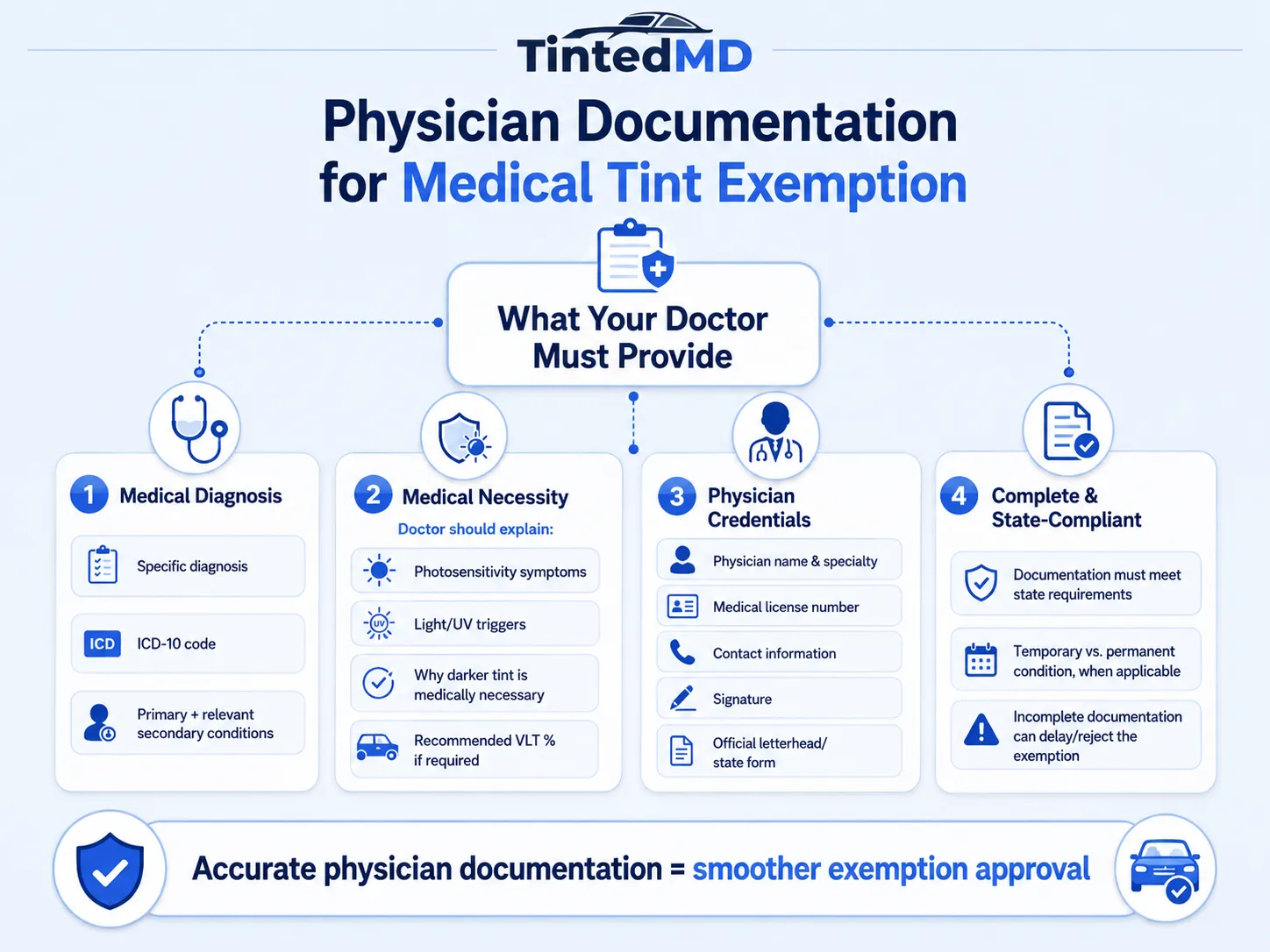
All state exemption forms need certification by a licensed physician. This can be a dermatologist, ophthalmologist, or specialist treating your qualifying condition. The medical window tint exemption form won’t be processed without proper physician documentation. You need specific paperwork that meets state requirements.
Getting this documentation right the first time saves you delays. Most rejections happen because of incomplete physician statements. Let’s break down exactly what your doctor needs to provide.
Medical Diagnosis and ICD-10 Code Requirements
Your physician must provide a specific diagnosis using standard medical terminology. This isn’t a casual note. It requires the corresponding ICD-10 diagnostic code that identifies your condition in medical records.
For example, lupus erythematosus uses code L93.0. Albinism uses E70.3. Porphyria uses E80.2. These codes prove your condition is real and documented. They also help DMV staff verify that your condition qualifies under state window tint exemption requirements.
Some states require multiple codes if you have related conditions. Your doctor should list the primary diagnosis first. Then add any secondary conditions that contribute to photosensitivity. This creates a complete medical picture.
Medical Necessity Statements: What Physicians Must Include
The medical necessity statement explains why darker window tinting is medically necessary for you. Your physician must describe how your condition creates photosensitivity. They should detail what happens when you’re exposed to bright light or UV radiation.
Strong statements include these elements:
-
Severity of your symptoms when exposed to light
-
Specific triggers related to light exposure (UV rays, glare, visible light intensity)
-
How window tinting will reduce medical harm or prevent symptom flare-ups
-
Expected health outcomes with proper UV protection in vehicles
Some states ask physicians to specify the recommended VLT percentage. This should match the severity of your condition. Understanding medical research behind exemptions helps doctors write stronger necessity statements. Temporary conditions need documentation of expected duration. Permanent conditions should be clearly identified as such.
Physician Licensing and Credential Verification
Your physician must include their medical license number on the form. This proves they’re authorized to practice in your state. Most states also require the physician’s specialty, contact information, and signature.
The documentation should appear on official letterhead or the state exemption form itself. This prevents fraud and confirms authenticity. Some states verify licenses directly with medical boards before approving exemptions.
Telemedicine platforms like Tinted MD connect you with licensed physicians experienced in writing exemption certifications. These doctors understand state requirements and how to get a window tint exemption approved quickly. They know which details matter most for each state’s physician certification for tint exemption process.
Step-by-Step Process: How to Complete Medical Window Tint Exemption Forms
Getting a medical window tint exemption approved starts with proper preparation. Each state has its own forms, documents, and approval rules. Following the correct process can help you avoid mistakes and delays.
1. Gather the Required Documents Before You Start
Start by downloading the correct medical window tint exemption form for your state. Visit your state’s DMV or Department of Transportation website to find the current form and instructions. Before you begin, gather your full legal name, current address, driver’s license number, vehicle registration, and VIN. Your state may also require proof of residency, medical records, or other supporting documents. Check your state’s requirements before submitting the application.
2. Complete the Applicant Information Section
Complete the applicant section using the same information shown on your driver’s license and official vehicle records. Double-check your name, driver’s license number, address, and other personal details. Enter your vehicle information carefully, including the make, model, year, color, VIN, and license plate number if required. Do not leave required fields blank. Missing or incorrect information can cause the application to be returned and delay approval.
3. Have Your Physician Complete the Medical Certification
Schedule an appointment with a licensed physician who can evaluate your condition and confirm whether darker window tint is medically necessary. The physician may need to provide your diagnosis, the required ICD-10 code, and a statement explaining why additional window tint is medically necessary. The form may also require the physician’s license number, signature, and date. Review the medical section with your doctor to make sure all required information is complete.
4. Review the Entire Application Before Submission
Review the entire application before sending it to the state authority. Make sure your personal and vehicle information matches your official documents and that the physician has completed and signed the required medical section. Check that all supporting documents are included and that any required fee has been paid. Make copies of the completed form and supporting documents for your records.
5. Submit the Application to the Correct State Authority
Submit your medical window tint exemption application according to your state’s instructions. Some states accept applications by mail, while others may allow in-person submission or online applications. Confirm the correct DMV or transportation agency, submission method, mailing address or online portal, and any required fee before submitting your application. Keep your receipt or application reference number if one is provided.
6. Track Your Application and Follow Up
Track your application after submission if your state provides a confirmation or reference number. Processing times vary by state, so check the current timeline provided by your DMV or transportation agency. If your application takes longer than the stated processing time, contact the appropriate state agency for an update. Keep your application records available when following up.
7. Carry Your Approved Exemption in the Vehicle
Once your exemption is approved, follow your state’s rules for carrying or displaying the certificate or permit. Keep the required documentation in your vehicle when driving. A medical tint exemption does not always allow any level of darkness. Follow the VLT limit and other conditions listed on your approved exemption to remain compliant with state law.
Medical Window Tint Exemption Approval Timelines and Processing Expectations
After submitting a medical window tint exemption form, processing time depends on your state and whether your application is complete. Some states review applications within a few weeks, while others may take longer due to medical review requirements, paper-based processing, or higher application volumes.
Processing times can also vary between states that use online systems and those that rely on mail or in-person submissions. Always check your state’s DMV or transportation agency for the most current timeline.
Average Processing Times by State
There is no single processing time for every state. Applications submitted through online portals may be reviewed faster, while paper applications can take longer.
Processing may also slow during periods when application volumes increase. If your state publishes an estimated processing time, use that timeframe as your main guide rather than relying on a general national estimate.
Factors That Affect Exemption Application Processing Speed
Incomplete or incorrect applications are among the most common reasons for delays. Missing physician signatures, incomplete medical information, incorrect vehicle details, or missing supporting documents may require you to correct and resubmit the application.
Before submitting your medical window tint exemption form, check that your physician has completed and signed the required sections, your medical documentation clearly supports the request, your mailing address is correct, and every required field is completed.
How to Check Your Application Status
Some states allow applicants to check their status online or by phone. If you receive a confirmation or reference number, keep it for tracking and follow-up.
Approval notices may be sent by mail, email, or through an online portal, depending on your state’s process. If your application has gone beyond the processing time provided by your state, contact the appropriate DMV or transportation agency to confirm that your application was received and is still under review.
Expedited processing may not be available for medical tint exemptions. If you need an exemption for an upcoming trip, vehicle inspection, or other reason, submit your application early and wait for official approval before relying on the exemption.
Common Reasons Medical Window Tint Exemption Forms Get Denied
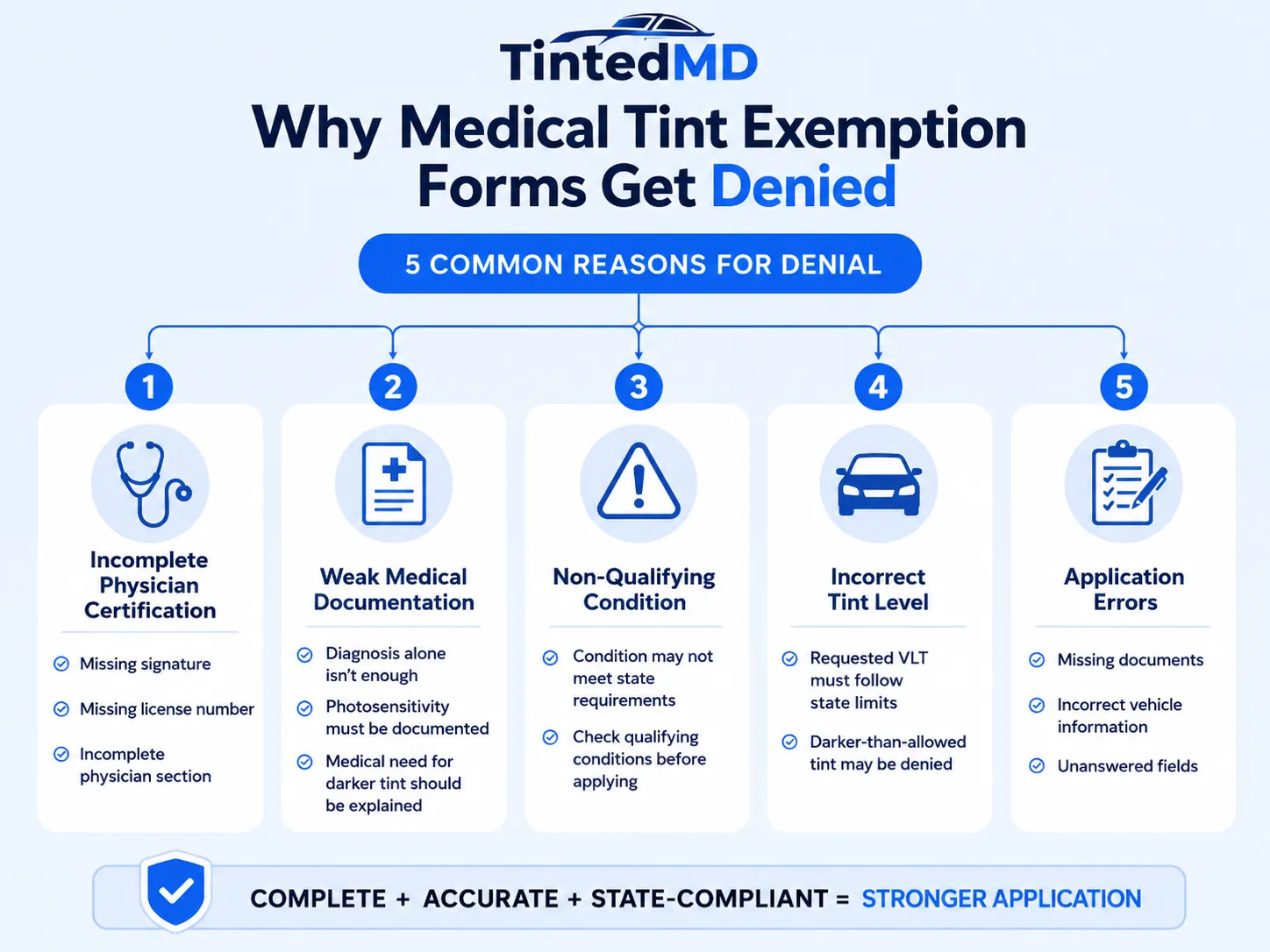
Medical window tint exemption forms are often denied because of incomplete forms, weak medical documentation, or requests that do not meet state rules. Knowing the common issues can help you submit a stronger application.
Incomplete or Missing Physician Certification
A missing signature, license number, or incomplete physician section can lead to denial. Make sure your doctor completes and signs every required section.
Insufficient Medical Documentation of Light Sensitivity
A general diagnosis may not prove medical necessity. Your physician should explain your light sensitivity and why darker window tint is medically needed.
Non-Qualifying Medical Condition
Not every condition qualifies for a tint exemption. Check your state’s approved medical requirements before applying.
Incorrect or Unapproved Tint Level Requested
Your requested tint must meet your state’s medical exemption limits. Asking for a darker VLT than allowed can result in denial.
Missing or Incorrect Application Information
Incorrect vehicle details, missing documents, or unanswered fields can delay or reject your application. Review the entire form before submission.
Medical Window Tint Exemption Renewal Requirements and Maintaining Valid Status
Medical window tint exemptions have expiration dates, and renewal rules vary by state. Some exemptions may last one year, while others remain valid for several years. Always check your certificate for the exact expiration date.
Exemption Expiration Dates and Renewal Timelines
Start the renewal process early, preferably 6 to 8 weeks before your exemption expires. Some states may send renewal notices, but you should not rely on them.
Keep a calendar reminder and check your state’s current renewal requirements. Rules can vary based on your medical condition and the type of exemption issued.
Updated Medical Documentation Required for Renewals
Many states require updated physician certification when you renew. Your doctor may need to confirm that your condition still exists and that darker tint remains medically necessary.
Use current signatures, dates, and medical information. Do not assume that an old medical letter will be accepted for renewal.
What to Do If Your Exemption Expires Before Renewal Approval
Submit your renewal application before your current exemption expires to help avoid a gap in coverage. If your exemption expires while the renewal is pending, check with your state agency to confirm whether you may legally continue using the exempted tint.
Keep copies of your renewal documents and previous exemption certificate. If your exemption is no longer valid, follow your state’s requirements to avoid a window tint violation.
Conclusion
Getting a medical window tint exemption form approved doesn’t have to be complicated. You need proper physician documentation and state-specific forms. Each state runs its own process with unique requirements. But the core steps stay the same across all locations.
This guide covered exemption processes for Florida, Ohio, California, Texas, and New York. You learned about physician certification requirements and approval timelines. We walked through common denial reasons and renewal procedures. You now understand how to pick compliant film after approval.
Start by checking your state’s window tint exemption requirements. Gather medical records that show your photosensitive condition. Find a physician who can certify medical necessity for your exemption.
Tinted MD connects you with licensed physicians who specialize in tint exemption certification. Our platform handles the documentation process for your medical window tint exemption form. We make sure your application meets state requirements and includes proper physician certification. Visit our service to begin your exemption application with qualified medical support today.
Frequently Asked Questions
What medical conditions qualify for a window tint exemption form?
Albinism, lupus, porphyria, and xeroderma pigmentosum qualify for window tint exemptions. Photosensitive epilepsy also qualifies in most states. Other dermatological or ophthalmological disorders may be eligible if they create medical necessity for enhanced UV protection. Each condition must be documented by a licensed physician. The doctor must verify that your condition requires protection beyond what standard automotive glass provides. This isn't about cosmetic preferences. It's about preventing painful flare-ups and long-term health complications from UV exposure during daily driving.
How dark can window tint be with a medical exemption form?
Medical exemptions allow VLT percentages between 20-35% on front side windows. Standard legal limits in most states range from 50-70%. The difference is substantial for people who need enhanced UV protection. Your specific state determines the exact darkness level permitted under exemption. Some states allow darker tint than others even with medical approval. The exemption applies primarily to front side windows since rear windows already allow darker tint in most jurisdictions. You must stay within your state's approved exemption limits to maintain legal status.
What documentation does my doctor need to provide for a tint exemption form?
Your physician must provide medical exemption certification that documents your diagnosis and treatment recommendations. The certification must verify that your condition creates medical necessity for enhanced UV protection. This isn't cosmetic or preference-based documentation. Your doctor needs to explain how standard automotive glass fails to provide adequate protection for your specific condition. The certification should detail how UV exposure triggers symptoms or complications. Some states require specific forms that physicians must complete. Others accept letters on official letterhead. Check your state's requirements before your doctor appointment to get the right documentation format.
How long does a window tint exemption form remain valid?
Exemption validity periods vary by state. Some states require annual renewal of your exemption form. Others grant longer-term authorizations based on the permanent nature of your condition. States recognize that conditions like albinism or lupus don't resolve over time. These may receive multi-year approvals or indefinite exemptions. Temporary photosensitive conditions might get shorter approval periods. You must track your expiration date and renew before it lapses. Driving with expired exemption documentation can result in citations. Keep copies of your current exemption in your vehicle at all times.
Why do medical window tint exemption applications get rejected?
Applications get rejected because people miss small details or submit incomplete paperwork. Common problems include insufficient physician documentation, wrong forms for your state, or missing signatures. Some doctors don't provide enough detail about medical necessity. Others use generic language that doesn't explain your specific condition. Submitting to the wrong agency also causes rejections. Some states process exemptions through the DMV. Others use health departments or specialized licensing agencies. Rejection means more time exposed to harmful UV rays while you wait for resubmission and approval. Review your state's specific requirements carefully before submitting.
Does a window tint exemption form work in other states?
Each state runs its own approval process for window tint exemptions. What works in one jurisdiction may not apply in another. Some states honor out-of-state medical exemptions during temporary visits. Others require you to comply with local tint laws regardless of your home state exemption. If you move to a new state, you typically need to apply for exemption under that state's process. The Americans with Disabilities Act supports reasonable accommodations for light-sensitive conditions. However, specific exemption processes are administered at the state level. This creates variation in how requirements are structured across different states.
How do I apply for a medical window tint exemption?
To apply for a medical window tint exemption, check your state's requirements and get the correct exemption form. Complete the required vehicle and personal details, then have a qualified doctor provide the required medical certification. Submit the completed form, medical documentation, and any other required documents to the appropriate state agency. Requirements, approval steps, and processing times vary by state.
Can a doctor's note get you a window tint exemption?
A doctor's note can support your request for a medical window tint exemption, but it may not be enough by itself. Many states require a specific tint exemption form or physician certification that explains your medical condition and why darker window tint is medically necessary. Your doctor may also need to provide their license details, signature, and other information required by your state.

Meet the author
Nida Hammad
I am a professional writer with over five years of experience creating clear, engaging, and well-researched content. I specialize in medical window tint exemptions and state compliance topics, helping readers understand tint laws and exemption requirements in simple, easy-to-follow language. Currently, I write for TintedMD, where I focus on producing accurate, trustworthy guides to help drivers navigate the medical tint exemption process with confidence.
Get Your Medical Tint Exemption Online in Minutes
Check Your Eligibility