
The Medical Science Behind Medical Window Tint Exemption - Research Review
 by Nida Hammad
 Last updated:
Medically reviewed by:
Dr. Matthew Reynolds, MD


If you live with a condition that makes sunlight painful, dangerous, or debilitating, you have likely already researched your options behind the wheel. A medical window tint exemption is the legal pathway that allows qualifying individuals to install darker window tint than their state normally permits. Whether you are managing lupus, albinism, xeroderma pigmentosum, a history of skin cancer, or another photosensitive disorder, understanding how to obtain a medical window tint exemption could change the quality and safety of your daily driving. This guide covers everything from qualifying conditions and state-specific rules to the step-by-step application process, with a special focus on how to get a medical exemption for window tint in states like North Carolina and Texas.
The science behind why darker tint matters is straightforward. Research published in Safety Science (PMC2892392) found that visual acuity declines significantly from daytime to nighttime conditions, and that older and more vulnerable drivers are disproportionately affected by light and UV-related impairments. A separate Virginia Transportation Research Council report confirmed that the adverse effects of reduced light transmittance are most pronounced for individuals wearing spectacles and for older drivers, particularly at night. These findings underpin the medical and safety case for the window tint medical exemption system that most states have now adopted.
What Is a Medical Window Tint Exemption?

A medical window tint exemption is a legal permit issued to individuals who require UV protection that exceeds what standard automotive glass and legally allowed tints can provide. Most states set Visible Light Transmission (VLT) minimums, typically between 35% and 70% on front side windows. A medical exemption for tinted windows overrides these restrictions, allowing patients to install tints as dark as 20% to 25% VLT or lower on side and rear windows, and in some cases limited windshield tinting above the AS-1 line.
The exemption is not a blanket permission to tint as dark as you please. Every state that issues a window tint medical exemption still sets specific limits, requires documentation from a licensed physician, and mandates that the exemption certificate be carried in your vehicle at all times. The exemption is issued to an individual, not to a vehicle, meaning it generally does not transfer when you sell your car.
Platforms like TintedMD’s Medical Window Tint Exemption Service have simplified this process by connecting patients with licensed physicians who can assess eligibility and produce state-compliant documentation, often through a telehealth appointment that takes less than 24 hours to complete.
What Medical Conditions Qualify for Window Tint Exemptions?
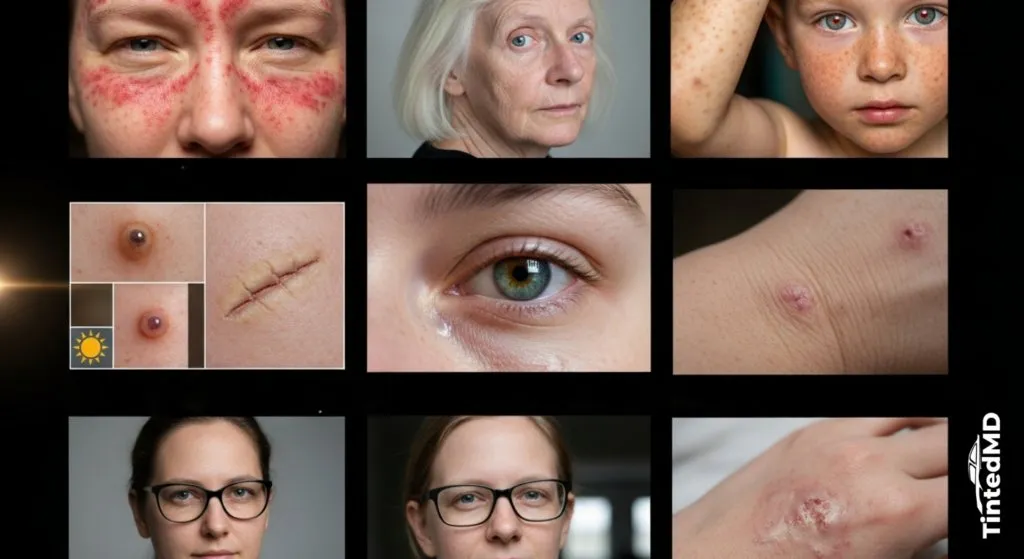
Understanding which conditions justify a medical exemption for tinted windows is the starting point for every applicant. State DMV offices and licensing authorities generally recognize conditions that cause significant photosensitivity, UV-related harm, or neurological or ophthalmic light sensitivity. The following are the most widely accepted qualifying conditions, drawn from official state sources including the New York DMV medical exemptions page, the Texas Department of Public Safety, and the Florida Statutes Section 316.29545.
Lupus (Systemic Lupus Erythematosus)
Lupus is among the most frequently approved conditions for a medical window tint exemption. This chronic autoimmune disease triggers severe photosensitivity, with UV exposure causing skin rashes, fatigue, joint pain, and potentially life-threatening flare-ups. According to the Lupus Foundation of America, up to 70% of lupus patients experience photosensitivity. Physicians regularly certify that standard automotive glass provides insufficient UV protection for patients who drive daily, making this one of the strongest qualifying conditions under virtually every state’s exemption program. For more detail, visit the TintedMD conditions page on Lupus.
Albinism
Individuals with albinism have little to no melanin pigmentation in their skin, hair, and eyes, leaving them acutely vulnerable to UV radiation and sun-induced skin damage. Albinism qualifies for a medical exemption window tint in virtually every state because the risk of severe sunburn, skin cancer, and ocular damage during routine vehicle operation is medically documented and well understood. For more information, see TintedMD’s dedicated page on Albinism.
Xeroderma Pigmentosum
This rare genetic disorder prevents the body from repairing DNA damage caused by UV radiation. Even brief, indirect sun exposure through standard vehicle glass can initiate cellular damage that dramatically increases skin cancer risk. Xeroderma pigmentosum is universally recognized by state exemption authorities as one of the highest-priority qualifying conditions. The National Cancer Institute classifies this as a condition requiring comprehensive UV protection at all times.
Melanoma and Skin Cancer History
Individuals with a documented history of melanoma, basal cell carcinoma, or squamous cell carcinoma frequently qualify for a window tint medical exemption. Dermatologists treating skin cancer survivors typically recommend minimizing UV exposure as a cornerstone of recurrence prevention. A physician letter linking the patient’s cancer history to the need for darker tinting is generally sufficient for DMV approval in most states.
Photophobia and Ophthalmic Conditions
Severe photophobia tied to ophthalmic conditions such as cataracts, corneal dystrophy, ocular albinism, or retinal disease qualifies for a medical exemption for tinted windows in states like New York and North Carolina. Neurological causes of photophobia, including traumatic brain injury and chronic migraine, are also recognized qualifying conditions. TintedMD provides detailed guidance on Photophobia.
Porphyria and Erythropoietic Protoporphyria
Porphyria is a group of rare disorders affecting the nervous system and skin. The most photosensitive subtype, erythropoietic protoporphyria, causes intense burning pain within minutes of sun exposure, including exposure through standard vehicle windows. This condition is listed as a qualifying condition by New York, Florida, and numerous other states.
Dermatomyositis and Chronic Actinic Dermatitis
These inflammatory conditions cause worsening skin symptoms with UV exposure. Dermatomyositis produces characteristic rashes on sun-exposed areas, while chronic actinic dermatitis results in persistent inflammation from minimal sunlight. Both conditions are recognized under the New York DMV’s medical exemption list and by other state authorities.
Drug-Induced Photosensitivity
Certain medications, including antibiotics, diuretics, chemotherapy agents, and anti-inflammatory drugs, cause prolonged and severe photosensitivity as a side effect. New York specifically recognizes severe drug-induced photosensitivity for medical exemption purposes when the course of treatment is expected to be of prolonged duration. Documentation from the prescribing physician is required.
Cockayne Syndrome, Bloom Syndrome, and Other Rare Genetic Disorders
Genetic conditions involving DNA repair deficiencies and extreme UV sensitivity, such as Cockayne syndrome and Bloom syndrome, represent strong qualifying cases for a medical window tint exemption. These conditions dramatically increase the risk of skin cancer from even moderate sun exposure, making UV protection during vehicle operation medically necessary.
For a comprehensive breakdown of all qualifying conditions, visit the TintedMD resource: What Medical Conditions Qualify for Window Tint Exemptions?
**Not sure if your condition qualifies?**TintedMD connects you with a licensed physician who can assess your eligibility and prepare state-compliant documentation, usually within 24 to 48 hours.Check Your Eligibility at TintedMD
State-by-State Overview of Medical Window Tint Exemption Rules
The medical window tint exemption framework varies considerably from state to state. Below is a summary of key rules in major states to help you understand the landscape before applying.
California
California allows a window tint medical exemption under Vehicle Code Section 26708(b)(10). The exemption requires a letter from a licensed physician or optometrist certifying that the person must be shaded from the sun. Medical tint must have a minimum VLT of 35% and be green, gray, or neutral smoke in color. A critical restriction applies: California Vehicle Code 26708(b)(10) explicitly states that medically exempt tinting cannot be used during darkness, meaning the device must be removable. Drivers must carry the exemption certificate in the vehicle at all times.
Florida
Florida issues exemptions through the Department of Highway Safety and Motor Vehicles under Section 316.29545 of the Florida Statutes. Qualifying conditions include lupus, albinism, porphyria, xeroderma pigmentosum, other autoimmune diseases requiring limited light exposure, and any condition documented by a licensed medical professional as requiring reduced UV and visible light exposure. Florida exemptions do not expire for permanent conditions and are issued via Form HSMV 83390.
New York
New York’s DMV formally lists qualifying conditions including albinism, chronic actinic dermatitis, dermatomyositis, lupus erythematosus, porphyria, xeroderma pigmentosum, severe drug photosensitivity of prolonged duration, and photophobia associated with ophthalmic or neurological disorders. Exemptions will not be granted if adequate protection can be provided by protective eyewear, and making false statements on the application is grounds for denial and potential legal consequences.
Georgia
Georgia requires physician or optometrist attestation with a $10 application fee. Medical exemptions require minimum 23% VLT with a 3% variance. The physician must explain why the condition can only be addressed by a 9% reduction in visible light beyond what protective eyewear or standard UV-blocking tint provides. Exemptions are valid for 3 years, and the Georgia DPS processes applications directly. Importantly, making false statements on a Georgia medical exemption application is classified as a felony offense.
Arizona, Arkansas, Indiana, and Michigan
Arizona permits medical exceptions for any condition attested to by a physician, and covers both vehicle owners and regular occupants. Arkansas allows exemptions for conditions including albinism and lupus, valid for 3 years. Indiana requires annual renewal and mandates physician or optometrist attestation by a provider licensed in Indiana. Michigan allows exemptions for photosensitive individuals, with a signed letter from a licensed physician required in the vehicle. Alaska requires annual renewal by an Alaska-licensed physician.
Texas
Texas takes a notably flexible approach to the medical exemption window tint program. Unlike states with a fixed list of qualifying diagnoses, Texas does not specify which medical conditions qualify for window tint. According to the Texas Department of Public Safety window tinting standards, any medical condition may qualify if a licensed physician or optometrist certifies that sun-screening devices are necessary to safeguard the health of the driver or a regular occupant.
The exemption statement must identify the driver or occupant with reasonable specificity and state that, in the physician’s or optometrist’s professional opinion, equipping the vehicle with sun-screening devices is medically necessary. Texas does not issue a separate certificate through the DMV. The signed medical exemption statement from the physician serves as the proof of exemption and must be carried in the vehicle at all times.
Practically, conditions that Texas physicians most commonly certify for a medical exemption for tinted windows include lupus, albinism, xeroderma pigmentosum, melanoma history, severe photosensitivity dermatitis, porphyria, chronic migraine with light sensitivity, and drug-induced photosensitivity. Eye conditions causing medically documented photophobia are also frequently approved.
The Texas medical exemption allows darker tint on front side windows, which are normally subject to a 25% VLT minimum, and permits limited tinting on the upper 5 inches of the front windshield or above the AS-1 line, whichever is less. No state-issued certificate or DMV fee is required, which makes the Texas window tint medical exemption process one of the more streamlined in the country. Annual renewal is required, and the physician statement must be renewed with updated certification.
North Carolina
North Carolina motorists frequently ask what medical conditions qualify for window tint in NC, and the state’s framework is relatively accessible. North Carolina allows physicians and optometrists to certify that a driver or regular vehicle occupant has a medical condition requiring sun protection beyond what standard tint laws permit. There is no fixed state list of qualifying diagnoses in North Carolina. Any condition that a licensed medical professional can certify as requiring reduced UV or sunlight exposure may qualify.
In practice, the conditions most commonly approved in NC mirror the national standard: lupus, albinism, xeroderma pigmentosum, melanoma history, photophobia associated with ophthalmic or neurological conditions, photosensitivity dermatitis, and drug-induced photosensitivity during prolonged treatment courses.
North Carolina requires the medical exemption form to be completed by an ophthalmologist in many documented cases, though primary care physicians and dermatologists can also provide qualifying certifications depending on the nature of the condition. Annual renewal is required. The exemption certificate must be carried in the vehicle at all times, and the tint installed must comply with the VLT percentage specified in the approved documentation.
One important North Carolina note: exemptions do not authorize windshield tinting beyond the standard AS-1 line strip, and installing tint that exceeds the physician-approved VLT level voids the exemption. Always confirm current NC DMV requirements before applying, as regulations are updated periodically.
Drivers in NC seeking a window tint medical exemption can begin the process through TintedMD’s telehealth platform, which pairs patients with licensed North Carolina physicians and produces the state-compliant documentation needed for DMV submission. Learn more at the TintedMD How to Get Window Tint Exemption guide.
States Without Medical Exemptions
Hawaii currently has no medical exemption program for window tinting. Iowa, as of July 2012, no longer permits darker tint for medical reasons. Drivers in these states must comply with standard VLT limits regardless of their medical condition and should consult their physician about alternative protective measures.
How to Get a Medical Exemption for Window Tint: Step-by-Step
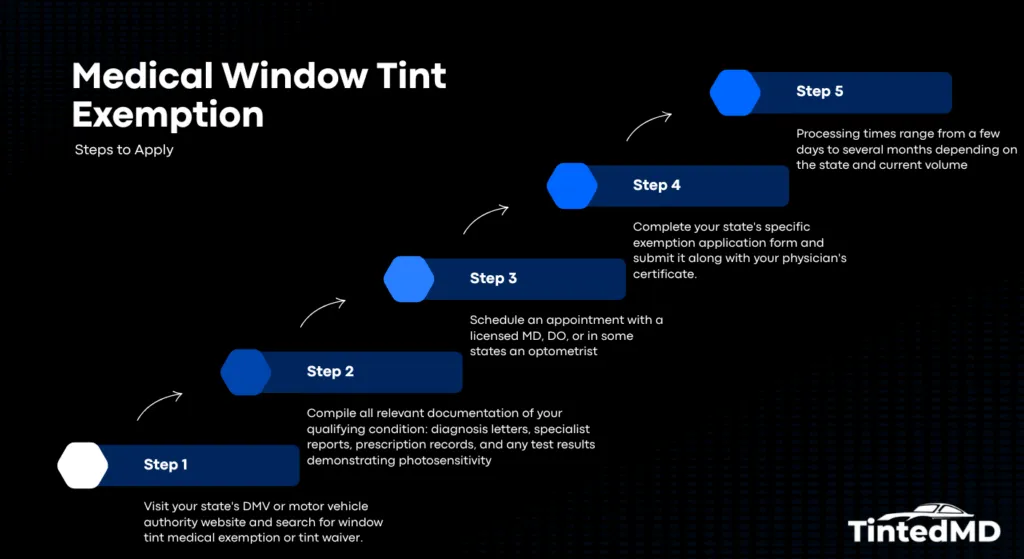
The process of obtaining a medical exemption for tinted windows follows a consistent framework across most states, though specific documentation requirements and fees vary. Here is the complete step-by-step process drawn from TintedMD’s How to Get Window Tint Exemption in 2026 guide.
Step 1: Verify Your State Allows Medical Exemptions
Visit your state’s DMV or motor vehicle authority website and search for window tint medical exemption or tint waiver. Confirm whether your state runs an exemption program and identify the specific forms, fee structure, and physician requirements. Hawaii and Iowa, for example, do not run exemption programs, so verifying this first saves time.
Step 2: Gather Your Medical Records
Compile all relevant documentation of your qualifying condition: diagnosis letters, specialist reports, prescription records, and any test results demonstrating photosensitivity. Having thorough records before your physician appointment makes the consultation more efficient and the exemption letter more comprehensive and persuasive to DMV reviewers.
Step 3: Consult a Licensed Physician
Schedule an appointment with a licensed MD, DO, or in some states an optometrist, to discuss your medical need for a medical window tint exemption. The physician will assess your history, review your records, and write an official exemption letter or complete a state-specific form. This letter must include your name, diagnosis, medical justification, recommended VLT percentage, physician signature, license number, and contact information.
Telehealth has simplified this step considerably. TintedMD’s platform connects patients with state-licensed physicians who specialize in window tint exemption consultations. Appointments are completed via video call, and documentation is typically ready within 24 to 48 hours. This route reduces the traditional 3 to 6 week process to as little as 1 to 2 weeks from start to finish and costs between $150 and $250, compared to $300 to $500 for traditional specialist visits.
Step 4: Submit Your Application to the DMV
Complete your state’s specific exemption application form and submit it along with your physician’s certificate. Some states accept online or mail submissions; others require in-person visits. Florida uses Form HSMV 83390; Georgia has its own state form with a $10 fee. Texas requires no DMV submission at all, only the signed physician statement. Most states charge a $10 to $50 application fee.
Step 5: Receive Approval and Install Tint
Processing times range from a few days to several months depending on the state and current volume. Never install tint before receiving official approval, as exemptions do not apply retroactively. Once approved, have your windows tinted by a professional installer who understands your exemption’s exact VLT specifications. Keep the original exemption certificate, or a state-issued certificate where applicable, in your vehicle at all times alongside your license and registration.
**Ready to start your medical window tint exemption application?**TintedMD makes the process simple. Connect with a licensed physician in your state, get your compliant documentation prepared, and submit with confidence.Get Started with TintedMD Today
The Science Supporting Medical Window Tint Exemption Programs
The medical and traffic safety case for the medical window tint exemption system is grounded in peer-reviewed research. A study published in Safety Science (Shi, Lockhart, and Arbab, 2008), conducted at Virginia Polytechnic Institute, tested the effects of tinted windshields on visual acuity and glare response in both young (average age 26) and elderly (average age 74) drivers. The study found that older subjects demonstrated significantly lower visual acuity and higher contrast thresholds across all testing conditions, confirming that aging populations experience measurably different visual performance challenges than younger drivers.
Crucially, the study also found that visual acuity declined significantly from daytime to nighttime conditions for all participants, regardless of tint color. Older individuals required more illumination to perceive glare but tolerated less glare overall once detected, a finding explained by the age-related increase in light scattering within the eye. This research supports the principle that UV-sensitive and older individuals require enhanced optical protection during vehicle operation, exactly the population that medical window tint exemptions are designed to serve.
The 1994 Virginia Transportation Research Council report by Dennis Proffitt reached complementary conclusions. The report found that the adverse effects of window tinting become increasingly pronounced as light transmittance goes below 70%, particularly for individuals who wear spectacles and for older drivers. The study also found no empirical evidence that tinting permitted under standard legal limits creates a significant safety hazard during well-illuminated daytime conditions, but flagged nighttime and low-light environments as areas of meaningful concern for vulnerable individuals.
Together, these studies form part of the evidentiary foundation that state legislatures and DMV authorities have used to justify the medical exemption for tinted windows framework. They confirm that for certain patients, standard automotive glass and legally permitted tint levels are genuinely insufficient to prevent harm, and that medically supervised darker tinting is a rational and evidence-based accommodation.
Costs, Timelines, and Common Mistakes to Avoid
Expected Costs
The total investment for a window tint medical exemption typically falls between $350 and $1,150, broken down as follows:
-
Physician consultation: $150 to $500 (telehealth typically $150 to $250; in-person specialist $300 to $500)
-
State application fee: $0 to $50 (most states charge $10 to $20; California charges no fee; Illinois charges up to $50)
-
Professional tint installation: $200 to $600 depending on vehicle size and film type
Health insurance generally does not cover tint installation, but Health Savings Accounts (HSA) or Flexible Spending Accounts (FSA) may allow pre-tax funds to be used for medically necessary window tinting with proper physician documentation.
Expected Timeline
Traditional route: 3 to 6 weeks from initial physician appointment to DMV approval and installation.
Telehealth route through TintedMD: 1 to 2 weeks from online consultation to installation, with physician documentation ready in 24 to 48 hours.
Common Mistakes to Avoid
Applying successfully for a medical exemption window tint requires attention to detail. These are the most frequent mistakes applicants make:
| Common Mistake | Explanation |
|---|---|
| Installing tint before receiving approval | Medical tint exemptions do not apply retroactively. If you install tint before approval, you may receive citations and face complications with your application. |
| Using incomplete physician letters | Letters missing the doctor’s license number, signature, specific diagnosis, or VLT recommendation are the most common reason for DMV rejection. |
| Exceeding the approved VLT level | Installing darker tint than the level recommended by your physician voids the exemption. Always confirm the exact VLT specifications with your installer. |
| Failing to renew on time | Some states require renewal. For example, Alaska and Indiana require annual renewal, while Arkansas exemptions are valid for 3 years. Driving with an expired exemption is treated the same as having illegal tint. |
| Not carrying documentation | The exemption certificate must always be kept inside the vehicle. Store it with your vehicle registration and insurance documents. |
| Assuming interstate validity | Medical tint exemptions issued in one state are usually not recognized in other states. If you travel across state lines frequently, you may still receive citations. |
Maintaining Your Medical Window Tint Exemption: Renewal and Interstate Considerations
Once issued, a medical window tint exemption is not automatically permanent. Renewal requirements vary significantly by state, and failing to renew on time has the same legal consequence as never having held an exemption.
Alaska and Indiana require annual renewal with re-certification from a licensed physician. Arkansas exemptions are valid for 3 years. Indiana certificates expire after 4 years in some processing categories. Florida exemptions do not expire for permanent conditions but can be revoked if laws change or the vehicle is sold. Georgia exemptions must be renewed every 3 years, and the physician must mail documentation directly from the medical office to prevent fraudulent applications.
Medical exemptions are issued to individuals, not vehicles. If you sell your vehicle, the exemption does not transfer to the new owner. If you purchase a new vehicle, most states require a new application tied to the new registration. If you have multiple vehicles, most states require separate applications for each, though some states allow one exemption certificate to cover multiple vehicles you own.
Interstate travel presents a meaningful limitation of the medical exemption for tinted windows system. Your home state’s exemption has no legal standing in another state. Law enforcement in a state with no exemption agreement with your state may issue a citation regardless of your documentation. For frequent interstate travelers, consulting a traffic attorney about the practical risks of your specific travel routes is advisable.
If you relocate permanently, you will need to reapply for a medical window tint exemption in your new state of residence. Some states, such as Hawaii and Iowa, do not have exemption programs, which means you would need to comply with standard tint laws or remove non-compliant film after moving.
Conclusion
A medical window tint exemption is more than a legal workaround. It is a documented medical accommodation that recognizes the genuine impact of UV radiation, sunlight, and visible light on people with qualifying health conditions. From lupus and albinism to xeroderma pigmentosum and severe photophobia, the range of conditions that qualify for a window tint medical exemption is broad, and the process, while state-specific, follows a consistent structure that most patients can navigate with the right guidance.
States like North Carolina and Texas have designed their medical exemption for tinted windows programs to be accessible and physician-driven, placing the authority for qualification in the hands of medical professionals rather than bureaucratic lists. Different research councils confirm that UV-sensitive and visually vulnerable populations genuinely benefit from enhanced windowing protection during vehicle operation.
If you have a qualifying condition and want to begin the application process, TintedMD’s medical window tint exemption service offers telehealth consultations with licensed physicians who specialize in producing state-compliant exemption documentation, typically within 24 to 48 hours. Pair that with the guides on qualifying conditions and how to get your exemption in 2026, and you have everything you need to move forward with confidence.
Frequently Asked Questions
How do I get a medical exemption for window tint?
To get a medical window tint exemption, start by confirming your state offers the program. Then gather medical records documenting your qualifying condition, consult a licensed physician who can write a state-compliant certification letter, and submit the letter along with your state's application form to your DMV. Telehealth services like TintedMD can complete physician consultations and prepare documentation within 24 to 48 hours, reducing the traditional process from weeks to days.
What medical conditions qualify for window tint in NC?
North Carolina does not maintain a fixed list of qualifying diagnoses. Any condition for which a licensed physician or optometrist can certify a medical need for UV protection may qualify for a window tint medical exemption in NC. Conditions most frequently approved in North Carolina include lupus, albinism, xeroderma pigmentosum, melanoma history, photophobia associated with ophthalmic or neurological conditions, severe photosensitivity dermatitis, and drug-induced photosensitivity during prolonged treatment. Annual renewal and in-vehicle documentation are required.
What medical conditions qualify for window tint in Texas?
Texas does not publish a specific list of qualifying conditions for a medical exemption for tinted windows. Any condition may qualify if a licensed Texas physician or optometrist certifies in writing that sun-screening devices are medically necessary to safeguard the driver's or regular occupant's health. In practice, the most commonly approved conditions in Texas include lupus, albinism, xeroderma pigmentosum, melanoma history, porphyria, photophobia, photosensitivity dermatitis, and medication-induced photosensitivity. The signed physician statement is the only required proof and must be kept in the vehicle.
How dark can tint be with a medical exemption?
The permitted tint darkness varies by state. Most states with a window tint medical exemption program allow front side window tint down to 20% to 35% VLT, compared to standard minimums of 35% to 70%. Georgia requires a minimum of 23% VLT. California typically allows 35% VLT for medically exempt devices. Windshield tinting, even with an exemption, is generally limited to a small strip above the AS-1 line. Always install tint that precisely matches the VLT percentage specified in your physician's documentation to remain within the terms of your exemption.
Does a medical window tint exemption expire?
Expiration policies differ by state. Alaska and Indiana require annual renewal. Arkansas exemptions are valid for 3 years. Florida exemptions do not expire for permanent conditions but may be revoked if laws change. Georgia requires renewal every 3 years. States that issue exemptions for permanent conditions may not require renewal, while exemptions for temporary photosensitivity typically carry expiration dates matching the expected duration of the condition. Always verify your state's specific renewal requirements and set calendar reminders well before expiration.
Can I get a medical exemption for window tint if my condition was diagnosed years ago?
Yes. A previous diagnosis can support a current window tint medical exemption application as long as the condition is still active and a physician can certify ongoing medical need. Most states require the physician certification to be recent, typically issued within the past 12 months, even if the underlying diagnosis is years old. You cannot simply submit old records without a current physician letter confirming that your condition still requires protection beyond standard legal tint levels.

Meet the author
Nida Hammad
I am a professional writer with over five years of experience creating clear, engaging, and well-researched content. I specialize in medical window tint exemptions and state compliance topics, helping readers understand tint laws and exemption requirements in simple, easy-to-follow language. Currently, I write for TintedMD, where I focus on producing accurate, trustworthy guides to help drivers navigate the medical tint exemption process with confidence.
Get Your Medical Tint Exemption Online in Minutes
Check Your Eligibility