Can Professional Drivers Get Window Tint Exemptions for Occupational Health?
 by Nida Hammad
 Last updated:
Medically reviewed by:
Dr. Matthew Reynolds, MD


If you spend hours behind the wheel every day, your vehicle’s cab is essentially your workplace. For professional drivers, including truck drivers, rideshare drivers, delivery couriers, and taxi operators, this means exposure to relentless solar ultraviolet (UV) radiation during every shift. Over time, that exposure is not just uncomfortable. It is a documented occupational health hazard. Window tint exemptions exist precisely to protect individuals whose medical conditions make this UV exposure dangerous. This guide explains the occupational risks professional drivers face, which medical conditions qualify for a medical exemption for tinted windows, and how to navigate the process state by state.
The Occupational UV Hazard: Why Professional Drivers Need Window Tint Exemptions
Most people think of sun exposure as an outdoor issue. But for professional drivers, the danger is hiding in plain sight: through the side window of their cab, van, or rideshare vehicle. Research published in the New England Journal of Medicine famously documented a Chicago delivery truck driver who, after 28 years on the job, had developed dramatic skin thickening and wrinkling on the left side of his face from chronic window-transmitted UV exposure. The right side of his face remained comparatively smooth. That single case became a landmark illustration of the hidden occupational toll that driving takes on skin health.
Subsequent research has deepened the picture. According to data cited by occupational health sources, UV exposure on the left arm is approximately five times greater than on the right for drivers in left-hand-drive countries, and exposure on the left side of the face can be up to 20 times greater. A study published in the Journal of the American Academy of Dermatology found more cases of skin cancer on the left arm and left side of the face in North American motorists, consistent with sustained window-side UV exposure.
Side and rear windows in most vehicles are made of tempered glass, which lacks the polyvinyl butyral (PVB) layer found in windshields. Research published by the National Institutes of Health confirms that this structural difference means side windows block significantly less UV radiation than front windshields, leaving occupants with far more UV penetration on their exposed sides. For someone with an underlying medical condition that makes UV exposure dangerous, this is not a cosmetic inconvenience. It is a genuine health threat.
This is exactly where window tint exemptions become a critical occupational health accommodation. They are not about aesthetics. They are a medically recognized tool to protect drivers whose conditions make standard tint levels insufficient.
What Is a Window Tint Medical Exemption?
A window tint medical exemption is a state-issued legal permit that allows a driver or vehicle occupant with a qualifying medical condition to install window tint darker than the standard legal limits defined by that state’s motor vehicle code. Most states regulate window darkness through Visible Light Transmission (VLT) percentages. Standard state laws often mandate a VLT of 35% or higher on front side windows, but for individuals with qualifying medical conditions, an exemption can allow darker tint of 20% to 25% VLT or lower on certain windows.
According to TintedMD, medical window tint exemptions are typically granted when sunlight or glare worsens a documented medical condition, UV exposure causes pain, flare-ups, or visual impairment, standard legal tint limits do not provide adequate protection, and a licensed medical professional certifies the medical need. The exemption does not allow completely blacked-out or opaque windows. States retain their own maximum darkness thresholds even within exemption frameworks.
Are you a professional driver dealing with a medical condition that makes driving in sunlight painful or dangerous? TintedMD’s 100% online process connects you with a licensed healthcare provider who reviews your case and, if approved, provides official certification for your window tint exemption. Check your eligibility today at tintedmd.com.
What Medical Conditions Qualify for Window Tint Exemptions?
Understanding which conditions qualify is essential before beginning the application process. States generally do not publish a rigid list of approved conditions. Instead, they require a licensed physician to certify that the patient’s specific documented condition necessitates darker window tint. A core group of conditions are widely recognized across most states. The full breakdown is available through TintedMD’s qualifying conditions guide.
Autoimmune and Inflammatory Conditions
Systemic Lupus Erythematosus (SLE) is among the most common qualifying conditions for a window tint medical exemption. Up to 70% of people with lupus experience photosensitivity, according to the Lupus Foundation of America. UV exposure can trigger skin rashes, lesions, fatigue, joint pain, and dangerous disease flares. For a professional driver with lupus who spends many hours per day with their side exposed to window-transmitted UV radiation, the medical case for darker tint is straightforward.
Research published in PMC by the National Institutes of Health confirms that UV irradiation is a well-established exacerbating factor for cutaneous lupus erythematosus (CLE), with photosensitivity forming part of the American College of Rheumatology’s diagnostic criteria for SLE. Dermatomyositis, scleroderma, and other autoimmune conditions causing photosensitivity similarly qualify in most states.
Skin Disorders and UV Sensitivity
Several skin conditions qualify because they cause painful, acute reactions to even brief sun exposure. These include chronic actinic dermatitis, solar urticaria (sun allergy), polymorphous light eruption, photosensitive eczema, and vitiligo affecting large areas of the face or body. Pellagra, caused by severe niacin deficiency, also causes photosensitivity and qualifies in applicable cases.
Genetic Conditions Requiring Maximum UV Protection
Xeroderma pigmentosum (XP) is among the most serious qualifying conditions. This rare genetic disorder prevents the body from repairing DNA damage caused by UV radiation, dramatically increasing skin cancer risk. The National Cancer Institute classifies XP as a high-priority condition requiring comprehensive UV protection. Oculocutaneous albinism (OCA) and other forms of albinism also qualify virtually everywhere, as affected individuals lack protective melanin pigment and are at severe risk from even brief UV exposure.
Erythropoietic protoporphyria, a specific form of porphyria, causes extreme burning pain within minutes of sun exposure. Cockayne syndrome and Bloom syndrome, both involving DNA repair deficiencies, carry dramatically elevated skin cancer risk and readily qualify for window tint exemptions in states that offer them.
Ocular Conditions and Photophobia
Eye conditions including cataracts, glaucoma, macular degeneration, retinitis pigmentosa, post-surgical light sensitivity, and severe photophobia associated with a documented ophthalmic or neurological disorder are recognized qualifying conditions in many states. New York explicitly lists photophobia associated with an ophthalmic or neurological disorder per the New York DMV’s medical exemption standards. For a rideshare or delivery driver who needs to see clearly through their side windows, these conditions can create genuine safety hazards when unaddressed.
Drug-Induced Photosensitivity and Neurological Triggers
Many commonly prescribed medications cause photosensitivity as a side effect, including certain antibiotics (such as doxycycline), diuretics, retinoids like isotretinoin, NSAIDs, chemotherapy agents, and some psychiatric or cardiac medications. When photosensitivity is expected to be severe and prolonged, a licensed physician can certify the need for a medical exemption for tinted windows. Chronic migraines that are light-triggered and post-concussion light sensitivity are also recognized in many states as qualifying neurological conditions.
Skin Cancer History
Individuals with a history of melanoma, basal cell carcinoma, or squamous cell carcinoma frequently qualify for window tint exemptions. After skin cancer treatment, dermatologists strongly recommend minimizing UV exposure. For professional drivers, who cannot simply avoid being in their vehicles, darker tint is a practical and medically supported protective measure. Given that skin cancer risk is elevated in jobs involving high sun exposure, and that one in five Americans will develop some form of skin cancer in their lifetime, this category is particularly relevant to the driving workforce.
State-by-State Overview: Medical Exemption for Tinted Windows
Requirements for obtaining a window tint medical exemption vary significantly from state to state. Professional drivers who operate across state lines should be aware that their home state’s exemption is generally not honored in other states.
How to Get a Medical Exemption for Window Tint in North Carolina
North Carolina allows medical tint exemptions when the need is certified by an ophthalmologist. The state uses a specific medical exemption form, and annual renewal is required. If you are asking what medical conditions qualify for window tint in NC, the state follows general principles of any documented medical need for reduced UV or light exposure, as determined by your treating physician.
How to Get a Medical Exemption for Window Tint in Texas
Texas takes a relatively flexible approach. According to the Texas Department of Public Safety’s window tinting standards, any motorist needing darker tint than the standard 25% VLT requirement can obtain a signed medical exemption statement from a licensed physician or optometrist. Texas does not specify a list of qualifying conditions. Any condition that, in the physician’s professional opinion, necessitates sun-screening devices to safeguard health can qualify. If you are wondering what medical conditions qualify for window tint in Texas, the answer is: any condition your licensed physician certifies as requiring protection from direct sun rays. The signed statement must be carried in the vehicle at all times. No separate state certificate is required.
New York, Florida, California, and Other States
New York explicitly lists qualifying conditions including albinism, lupus, porphyria, xeroderma pigmentosum, severe drug photosensitivity, and photophobia associated with documented ophthalmic or neurological disorders. Florida issues non-expiring exemptions under Florida Statutes section 316.29545 using Form HSMV 83390. California permits exemptions under Vehicle Code Section 26708(b)(10) with a critical restriction: medically exempt tint cannot be used during nighttime hours, which may limit its practicality for drivers who work evening shifts.
Arizona permits exemptions for any medical condition attested by a physician, but windshields are excluded. Georgia requires minimum 23% VLT and charges a $10 fee. For a comprehensive guide to how to get a window tint exemption in 2026, the step-by-step process is explained at TintedMD’s 2026 exemption guide.
How to Get a Medical Exemption for Window Tint: The Step-by-Step Process
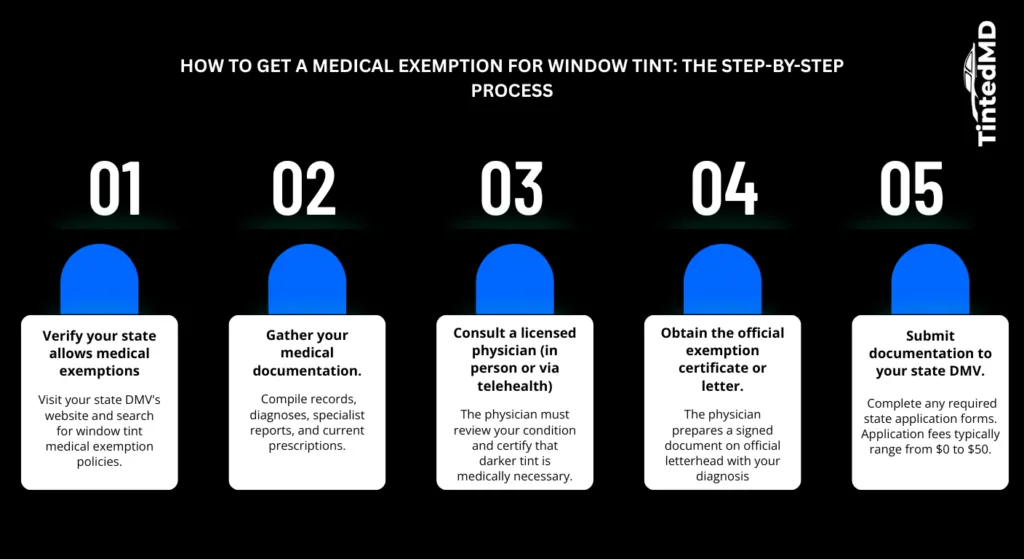
Whether you are a long-haul trucker, a local delivery driver, or a rideshare operator, the process for obtaining a window tint medical exemption follows a broadly consistent path across most states.
-
Verify your state allows medical exemptions. Visit your state DMV’s website and search for window tint medical exemption policies.
-
Gather your medical documentation. Compile records, diagnoses, specialist reports, and current prescriptions.
-
Consult a licensed physician (in person or via telehealth). The physician must review your condition and certify that darker tint is medically necessary.
-
Obtain the official exemption certificate or letter. The physician prepares a signed document on official letterhead with your diagnosis, medical justification, their license number, and contact information.
-
Submit documentation to your state DMV. Complete any required state application forms. Application fees typically range from $0 to $50.
-
Wait for approval before installation. Installing darker tint before approval can result in citations. Exemptions do not apply retroactively.
-
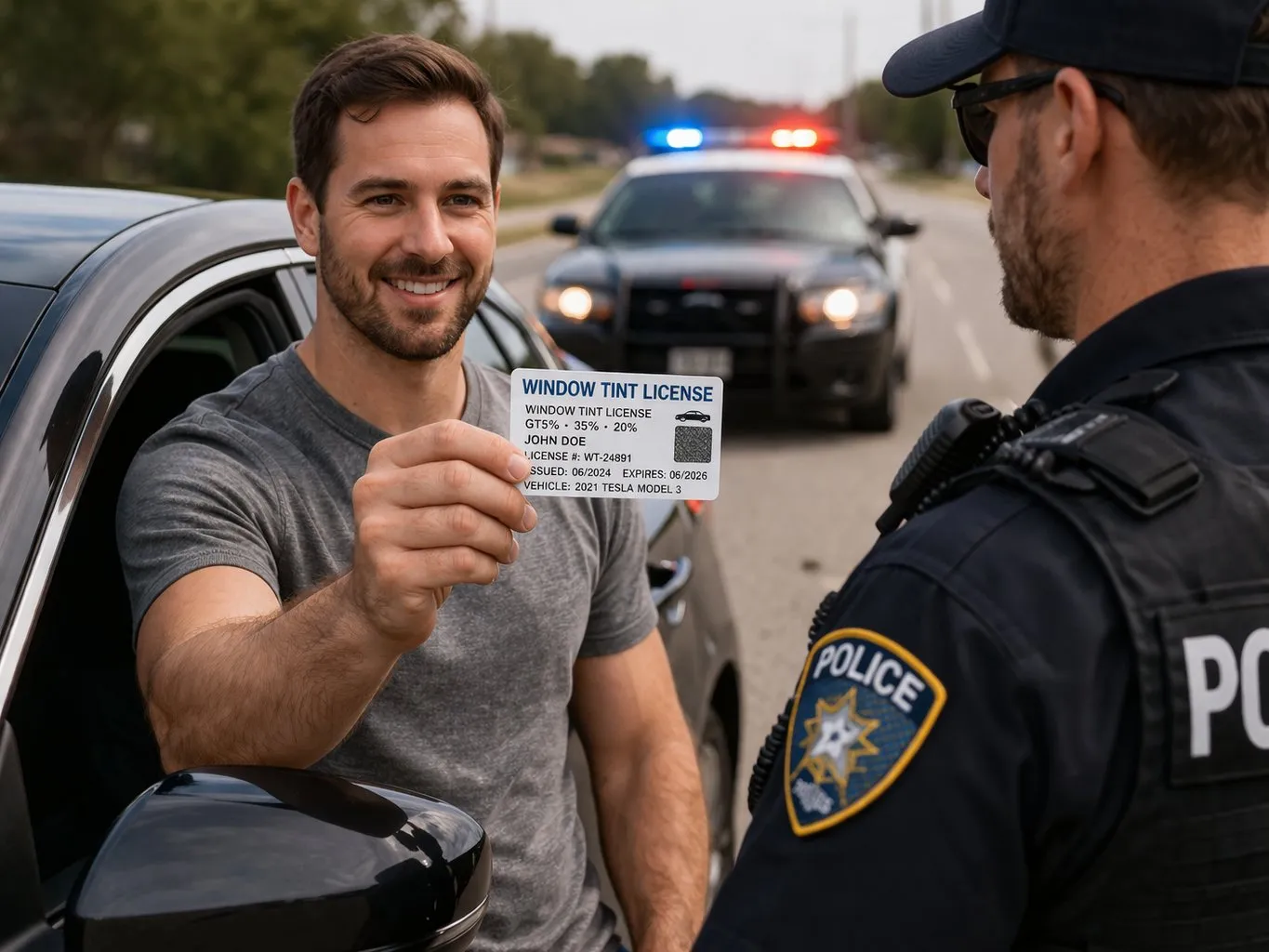
Carry your exemption certificate in the vehicle at all times. Law enforcement may request documentation during a traffic stop.
Telehealth Solutions for Busy Professional Drivers
For professional drivers who work unpredictable hours or live in areas with limited specialist access, scheduling a traditional in-person physician appointment for a window tint medical exemption can be challenging. Telehealth platforms have transformed this process significantly.
TintedMD offers a fully online, HIPAA-compliant process designed specifically for window tint exemptions. The three-step process involves submitting an online application, having a licensed healthcare provider review the case for medical accuracy and state compliance, and receiving official doctor-signed documentation upon approval. There is no in-person visit required. The platform handles everything securely through telehealth, and most applications are reviewed within 24 to 48 hours. TintedMD has served over 100,000 patients and offers a money-back guarantee if the application is not approved.
Traditional in-person physician consultations for tint exemptions typically cost between $300 and $500. Telehealth services generally cost $150 to $250, and the entire process, from application to certified documentation, can be completed in one to two weeks rather than the three to six weeks a traditional route might take. For drivers weighing long-term citation risk against physician documentation fees, see the medical exemption vs ticket cost comparison.
Ready to protect your health behind the wheel? TintedMD makes it fast and simple to get your official medical window tint exemption certification online in three steps. No appointment needed. No waiting room. Just secure, HIPAA-compliant telehealth from home. Start your eligibility check now at TintedMD.
Renewal, Validity, and Interstate Considerations
Professional drivers should pay close attention to renewal requirements for their window tint exemptions. Renewal timelines vary widely by state. Alaska and Indiana require annual renewal. Arkansas exemptions are valid for three years. Indiana certificates must be renewed every four years. Florida exemptions do not expire for permanent conditions but can be revoked if laws change or the vehicle is transferred.
For drivers who regularly cross state lines, it is important to know that a home state’s window tint medical exemption is generally not recognized in other states. Not all states offer exemption programs at all: Hawaii has no medical exemption regulations, and Iowa eliminated medical exemptions for tinted windows after July 2012.
Most exemptions are also vehicle-specific. If you change vehicles, you will typically need to reapply or update your exemption. Some states, including Idaho, issue exemptions to individuals rather than vehicles.
Occupational Health Frameworks Supporting Window Tint Exemptions
The medical and occupational science literature strongly supports the need for UV protection in professional driving roles. The National Institute for Occupational Safety and Health (NIOSH) recognizes UV radiation as an occupational hazard and supports research and guidelines around worker UV exposure. UV exposure is a significant workplace health concern, with the American Conference of Governmental Industrial Hygienists (ACGIH) publishing Threshold Limit Values (TLVs) for occupational UV exposure.
For drivers with documented medical conditions, the gap between these threshold limits and what standard vehicle glass provides is significant. NIH-published research confirms that side windows transmit substantially more UV radiation than windshields due to the absence of the protective PVB interlayer. A professional driver with lupus, xeroderma pigmentosum, or medication-induced photosensitivity is effectively exposed to a known occupational hazard with inadequate protection. The window tint exemption is the vehicle-specific equivalent of a personal protective equipment (PPE) accommodation.
It is also worth noting that under the Americans with Disabilities Act (ADA), employers are generally required to provide reasonable workplace accommodations for employees with conditions that substantially limit major life activities. The Lupus Foundation of America specifically notes that window tinting in company cars (where legal) is a recognized ADA accommodation for lupus-related photosensitivity.
Frequently Asked Questions
Q1: How do I get a medical exemption for window tint as a professional driver?
The process begins with a licensed physician's certification confirming that your medical condition requires darker window tint than your state's standard legal limits allow. You then submit this certification, along with any required state forms and fees, to your state DMV. Telehealth platforms like TintedMD allow qualifying drivers to complete this process entirely online, typically within 24 to 48 hours of submission.
Q2: What medical conditions qualify for window tint in NC?
North Carolina follows the general principle that any documented medical condition requiring protection from sunlight or UV exposure may qualify, when certified by an ophthalmologist. Common qualifying conditions include lupus, photophobia, albinism, xeroderma pigmentosum, and chronic skin conditions worsened by UV exposure. Annual renewal is required.
Q3: What medical conditions qualify for window tint in Texas?
Texas does not specify a fixed list of qualifying conditions. Any medical condition that a licensed physician or optometrist determines requires sun-screening devices to safeguard the health of the driver or occupant can qualify. The physician's signed statement, which must identify the driver or occupant and state that darker tint is medically necessary, serves as the proof of exemption and must be kept in the vehicle.
Q4: Can a professional driver get a window tint exemption for a company vehicle?
In most cases, window tint exemptions are issued to individuals rather than vehicles. If you drive a company-owned vehicle and have a qualifying medical condition, you would typically need to work with your employer to have the vehicle tinted in compliance with your exemption. The ADA requires employers to provide reasonable accommodations, and medically necessary window tint in a company vehicle has been recognized as a potential accommodation.
Q5: Will my window tint medical exemption protect me if I drive through another state?
Generally, no. Window tint exemptions are state-specific and are not recognized across state lines. If you are a commercial driver who regularly crosses state borders, you should research the tint laws in the states you frequent and carry your medical documentation at all times.
Q6: Does a window tint medical exemption expire, and what happens if it lapses?
Expiration timelines vary by state, ranging from annual renewal (Alaska, Indiana) to no expiration for permanent conditions (Florida). If your exemption lapses, driving with tint darker than your state's legal limits is treated the same as having illegal tint, and you can be cited. Set calendar reminders to renew well in advance of your expiration date. Telehealth platforms make renewal straightforward, often allowing online re-evaluation and re-certification.

Meet the author
Nida Hammad
I am a professional writer with over five years of experience creating clear, engaging, and well-researched content. I specialize in medical window tint exemptions and state compliance topics, helping readers understand tint laws and exemption requirements in simple, easy-to-follow language. Currently, I write for TintedMD, where I focus on producing accurate, trustworthy guides to help drivers navigate the medical tint exemption process with confidence.
Get Your Medical Tint Exemption Online in Minutes
Check Your Eligibility