State-by-State Medical Window Tint Exemption — Complete 2026 Reference Guide
 by Nida Hammad
 Last updated:
Medically reviewed by:
Dr. Matthew Reynolds, MD


Window tinting offers real-world benefits, including UV protection, heat reduction, glare control, and privacy. But in the United States, what’s perfectly legal in one state can earn you a $250 fine in another. The variation is dramatic: California requires 70% Visible Light Transmission (VLT) on front windows, while New Mexico permits as dark as 20% on those same windows.
This comprehensive reference guide aggregates 2026 data for all 50 states and Washington, D.C., covering front and rear side windows, rear windshields, windshield rules, and reflectivity restrictions. A dedicated section on medical exemption for tinted windows explains how qualifying drivers can legally obtain a darker tint. Whether you’re shopping for tint, relocating, or planning a cross-country road trip, this is the reference you need.
“What’s fine in Texas could earn you a fix-it ticket in New York. Laws vary by state, window position, vehicle type, and even film color. And for drivers with certain medical conditions, a medical window tint exemption may be the legal path to greater comfort and protection.”
Understanding VLT: The Key Measurement
Every tint law in America is built around a single metric: Visible Light Transmission (VLT); the percentage of visible light that passes through the glass and film combined. The lower the VLT number, the darker the tint. Law enforcement uses calibrated handheld meters during traffic stops to measure the actual combined (net) VLT of your glass and any applied film.
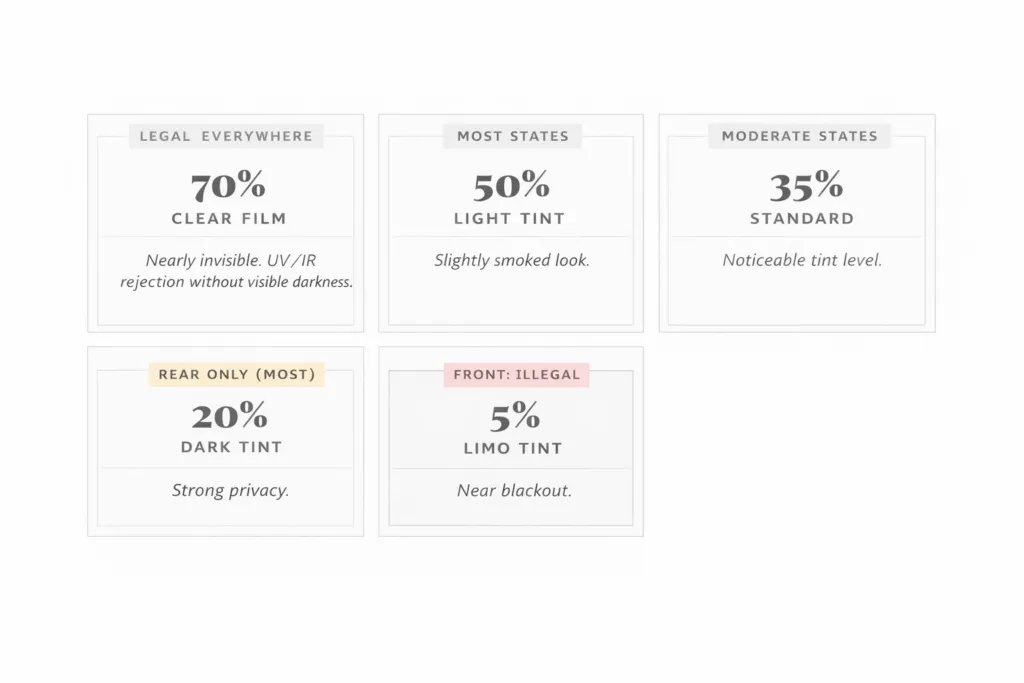
VLT Levels at a Glance
-
70% — Clear Film: Nearly invisible. UV/IR rejection without visible darkness. Required for front windows in strict states. Legal everywhere.
-
50% — Light Tint: Slightly smoked look. Legal for front windows in states like Virginia, Wisconsin, and Ohio.
-
35% — Standard: Noticeable tint. The most common front-window legal limit in the U.S., used by roughly 20 states.
-
20% — Dark Tint: Strong privacy. Legal for front windows only in very permissive states like New Mexico and Nebraska. Mostly rear-window only.
-
5% — Limo Tint: Near blackout. Blocks 95% of light. Illegal on front windows in virtually every state nationwide.
The Net VLT Trap
Net VLT = Factory Glass VLT × Film VLT
Example: 70% factory glass × 50% aftermarket film = 35% Net VLT. If your state requires a 35% minimum, you must install approximately a 50% film, not a 35% film. Law enforcement meters measure the combined result directly through the glass.
Complete 2026 State-by-State Medical Window Tint Exemption Law Table
All percentages are minimum VLT (higher = lighter tint required by law). Data reflects standard passenger sedans. SUVs, vans, and pickup trucks often have more lenient rear-window rules.
| State | Front Side | Rear Side | Rear Window | Windshield Rule | Strictness | Key Notes |
|---|---|---|---|---|---|---|
| Alabama | 32% | 32% | 32% | Top 6 inches | Moderate | 3% margin of error allowed during stops |
| Alaska | 70% | 40% | 40% | Top 5 inches | Strict | Strict front; moderate rear rules |
| Arizona | 33% | Any % | Any % | AS-1 line | Lenient | No restrictions on rear window darkness |
| Arkansas | 25% | 25% | 25% | AS-1 or top 5” | Lenient | Uniform permissive rules statewide |
| California | 70% | Any % | Any % | Top 4 inches | Strict | Strictest enforcement; 2026 updates pending |
| Colorado | 27% | 27% | 27% | Top 4 inches | Lenient | No medical exemptions offered |
| Connecticut | 35% | 35% | Any % | AS-1 line | Moderate | Dual mirrors required if rear tinted |
| Delaware | 70% | Any % | Any % | AS-1 line | Strict | Very strict on front windows only |
| Florida | 28% | 15% | 15% | AS-1 line | Moderate | Criminal penalties possible for violations |
| Georgia | 32% | 32% | 32% | Top 6 inches | Moderate | Up to $1,000 fine; 12 months imprisonment |
| Hawaii | 35% | 35% | 35% | Top 4 inches | Moderate | Uniform rules; island enforcement varies |
| Idaho | 35% | 20% | 35% | AS-1 line | Moderate | Rear side darker than rear windshield |
| Illinois | 35% | 35% | 35% | Top 6 inches | Moderate | Tint sticker certification required |
| Indiana | 30% | 30% | 30% | AS-1 line | Moderate | Uniform 30% across all side windows |
| Iowa | 70% | Any % | Any % | AS-1 line | Strict | Strict front; very permissive rear |
| Kansas | 35% | 35% | 35% | AS-1 line | Moderate | Medical exemptions available |
| Kentucky | 35% | 18% | 18% | AS-1 line | Moderate | Darker rear windows permitted |
| Louisiana | 40% | 25% | 12% | AS-1 line | Moderate | Front lowered to 25% effective Aug 2025 |
| Maine | 35% | 35% | 35% | Top 5 inches | Moderate | Uniform rules across all windows |
| Maryland | 35% | 35% | 35% | AS-1 or top 5” | Moderate | Medical exemptions available |
| Massachusetts | 35% | 35% | 35% | AS-1 or top 6” | Moderate | Mirrors required if rear dark |
| Michigan | Any % (top 4” only) | Any % | Any % | Top 4 inches | Lenient | Unique: any darkness except top 4” of front |
| Minnesota | 50% | 50% | 50% | No tint allowed | Moderate | No windshield tint whatsoever permitted |
| Mississippi | 28% | 28% | 28% | AS-1 line | Moderate | Uniform rules across all windows |
| Missouri | 35% | Any % | Any % | AS-1 line | Moderate | No restrictions on rear window darkness |
| Montana | 24% | 14% | 14% | AS-1 line | Lenient | Among the most permissive states |
| Nebraska | 20% | 20% | 20% | AS-1 or top 5” | Lenient | Very permissive uniform rules statewide |
| Nevada | 35% | Any % | Any % | AS-1 line | Moderate | No restrictions on rear window darkness |
| New Hampshire | No tint | 35% | 35% | Top 6 inches | Ban | No front side window tinting at all |
| New Jersey | No tint | Any % | Any % | No tint | Ban | No front tint; no windshield tint |
| New Mexico | 20% | 20% | 20% | AS-1 or top 5” | Lenient | Darkest legal front-window tint in U.S. |
| New York | 70% | 70% | Any % | Top 6 inches | Strict | Mandatory annual inspection tint check |
| North Carolina | 35% | 35% | 35% | AS-1 line | Moderate | Reflectivity capped at 20% |
| North Dakota | 50% | 50% | 50% | Top 70% must be clear | Moderate | Unique windshield clarity requirement |
| Ohio | 50% | Any % | Any % | AS-1 line | Moderate | Permissive rear windows; moderate front |
| Oklahoma | 25% | 25% | 25% | AS-1 or top 5” | Lenient | Permissive rules statewide |
| Oregon | 35% | 35% | 35% | Top 6 inches | Moderate | Sticker certification recommended |
| Pennsylvania | 70% | 70% | 70% | No tint allowed | Strict | Strictest state overall; no windshield tint |
| Rhode Island | 70% | 70% | 70% | AS-1 line | Strict | Uniform 70% requirement across all windows |
| South Carolina | 27% | 27% | 27% | AS-1 line | Lenient | Among more permissive Eastern states |
| South Dakota | 35% | 20% | 20% | AS-1 line | Moderate | Darker rear windows permitted |
| Tennessee | 35% | 35% | 35% | AS-1 line | Moderate | Sticker certification required by law |
| Texas | 25% | 25% | Any % | AS-1 or top 5” | Lenient | No rear windshield limit; 25% reflectivity OK |
| Utah | 43% | Any % | Any % | AS-1 line | Moderate | Unique 43% front requirement |
| Vermont | No tint | Any % | Any % | AS-1 line | Ban | Front side windows must remain completely clear |
| Virginia | 50% | 35% | 35% | AS-1 line | Moderate | Front more restrictive than rear |
| Washington | 24% | 24% | 24% | Top 6 inches | Lenient | Fines up to $1,000; uniform rules statewide |
| Washington, D.C. | 70% | 50% | 50% | AS-1 line | Strict | Strict metro-area enforcement standards |
| West Virginia | 35% | 35% | 35% | AS-1 or top 5” | Moderate | Mirrors required if rear window dark |
| Wisconsin | 50% | 35% | 35% | AS-1 line | Moderate | Front more restrictive than rear windows |
| Wyoming | 28% | 28% | 28% | AS-1 or top 5” | Lenient | Uniform lenient rules across all windows |
Windshield Tinting Rules
Every state restricts windshield tinting to protect forward visibility. The critical reference point is the AS-1 line, a marking etched near the top edge of the windshield by the manufacturer, typically sitting 4–6 inches from the top. Only non-reflective tint strips above this line are permitted in most states.
States Prohibiting ALL Windshield Tint
-
Minnesota — no windshield tint whatsoever
-
New Jersey — no windshield tint permitted
-
Pennsylvania — no windshield tint at all
Common Windshield Strip Rules
-
Top 4 inches — California, Colorado, Michigan, Hawaii
-
Top 5 inches — Alaska, Maine, Arkansas, Oklahoma, Wyoming
-
Top 6 inches — Alabama, Georgia, Illinois, New Hampshire, New York, Oregon
-
AS-1 line — Arizona, Florida, Kansas, Nevada, Texas, and most other states
Reflectivity & Color Restrictions
Beyond darkness limits, most states cap how mirror-like or shiny window film can be. Highly reflective ‘chrome’ tints create dangerous glare for oncoming drivers and are restricted nationwide.
Reflectivity Limits
| State / Region | Reflectivity Rule |
|---|---|
| Most U.S. States | Reflectivity usually capped between 20%–35% |
| California | 10% reflectivity limit on front windows |
| Texas | Allows up to 25% reflectivity |
| Michigan | Reflective tint banned on front windows |
| New Hampshire | Reflective tint prohibited on front windows |
Banned Tint Colors (Nearly Universal)
| Tint Color | Legal Status |
|---|---|
| Red | Prohibited in all 50 states |
| Amber / Yellow | Prohibited in all 50 states |
| Blue | Restricted in most states |
| Neutral Charcoal / Black / Gray | Universally permitted |
Medical Window Tint Exemption Programs
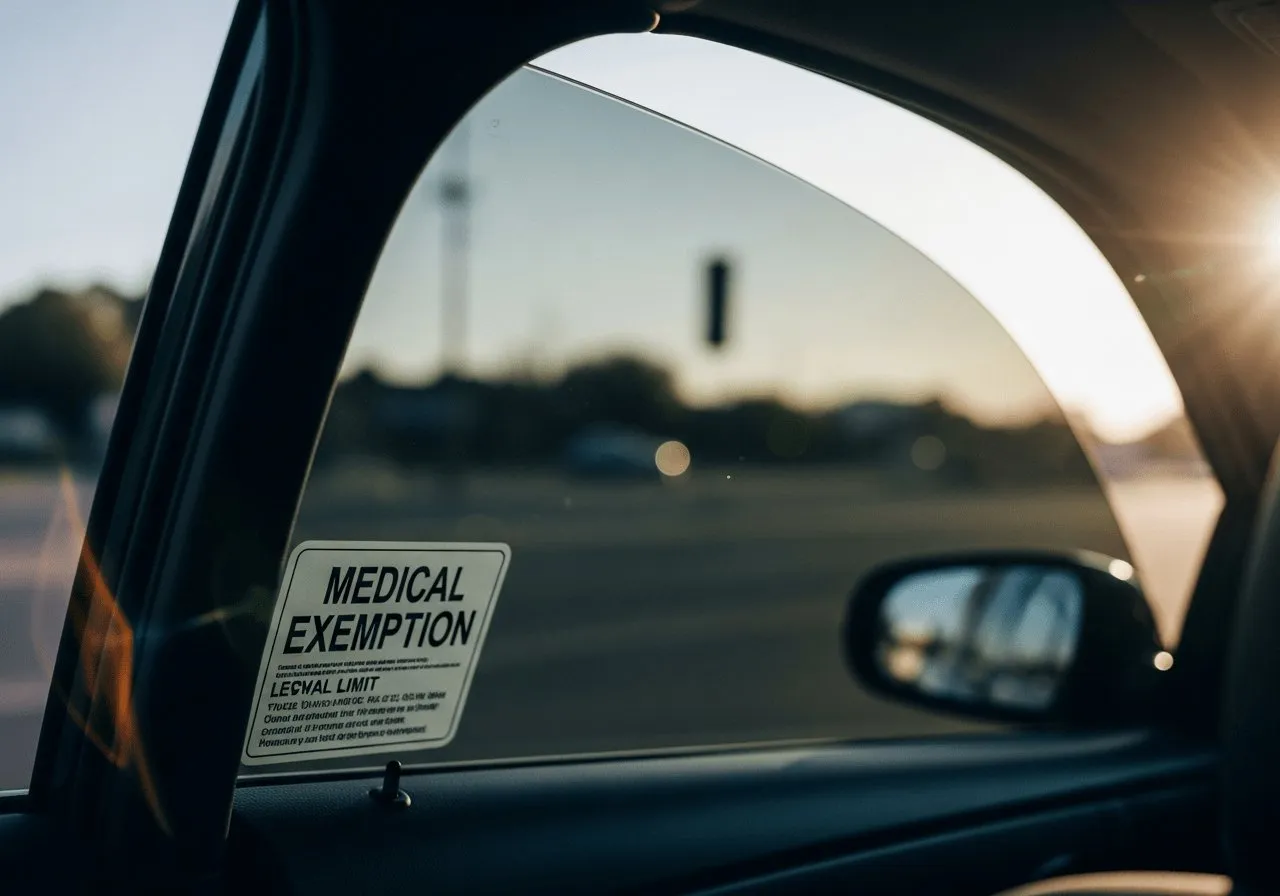
A medical window tint exemption is a state-issued authorization that allows drivers or passengers with documented light-sensitive medical conditions to legally use darker window tint than standard laws permit. Most states offer a formal window tint medical exemption program, and understanding how it works can be the difference between legal protection and unnecessary fines.
If you suffer from a qualifying condition and spend significant time in a vehicle, applying for a medical exemption for tinted windows may be one of the most important steps you take for your health and legal compliance. The exemption certificate must be carried in the vehicle at all times and presented to law enforcement upon request.
STATES OFFERING NO MEDICAL EXEMPTION PROGRAM
Colorado, New Hampshire, and a small number of other states do not offer medical exemption programs for window tinting. Drivers in those states with photosensitivity conditions should consult their state DMV directly for any available accommodations.
Qualifying Medical Conditions for Window Tint Exemptions
The following conditions are commonly accepted for a medical exemption window tint application. For a complete, state-by-state breakdown of qualifying diagnoses, visit: What Medical Conditions Qualify for Window Tint Exemptions
-
Systemic Lupus Erythematosus (SLE)
-
Porphyria (all types)
-
Severe photosensitive dermatitis
-
Cockayne syndrome
-
Albinism
-
Severe photophobia and other ocular conditions
A board-certified physician, typically a dermatologist or ophthalmologist, must certify the medical necessity in writing on a state-issued form.
What Medical Exemptions Typically Allow
A medical exemption for tinted windows does not grant unlimited darkness. Most states cap exemption-approved front windows at 35–50% VLT, compared to the standard 70% minimum in strict states. Exemptions generally apply only to front side windows, as rear windows in most states already permit any level of darkness for standard vehicles.
How to Get a Medical Exemption for Window Tint
The process for obtaining a medical window tint exemption varies by state but generally follows these steps. For the complete 2026 step-by-step guide, visit: How to Get a Window Tint Exemption in 2026
-
Step 1 — Obtain physician certification: Visit a board-certified specialist who can document your qualifying condition on a state-approved form.
-
Step 2 — Submit to your DMV: File the completed form with your state’s DMV or medical review board.
-
Step 3 — Receive your exemption certificate: Once approved, you’ll receive official documentation authorizing darker tint.
-
Step 4 — Keep it in your vehicle: The exemption certificate must be present in the vehicle at all times for law enforcement review.
-
Step 5 — Choose compliant film: Work with a certified installer to select film that meets your exemption’s specific VLT limits.
For professional assistance navigating the medical window tint exemption process, visit: Medical Window Tint Exemption Services — TintedMD
Penalties & Enforcement
Enforcement methods include handheld VLT meters during traffic stops and mandatory tint checks during annual safety inspections. Penalties vary significantly by jurisdiction and by number of prior offenses.
| State / Situation | Penalty Type | Amount / Consequence |
|---|---|---|
| Most States — First Offense | Fix-it / correctable violation | Proof of removal within 10–30 days; fine reduced or dismissed |
| Most States — Fine Range | Non-moving violation | $50–$300 plus tint removal cost ($50–$150) |
| Florida | Criminal penalty possible | Up to $500 fine, 60 days jail, 6 months probation |
| Georgia | Misdemeanor offense | Up to $1,000 fine and up to 12 months imprisonment |
| Washington State | Civil infraction | Fines reaching up to $1,000 for non-compliance |
| New York | Mandatory inspection failure | Vehicle cannot pass annual safety inspection with illegal tint |
| Repeat Violations | Escalating penalties | Higher fines, vehicle impoundment, registration suspension |
INTERSTATE TRAVEL WARNING — NO RECIPROCITY
No reciprocity agreements exist between states for window tint laws. If your Nevada-registered vehicle has 35% front tint (legal in Nevada) and you drive through California (which requires 70%), you can be cited. Officers enforce the law of the state where the stop occurs, regardless of your vehicle’s home registration.
Strictest vs. Most Permissive States
Strictest States (70% front VLT or ban)
-
California — 70% front required
-
New York — 70% front, 70% rear side
-
Pennsylvania — 70% all windows; no windshield tint
-
Rhode Island — 70% uniform across all windows
-
Alaska — 70% front, 40% rear
-
Iowa — 70% front window minimum
-
Delaware — 70% front window minimum
-
New Jersey — Front tinting completely banned
-
New Hampshire — Front tinting completely banned
-
Vermont — Front tinting completely banned
Most Permissive States
-
New Mexico — 20% front (darkest legal in U.S.)
-
Nebraska — 20% front allowed
-
Montana — 24% front allowed
-
Washington — 24% front allowed
-
Oklahoma — 25% front allowed
-
Texas — 25% front; no rear window limit
-
Arizona — 33% front; any rear darkness
-
Michigan — Any darkness (front top 4” only)
-
Missouri — 35% front; any rear darkness
-
Nevada — 35% front; any rear darkness
Frequently Asked Questions
What does VLT percentage actually mean?
VLT stands for Visible Light Transmission — the percentage of visible light that passes through both your window glass and any tint film applied. A 35% VLT tint allows 35% of light through and blocks 65%. Lower VLT equals darker tint. Law enforcement measures the combined (net) VLT using calibrated handheld meters during traffic stops.
Do tint laws apply to my factory-tinted glass?
Yes. State laws regulate the net VLT — the combined result of factory glass and any aftermarket film. Most factory glass measures 70–80% VLT. Adding a 35% film on 70% factory glass produces roughly 24.5% net VLT, which would be illegal in states requiring 35% minimum. Always measure factory glass VLT before selecting aftermarket film.
Can I drive through a strict state if my tint is legal at home?
No. There are no reciprocity agreements for tint laws between states. You are subject to the laws of whatever state you're currently driving through, regardless of where your vehicle is registered. Drivers who regularly cross state lines should comply with the strictest state on their route.
Are SUV tint laws different from sedan laws?
Often yes, particularly for rear windows. SUVs, vans, and pickup trucks are classified as Multi-Purpose Vehicles (MPVs). Many states permit any level of darkness on rear-side and rear windows of MPVs while requiring the same strict front-window limits as sedans.
What is the AS-1 line and why does it matter?
The AS-1 line is a marking etched into most windshields by the manufacturer, typically located 4–6 inches from the top. Most states allow non-reflective tint strips on the windshield only above this line. Tinting below the AS-1 line is illegal in virtually every state.
How to get a medical exemption for window tint?
Obtaining a medical window tint exemption requires: (1) a physician's certification of your qualifying condition on a state-issued form, (2) submission to your state DMV or medical review board, (3) receipt of an official exemption certificate, and (4) carrying the certificate in your vehicle at all times. For a state-specific 2026 guide on how to get a medical exemption for window tint, visit: How to Get a Window Tint Exemption in 2026
What medical conditions qualify for window tint exemptions?
Qualifying conditions for a window tint medical exemption typically include lupus, porphyria, severe photosensitive dermatitis, Cockayne syndrome, albinism, and severe photophobia. Each state maintains its own approved list. For a full breakdown, visit: What Medical Conditions Qualify for Window Tint Exemptions
What are the most common penalties for illegal tint?
The most common outcome is a 'fix-it ticket' requiring proof of tint removal within 10–30 days. Direct fines range from $50 for first offenses to $300+ for repeat violations. Florida can impose $500 fines plus jail time; Georgia violations can reach $1,000 in fines and up to 12 months imprisonment.
Can I get a medical exemption for darker tint?
Yes — most states offer a medical exemption for tinted windows for documented conditions including lupus, porphyria, photosensitive dermatitis, albinism, and certain ocular disorders. The exemption allows front windows down to 35–50% VLT even in strict states. States including Colorado and New Hampshire offer no exemption program. To start the process, visit: Medical Window Tint Exemption Services

Meet the author
Nida Hammad
I am a professional writer with over five years of experience creating clear, engaging, and well-researched content. I specialize in medical window tint exemptions and state compliance topics, helping readers understand tint laws and exemption requirements in simple, easy-to-follow language. Currently, I write for TintedMD, where I focus on producing accurate, trustworthy guides to help drivers navigate the medical tint exemption process with confidence.
Get Your Medical Tint Exemption Online in Minutes
Check Your Eligibility