If you have window tint on your vehicle, whether installed for comfort, privacy, or a qualifying medical condition, staying legally compliant requires more than just a one-time installation. Across all 50 states and Washington D.C., the rules around window tint exemption renewal, certification stickers, inspection requirements, and medical waiver renewals vary dramatically. What works in Florida may get you a ticket in New York. A permanent exemption in Illinois is meaningless in Indiana, where you must renew every single year.
This comprehensive guide was written with the focus keyword window tint exemption renewal at its core. Whether you are a first-time tint customer trying to understand your state’s process, a shop owner advising clients on compliance, or a medical patient managing a tint exemption waiver, this reference covers everything you need to know, including the official forms, responsible agencies, and renewal timelines for all 50 states plus D.C.
We have also included critical 2025 updates: Louisiana lowered its front-side VLT to 25% under Act 143 effective August 1, 2025, and North Carolina removed window tint checks from safety inspections entirely as of December 1, 2025. Staying on top of these changes is exactly why this guide exists.
Why Window Tint Exemption Renewal Matters
Millions of Americans drive with tinted windows for legitimate reasons, reducing glare, protecting against UV radiation, managing heat inside the vehicle, or accommodating diagnosed medical conditions that make sun exposure dangerous or painful. Yet a large number of these drivers are unaware that the window tint exemption renewal process exists, or that their current exemption may have already expired.
The consequences of driving with an expired or non-compliant tint exemption can be significant. Depending on the state, you could face fines ranging from $50 to several hundred dollars, fail your annual vehicle safety inspection, be unable to renew your vehicle registration, or receive a fix-it ticket requiring documented proof of correction within a specified timeframe. In some cases, law enforcement can require on-the-spot removal of non-compliant film.
Beyond financial penalties, there are real safety and legal risks. Window tint laws exist to ensure that law enforcement officers can see into vehicles during traffic stops, that other drivers are not blinded by excessive reflectivity, and that drivers themselves maintain adequate visibility especially at night. When you allow a medical tint exemption to lapse, you are technically in violation even if your underlying medical condition has not changed.
Who Needs to Pay Attention to Renewal
- Drivers with medical conditions such as lupus, albinism, xeroderma pigmentosum, photophobia, or drug-induced photosensitivity
- Vehicle owners who recently moved to a new state and installed tint under a different state’s rules
- Shop owners and installers who have a responsibility to inform customers about compliance timelines
- Anyone who purchased a used vehicle with pre-installed aftermarket tint
- Drivers preparing for annual vehicle inspections in states where tint is tested
Understanding the Window Tint Compliance Landscape
Before diving into the full state-by-state table, it helps to understand the three main compliance mechanisms that states use to regulate window tint. Not every state uses all three, and the combination varies widely.
1. Installer Certification Stickers
Many states require the installer to place a certification sticker between the film and the glass on each tinted window, or in a specific location such as the driver’s side door jamb. This sticker typically identifies the installer, confirms the film meets legal VLT requirements, and may include the manufacturer’s certification. States with this requirement include Maryland, Nevada, Oregon, Washington, Mississippi, South Dakota, and others. Texas takes a different approach, requiring only one label for the entire vehicle rather than one per window.
2. Annual Safety Inspections
Several states incorporate tint testing into their mandatory annual vehicle safety inspections. In these states, a licensed inspection station uses a calibrated tint meter to measure VLT on each tinted window. If the vehicle fails, it cannot pass inspection and the owner cannot renew their vehicle registration until the non-compliant tint is removed or replaced. New York, Ohio, Texas, South Carolina, Washington D.C., and Massachusetts are among the states where inspection compliance plays a key role. North Carolina notably removed this requirement as of December 2025.
3. Medical Exemption Certificates
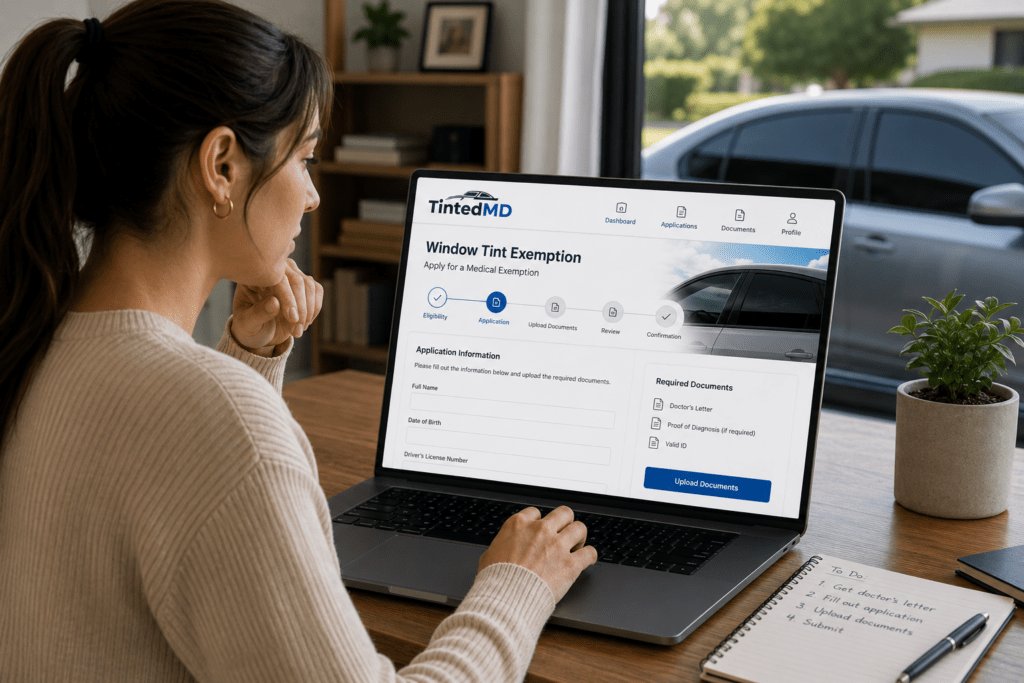
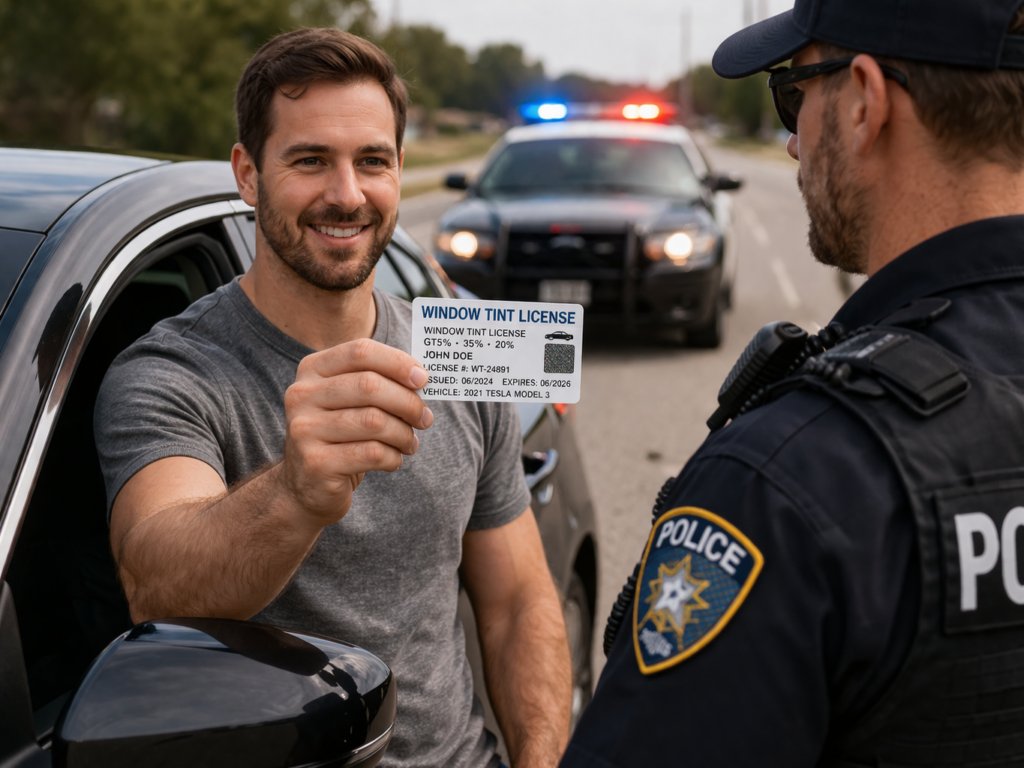
Drivers with qualifying medical conditions can apply for a window tint exemption that permits darker-than-legal tint. The window tint exemption renewal process for these certificates is the most variable across states. Some states issue permanent exemptions, others require annual physician sign-offs, and others fall somewhere in between at 2- or 4-year intervals. In most cases, the driver must carry the exemption documentation in the vehicle at all times and present it to law enforcement or inspection stations upon request.
All 50 States : Window Tint Renewal & Compliance Table
The table below covers every U.S. state and Washington, D.C. For each entry, you will find the compliance method required, the renewal timeline, a plain-language description of how to comply or renew, the medical exemption renewal interval, and the official governing agency. Use this as your starting reference, then confirm current requirements directly with the listed authority before taking action.
Note: ‘No Formal Renewal’ means no recurring renewal process is defined by law for standard tint compliance. Medical exemptions in those states may still require physician documentation to be carried in the vehicle.
| State | Renewal Type | Compliance Method | How to Comply / Renew | Med. Exemption Renewal | Official Website |
|---|---|---|---|---|---|
| Alabama | No Formal Renewal | Installer sticker on window + physician decal | Certified installer places compliance sticker. Medical users display a unique ID decal on windshield. Written physician statement required. | No defined period; physician statement in vehicle | ALEA — Tinting Regulations |
| Alaska | Annual | Written physician statement (renewed annually) | Written statement from AK-licensed physician required. Renewed EVERY YEAR. Carry statement in vehicle at all times. | Annual — new physician statement each year | Alaska DMV |
| Arizona | No Set Renewal | Physician letter to ADOT Medical Review Program | Physician-signed letter sent to AZ DOT Medical Review Program. No standard renewal period — re-apply if condition changes. | No set renewal | ADOT — Window Tint Exemption |
| Arkansas | Every 3 Yrs (Med) | Installer sticker; physician affidavit | Installer provides sticker. Medical: physician affidavit valid for 3 years. | Every 3 years | Arkansas DFA — Motor Vehicle |
| California | No Set Renewal | Installer/manufacturer sticker on each window (required) | Installer affixes sticker on each tinted window. Medical: DMV Form REG 256A + physician letter submitted to local DMV. | No set expiration — verify periodically with DMV | California DMV — Window Tinting |
| Colorado | N/A — No Med. Exempt | No sticker or cert required | No process required. No medical exemptions permitted. Enforcement is roadside only. | N/A — no exemptions allowed | Colorado DMV |
| Connecticut | No Set Renewal | DMV compliance sticker affixed by DMV at inspection lane | Bring vehicle to DMV inspection lane (Wethersfield). DMV measures VLT and affixes sticker. Medical: Form E-220. | No renewal; medical re-checked at DMV lane | CT DMV — Vehicle Inspection |
| Delaware | No Set Renewal | Online medical tint waiver application; physician certification | Complete medical tint waiver application online at DE DMV site. Print, have physician sign, upload to DMV. Waiver valid as long as individual owns vehicle. | Valid as long as individual owns vehicle — new waiver needed for new vehicle | DE DMV — Medical Tint Waiver |
| Florida | Non-Expiring (Med) | No sticker; medical Form DHSMV 83390 — non-expiring | No certification sticker required. Medical: submit Form 83390 to FLHSMV. Exemption does NOT expire for qualifying conditions. | Non-expiring for qualifying conditions | FL DHSMV — Form 83390 (PDF) |
| Georgia | No Set Renewal | No sticker required; physician letter for medical | No certification sticker required. Medical: physician letter in vehicle. $10 application fee. | No set renewal | Georgia DDS |
| Hawaii | N/A — No Med. Exempt | No sticker or process required | No formal process. No medical exemptions in Hawaii. Enforcement is roadside. | N/A — no exemptions | Hawaii DOT |
| Idaho | No Set Renewal | Film VLT certification by installer | Installer certifies film VLT compliance. Medical: physician letter in vehicle. | No set renewal | Idaho Transportation Dept. |
| Illinois | Every 4 Yrs (Med) | Physician affidavit + IL Secretary of State filing; tinted window plates | Obtain physician letter, file with IL Secretary of State, apply for tinted window license plates ($29 fee). Certification must be renewed every 4 years. Copy must accompany plate renewal each year. | Every 4 years — copy required with annual plate renewal | IL SOS — Tinted Windows |
| Indiana | Annual | Physician/optometrist certificate (renewed annually) | Physician or optometrist licensed in Indiana must certify. MUST BE RENEWED ANNUALLY. Carry in vehicle. | Annual — new certificate each year | Indiana BMV |
| Iowa | N/A — Closed Since 2012 | No formal process | No sticker required. No new medical exemptions since July 2012. Enforcement is roadside. | N/A — no new exemptions since July 2012 | Iowa DOT — Window Tinting |
| Kansas | N/A — No Med. Exempt | No sticker required | No certification process. No medical exemptions. Enforcement is roadside. | N/A — no exemptions | Kansas DMV / DOR |
| Kentucky | No Set Renewal | Installer sticker on each window | Installer places sticker on each tinted window. Medical: physician letter in vehicle. | No set renewal | Kentucky Transportation Cabinet |
| Louisiana | No Set Renewal | Installer certification sticker (Act 143 — updated Aug 1 2025) | Installer provides compliance sticker. NOTE: Front-side VLT lowered to 25% effective Aug 1, 2025 per Act 143. Verify tint still complies with new standard. | No set renewal | Louisiana OMV — Express Lane |
| Maine | No Set Renewal | Manufacturer/installer sticker on each window | Installer must place sticker on each window. Medical: physician letter in vehicle. | No set renewal | Maine Bureau of Motor Vehicles |
| Maryland | No Set Renewal | Installer tint certificate + compliance sticker on each window | Licensed installer issues certificate and affixes sticker between film and glass. Medical: Physician’s Certification to Maryland MVA. | No set renewal; carry docs at all times | Maryland MVA — Vehicle Inspection |
| Massachusetts | No Set Renewal | No sticker; annual safety inspection | No formal sticker required. Enforcement via annual safety inspection. Medical: physician letter in vehicle. | No set renewal | Massachusetts RMV |
| Michigan | No Set Renewal | No sticker or certification required | No certification required. No restrictions on rear/side windows. Medical: physician letter in vehicle. | No set renewal | Michigan SOS |
| Minnesota | No Set Renewal | No sticker; physician statement for medical | No certification required. Medical: physician statement in vehicle. | No set renewal | Minnesota DVS |
| Mississippi | No Set Renewal | Installer certification sticker required | Installer must certify compliance and affix sticker. Medical: physician docs in vehicle. | No set renewal | Mississippi DPS |
| Missouri | No Set Renewal | No sticker; physician letter for medical | No sticker required. Medical: physician letter in vehicle. | No set renewal | Missouri DOR — Motor Vehicle |
| Montana | No Set Renewal | Installer sticker recommended (not legally required) | Sticker recommended but not legally required. Medical: physician statement in vehicle. | No set renewal | Montana DOJ — MVD |
| Nebraska | N/A — No Statute | No sticker; no medical exemption in statute | No formal process. No medical exemptions in Nebraska statutes. | N/A — no exemptions in statute | Nebraska DMV |
| Nevada | No Set Renewal | Installer sticker required on each window | Installer places sticker on each tinted window. Medical: physician statement in vehicle. | No set renewal | Nevada DMV |
| New Hampshire | Every 2 Years | Physician letter to NH Dept. of Safety — 2-year waiver | No front tint allowed. Medical waiver valid 2 YEARS. Renewal: new physician statement within 6 months of expiry + copy of registration. | Every 2 years — new physician statement required | NH DMV — Tinted Windows |
| New Jersey | Every 48 Months (Med) | Medical exemption via NJ MVC Sunscreening form — 48-month renewal | No front tint without exemption. Medical: complete MVC Sunscreening 1 form, submit with physician prescription to [email protected] or PO Box 403, Trenton NJ 08666. Approval valid 48 months. Renew every 48 months with updated prescription. | Every 48 months — updated physician prescription required | NJ MVC — Window Sunscreening |
| New Mexico | No Set Renewal | Installer sticker required | Installer places certification sticker. Medical: physician docs in vehicle. | No set renewal | New Mexico MVD |
| New York | Annual Inspection | Installer sticker + annual DMV safety inspection | Installer places sticker on each window. ALL vehicles pass annual safety inspection — VLT tested. Fail = fix before registration renewal. Medical: Form MV-80W to NYS DMV. | Annual — must stay current with NYS DMV | NY DMV — Tinted Windows |
| North Carolina | No Set Renewal | Roadside enforcement only (tint removed from inspection Dec 1 2025) | As of Dec 1, 2025: tint checks REMOVED from NC safety inspections (S.L. 2025-47). Enforcement now roadside only. Tint must still comply with G.S. 20-127. | No set renewal | NC DMV — Window Tinting |
| North Dakota | No Set Renewal | No sticker; physician statement for medical | No formal certification. Medical: physician statement in vehicle. | No set renewal | North Dakota DOT — Motor Vehicle |
| Ohio | Annual Inspection | Installer sticker + annual safety inspection | Installer places sticker between film and glass. Tint checked during Ohio’s annual safety inspection at licensed stations. Medical: physician statement in vehicle. | No set renewal for medical | Ohio BMV |
| Oklahoma | No Set Renewal | Installer certification sticker required | Installer provides and affixes certification sticker. Medical: physician docs in vehicle. | No set renewal | Oklahoma DPS |
| Oregon | No Set Renewal | Installer sticker on each window | Installer places sticker on each window. Medical: physician letter in vehicle. Note: red, green, amber, yellow, black film banned. | No set renewal | Oregon DMV |
| Pennsylvania | No Set Renewal | No sticker; physician statement for medical | No certification sticker required. Medical: physician docs in vehicle. | No set renewal | PennDOT — Vehicle Services |
| Rhode Island | No Set Renewal | No sticker; physician statement for medical | No formal process. Medical: physician letter in vehicle. | No set renewal | Rhode Island DMV |
| South Carolina | Annual Inspection | Installer sticker + annual vehicle inspection | Installer affixes sticker. Tint checked during annual vehicle inspection at a certified station. Medical: physician docs in vehicle. | No set renewal for medical | SC DMV |
| South Dakota | No Set Renewal | Installer sticker on each window | Installer places sticker on each window. Medical: physician docs in vehicle. | No set renewal | SD DMV |
| Tennessee | No Set Renewal | Installer sticker on driver’s side window | Installer places sticker on driver’s side window. Medical: physician letter in vehicle. | No set renewal | Tennessee Dept. of Safety |
| Texas | Annual Inspection | One compliance label per vehicle + annual inspection | ONE label per vehicle — rearmost bottom corner of driver’s side window — reading ‘Complies with TRC Chapter 547’. Annual inspection tests tint; under 25% VLT fails. Medical: physician statement presented at each inspection. | Must present at each annual inspection | Texas DPS — Window Tinting |
| Utah | No Set Renewal | No sticker; no state guidance on medical exemptions | No certification required. No state-published medical exemption guidance. Enforcement is roadside. | No information published by state | Utah DMV |
| Vermont | Every 4 Years (or Permanent) | Application + physician letter; Form VN-022 to VT DMV | Medical: submit Form VN-022 to VT DMV. Permit issued for 4-year term (temporary conditions) OR indefinitely (permanent stable conditions). Void upon sale of vehicle. | 4-year term for temporary conditions; permanent for stable conditions | VT DMV — Window Tint Permit |
| Virginia | Permanent (until vehicle sold) | Medical via Form MED-20 to VA DMV — permanent while condition exists | No sticker required. Medical: submit Sun-Shading Medical Authorization Application (MED-20) to VA DMV Data Integrity, PO Box 27412, Richmond VA 23269. Valid until vehicle is sold or condition ends. | Permanent — valid until vehicle sold or condition ends | VA DMV — Sun-Shading Medical Auth. |
| Washington | No Set Renewal | Installer sticker on each window | Installer places sticker on each window. Medical: physician docs in vehicle. | No set renewal | Washington DOL |
| Washington D.C. | Annual Inspection | Annual vehicle inspection includes tint check | All DC vehicles must pass annual inspection at DC DMV Inspection Station. Tint is checked. Renewal notices sent 60 days before expiration. Late inspection incurs late fees. | No separate medical process — covered by annual inspection | DC DMV — Inspection Renewals |
| West Virginia | No Set Renewal | Installer sticker on each window | Installer places sticker. Medical: physician letter in vehicle. | No set renewal | WV DMV |
| Wisconsin | No Set Renewal | No sticker; physician statement for medical | No sticker required. Medical: physician docs in vehicle. | No set renewal | Wisconsin DMV |
| Wyoming | No Set Renewal | No sticker; physician statement for medical | No formal process. Medical: physician docs in vehicle. | No set renewal | Wyoming DOT — Motor Vehicle |
How to Renew a Window Tint Medical Exemption: Step-by-Step
While exact steps vary by state, the following general process applies to most states that allow window tint exemption renewal for medical conditions.
- Schedule an appointment with your licensed physician, dermatologist, or optometrist well before your current exemption expires.
- Request a written statement or signed form confirming your diagnosis and the medical necessity of darker window tint. Some states (New York, California, Virginia) require a specific state-issued form rather than a general letter.
- Complete your state’s official exemption application form, available from your state DMV, DPS, or DOT website.
- Submit the application along with the physician’s statement to the appropriate agency. Some states accept mail; others require an in-person visit.
- Pay any processing fees if required. Fees vary but are typically under $25.
- Once approved, receive your updated exemption certificate, sticker, or decal. Place it as directed — some states require it on the windshield, others in the door jamb or rear window area.
- Set a calendar reminder for your next renewal date. For annual states like Alaska and Indiana, this is every 12 months. For New Hampshire, it is every 24 months. For Vermont, every 48 months.
- Keep ALL documentation, physician statement, approval letter, and exemption certificate — in your vehicle at all times.
Important: Some states, such as New York, will not accept a general physician letter — they require the specific state form (MV-80W in New York’s case) completed by the physician and submitted to the DMV before the exemption is valid. Always download the current form directly from your state’s official DMV website to ensure you are using the right version.
States That Do Not Allow Window Tint Medical Exemptions
Eight states currently provide no pathway for medical window tint exemptions, regardless of the severity of the condition. Drivers in these states must comply with standard tint laws even if they have a documented medical need. Those states are:
- Colorado
- Hawaii
- Kansas
- Iowa (closed to new applicants since July 2012)
- Nebraska (no provision in statute)
- Utah (no published guidance from the state)
- Vermont (for front windows — no tint permitted at all)
- New Hampshire (front windows prohibited outright)
Drivers in these states with light-sensitive conditions should consult with their physician about alternatives such as UV-blocking clear film (which many states allow without a tint exemption), high-quality polarized sunglasses, or seeking a legal opinion about ADA-related accommodations.
Conclusion
Window tint exemption renewal is not a one-size-fits-all process. Across all 50 states and Washington D.C., the rules, timelines, forms, and enforcement mechanisms differ in ways that can catch even careful, well-intentioned drivers off guard. Whether your tint was installed purely for comfort or as a medical necessity, understanding your specific state’s compliance requirements and staying on top of renewal deadlines, is the only way to avoid fines, failed inspections, and registration problems.
The table in this guide gives you a clear, state-by-state breakdown of what is required, how to renew, and who the official authority is. But remember: this guide is a starting point, not a legal guarantee. Laws change, as Louisiana and North Carolina demonstrated in 2025 alone. Always verify the latest requirements directly with your state’s DMV, Department of Public Safety, or Department of Transportation before installing new tint or submitting an exemption renewal application.
If you have a qualifying medical condition and live in a state that allows window tint exemption renewal, take the process seriously. Renew on time. Keep your documentation in the vehicle. Use only a licensed, certified installer who provides proper sticker documentation. And if you are ever unsure, a short call to your state DMV is far less expensive than the fine that comes from letting your compliance lapse.
Frequently Asked Questions
Q1: What happens if my window tint medical exemption expires and I forget to renew it?
If your window tint medical exemption lapses, you are technically driving out of compliance — even if your underlying medical condition has not changed and your tint has not been altered. In states like New York and Texas, where tint is tested during annual vehicle safety inspections, an expired exemption can cause your vehicle to fail inspection and block your registration renewal until the issue is corrected.
In states that rely on roadside enforcement rather than inspections, a traffic stop could result in a fine or a fix-it ticket even if your exemption was previously valid. The most important step is to start the renewal process before your exemption expires, not after. For states requiring annual renewal such as Alaska and Indiana, build a reminder into your calendar at least 30 days before the anniversary date. For states with 2-year or 4-year terms like New Hampshire and Vermont, the renewal is easy to forget. If you have already lapsed, contact your state DMV as soon as possible and do not wait until your next inspection or traffic stop.
Q2: Can I transfer my window tint medical exemption to a new vehicle if I buy a new car?
In most states, window tint medical exemptions are tied to a specific vehicle, not the driver. This means that if you sell your current vehicle or purchase a new one, you generally cannot carry your existing exemption over — you must apply for a new one. Virginia makes this explicit: the sun-shading authorization is void the moment the vehicle is sold or transferred to another person. Delaware similarly requires a new waiver application any time you acquire a different vehicle, though it allows you to apply online without a new physician signature if your current waiver is still on record.
New Jersey takes a similar approach: each vehicle requires its own Sunscreening Exemption Card (MVC Sunscreening 4), although you may not need the physician to re-sign if your current exemption is not within six months of expiring. Illinois also voids the exemption upon sale of the vehicle. The practical takeaway: when you buy a new car, contact your state’s DMV before having tint installed and apply for a fresh exemption for the new vehicle. Tinting the car first and applying later puts you in violation for the period between installation and approval.
Q3: If I move to a new state, does my window tint exemption from my old state still apply?
No. Window tint exemptions are state-specific documents issued under the laws of the state where you registered your vehicle. When you relocate and re-register your vehicle in a new state, your old exemption has no legal standing there. You must apply for a new window tint exemption under your new state’s rules, which may differ significantly from your previous state.
This also means your tint itself may no longer be legal. For example, if you moved from Florida (which allows very dark tint with a non-expiring medical exemption) to New York (which requires 70% VLT even with a medical exemption and mandates annual renewal via Form MV-80W), your existing tint and paperwork are both non-compliant in your new state. The same applies if you move into a state with no medical exemption at all, such as Colorado or Kansas — in that scenario you would need to remove any tint that does not meet the standard legal limit, regardless of your condition. As soon as you establish residency in a new state, check that state’s specific window tint exemption renewal rules and contact the DMV before driving the vehicle on public roads with non-standard tint.