Fake Tint Exemption Letters vs a Real Medical Certificate
 by Sahar Mustafa
Last updated:
Medically reviewed by:
Dr. Matthew Reynolds, MD


A fake tint exemption is a forged document claiming you need darker window tints for medical reasons. These fraudulent certificates are easy to buy online. Using one exposes you to criminal charges and fines up to several thousand dollars. Police can take your vehicle. Police and DMV offices now use verification databases and trained inspectors. They can spot fake medical certificates within minutes of a traffic stop. Penalties vary state by state.
This guide covers what authorities check when verifying tint exemptions. It explains the legal consequences of using counterfeit documentation. You’ll also learn how to obtain a legitimate medical exemption through proper channels. You’ll learn what a real exemption must include. You’ll see how verification systems work in different states. A fake letter saves time today. The problems it causes later far outweigh that benefit.
What Is a Fake Tint Exemption and Why People Seek Them
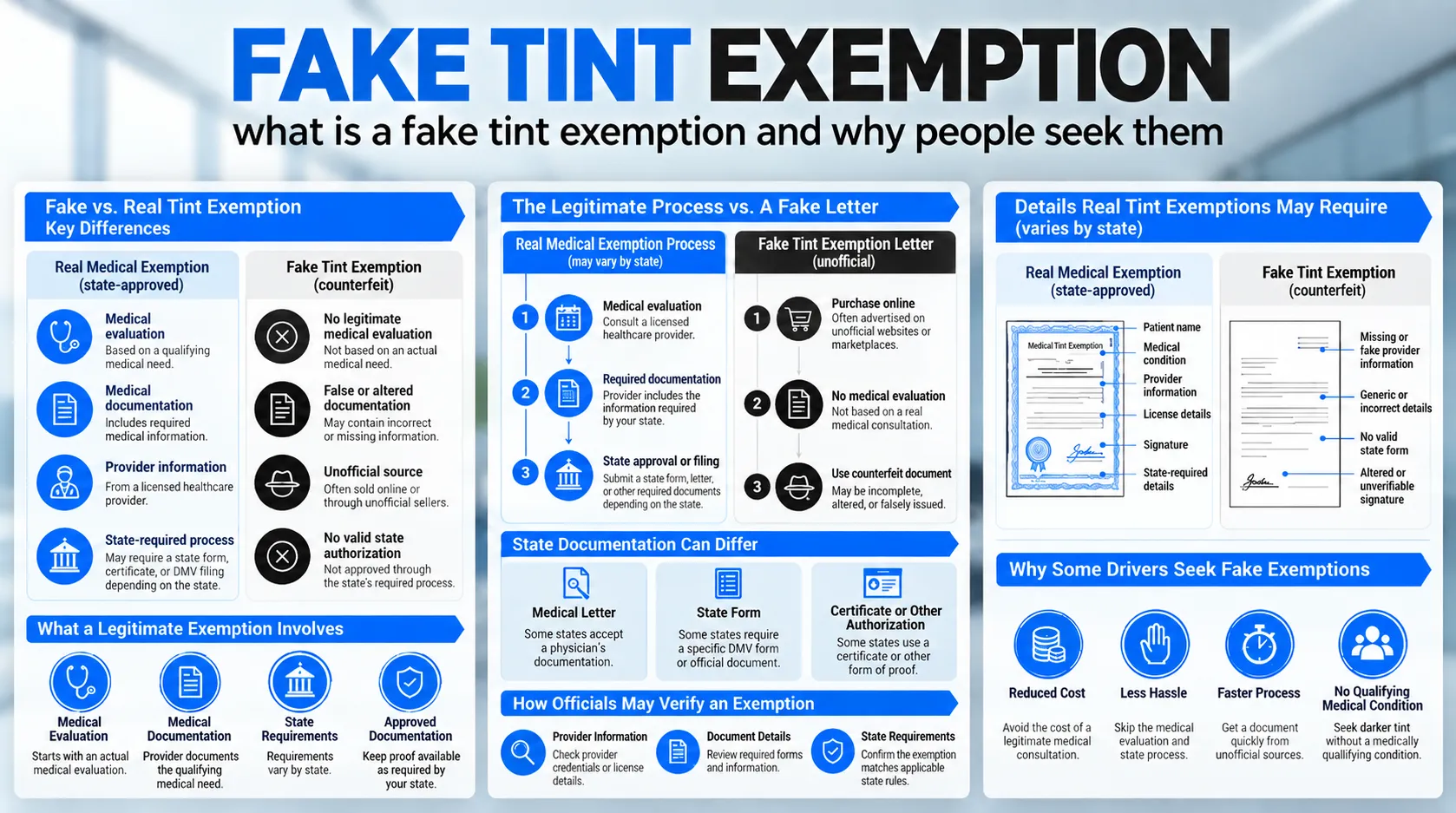
A fake tint exemption is a forged document claiming you need darker tints for medical reasons. No physician has evaluated the driver. These counterfeit certificates let drivers install tints darker than state law permits. They bypass legal requirements with deceptive paperwork.
Common Sources of Counterfeit Tint Exemption Letters
Online marketplaces and social media groups sell counterfeit exemption letters. Prices range from $50 to $200. They promise instant approval with no medical appointment. Sellers advertise on Facebook Marketplace, Telegram channels, and classified ad sites.
These sellers use generic templates with made-up doctor names and invalid license numbers. The documents usually lack medical letterhead, license verification, and state-required formatting.
The Appeal of Bypassing Medical Requirements
Drivers seek fake exemptions to skip the time and cost of a real medical visit. They still get the tint darkness they want. A counterfeit letter takes minutes to buy online. A legitimate medical exemption through proper channels requires appointments and documented medical conditions.
This appeals to people who want darker tints for privacy or looks, without a medical need. The initial cost savings seem attractive compared to proper medical evaluations.
How Fake Exemptions Differ from Legitimate Certificates
Counterfeit certificates lack the security features and verifiable information that authentic documents contain. A real exemption has ICD-10 diagnosis codes, a physician license number, and official letterhead.
Fake documents typically contain red flags. These include spelling errors, generic medical language, and inconsistent formatting. They fail verification checks. The physician names don’t match active medical licenses, and the contact details lead nowhere.
What Police and DMVs Check When Verifying Tint Exemptions
Police and DMV staff use several methods to spot fake tint exemptions. This includes visual checks and database searches that confirm a doctor’s real credentials.
Documentation and Physician Information Verification
Officers can check a doctor’s license in state medical board databases in minutes. The check takes minutes. The check shows if the doctor exists, has an active license, and works in that field.
Some DMV systems flag duplicate exemption numbers. They also check physician details against active medical licenses. Your paperwork must match the doctor’s records on file with the state.
If fraud is suspected, officers may call the doctor’s office to verify the document. TintedMD connects patients with licensed physicians. Their verifiable documentation holds up under this level of scrutiny.
Physical Document Authentication Methods
Real exemption letters in many states have specific security features. These include watermarks, official seals, and unique identification numbers. These elements make counterfeiting difficult and allow quick visual verification during traffic stops.
Officers may check the document details and provider information. Learn how to get a medical window tint exemption through the proper process.
Red Flags That Trigger Closer Inspection
Inconsistent formatting, spelling errors, and generic medical language raise suspicion during traffic stops. Officers spot fakes quickly because they see hundreds of real exemptions.
Rules differ by state, so check your state’s rules before you drive.
Legal Consequences of Using Counterfeit Tint Documentation
Using a fake tint exemption brings serious legal trouble, far worse than a simple traffic ticket. Understanding these risks helps drivers make informed decisions about tint compliance.
Criminal Charges Beyond Simple Traffic Violations
Showing a fake medical exemption to police is forgery or fraud in most states. Your jurisdiction sets whether charges are misdemeanors or felonies. The offense details also affect how courts charge you.
Document fraud is a criminal act separate from tint violations. An illegal tint may bring a $100 fix-it ticket. Using fake papers to justify it is a crime. Presenting exemption documents correctly during traffic stops helps drivers avoid problems.
Repeat offenses or aggravating factors can elevate charges to felony level. That means using fake exemptions at several traffic stops, or pairing document fraud with other violations.
Financial Penalties and Court Costs
Fines for document fraud range from $500 to $5,000, with potential jail time of 30 days to one year. These penalties apply on top of any tint violation fines. The fines and penalties vary state by state.
Authorities will seize your vehicle as soon as they find fraud. You’ll need to remove the illegal tint before release. You’ll also pay impound fees, which typically add $500 to $1,000 to your costs. Court costs, attorney fees, and lost wages add to the burden.
Impact on Your Driving Record and Insurance
Insurance firms deny claims when they find fraud. They can also cancel your policies. This can limit your future coverage and raise premiums by 50-100% for three to five years.

A fraud conviction shows up on background checks. It can hurt your job prospects and your professional licenses. Many employers run these checks, and they read fraud as a sign of poor judgment. Fraud convictions can cause employers to deny professional licenses. Healthcare, law, finance, and education fields face this risk.
What a Real Medical Tint Exemption Must Include
A real medical tint exemption has specific documents. These distinguish it from fake versions. Understanding these requirements helps you recognize authentic exemptions and avoid legal trouble.
Required Medical Information and Documentation
A valid exemption must include the medical information required by the state issuing it. A valid exemption typically requires a documented medical diagnosis with specific ICD-10 codes. The codes explain your light sensitivity condition. Common qualifying codes include H53.14 for abnormal light sensitivity and L56.8 for other specified acute skin changes due to ultraviolet radiation.
You must provide your full legal name, date of birth, and an explanation of why the treatment is medically necessary. Your physician needs to describe how your condition creates a need for darker window tints. They must explain how the tint will reduce your symptoms or health risks.
Some states require medical documentation stating the minimum light transmission needed. The letter may show recommended tint levels as VLT percentages based on your condition. For example, someone with severe photophobia might need 20% VLT, while moderate cases might require 35% VLT.
Provider Information and Signature Requirements
The exemption needs the provider’s full name, license number, specialty, and contact details. This allows law enforcement to verify the document’s authenticity during traffic stops.
The document needs an original signature from a doctor, physician assistant, or nurse practitioner. Requirements vary by state. Printed names or electronic signatures may not meet requirements in all jurisdictions.
State-Specific Forms and Certification Requirements
For example, New York’s tinted window exemption form requires medical details, provider information, and a signed certification. These forms often include verification sections and unique identification numbers.
Some areas require exemptions on official medical letterhead. The letterhead must show all practice details. The letterhead should include the clinic name, address, phone number, and sometimes a practice logo or seal to prevent forgery.
How to Get a Legitimate Tint Exemption
Start by learning your state’s rules and following the proper legal steps. Unlike counterfeit documents, authentic exemptions provide legal protection and peace of mind. Start by checking your state’s requirements and following the exemption process.
Determine Your State’s Eligibility and Documentation Requirements
Start by researching your state’s specific medical exemption requirements. A real exemption has specific paperwork that sets it apart from fake versions. Understanding these requirements helps you recognize authentic exemptions and avoid legal trouble. Processes differ across jurisdictions. Some states require formal DMV registration, while others only need physician documentation.
Check whether your state accepts general physician letters. Some states require completion of state-specific exemption forms instead. Some states require formal applications with specific forms and fees.
Review the qualifying medical conditions in your jurisdiction. Most states accept photophobia, lupus, porphyria, and certain eye conditions. But rules differ by state.
Complete the Required Medical Evaluation and Paperwork
Schedule a consultation with a licensed physician to diagnose and document a qualifying medical condition. Your doctor must complete state-specific exemption forms including diagnosis codes, recommended tint darkness levels, and medical justification.
The physician will evaluate your light sensitivity and determine appropriate VLT (visible light transmission) percentages based on your condition. TintedMD helps patients find qualified doctors. The service also handles all paperwork needs.
You’ll need to provide your full name, date of birth, and detailed medical history. The physician must sign the documentation and include their medical license number and contact information.
Submit or Keep the Documentation as Required by Your State
Some states require submission of completed medical documentation to the DMV or motor vehicle department with application fees. Processing times vary from immediate approval to 4-6 weeks depending on state verification procedures.
Other states allow drivers to simply carry the medical certificate in the vehicle without formal DMV registration. Always verify your state’s specific requirements to ensure compliance.
Keep the original exemption certificate or certified copy in an easily accessible location like your glove compartment for quick retrieval during traffic stops.
What to Carry in the Vehicle After Approval
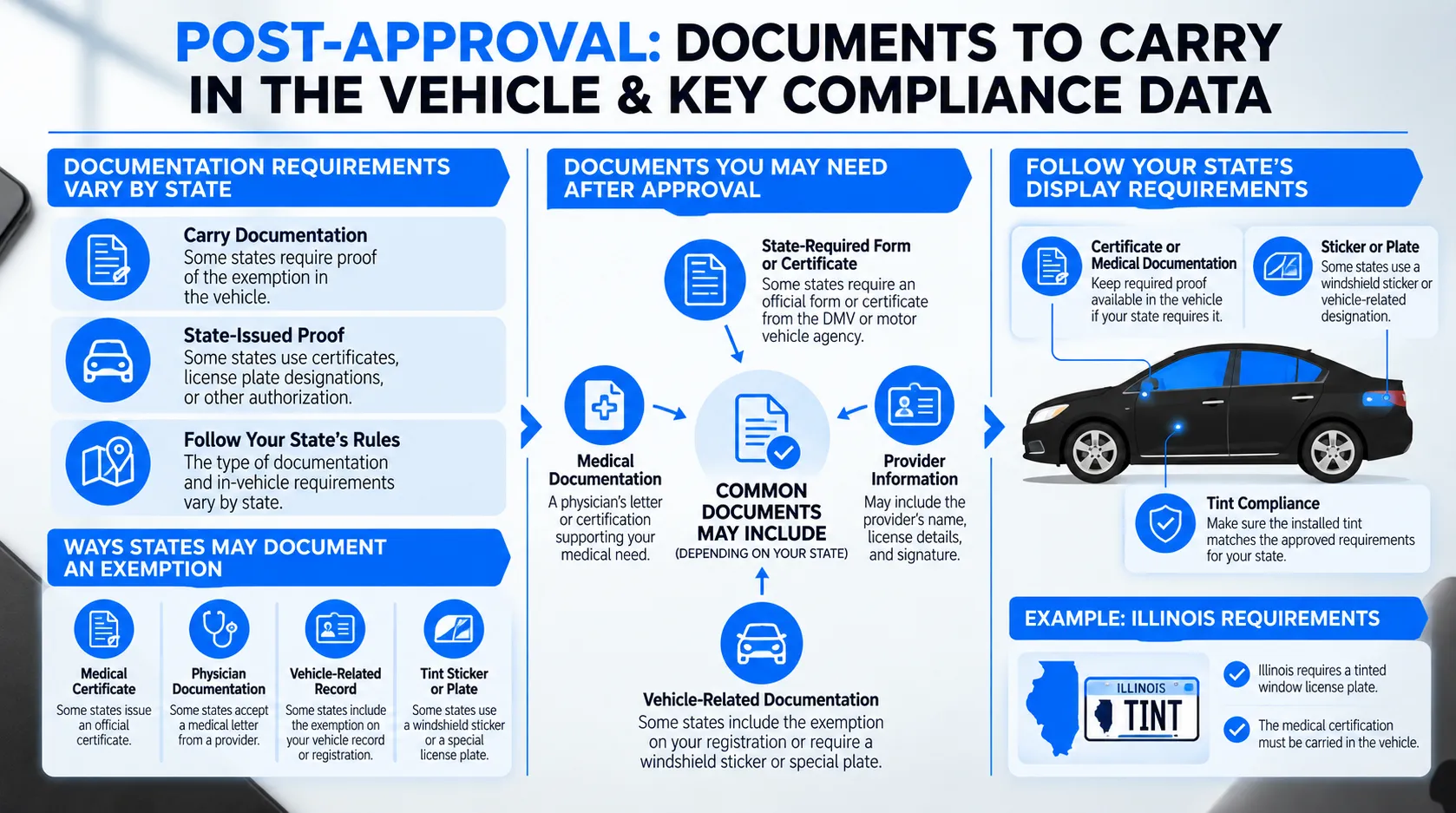
After you get a real exemption, carry the paperwork in your vehicle at all times. If you can’t show papers at a stop, you may get a ticket even with a valid exemption.
Required Exemption Certificate, Letter, or State Documentation
Most states require you to carry the original certificate or a certified copy. Include your doctor’s signature, license number, and details about your condition and needed tint darkness.
Some states issue special license plates or windshield stickers instead of requiring carried paperwork. Requirements vary by state. Illinois, for example, requires a tinted window license plate and medical certification in the vehicle.
Some states need both your certificate and proof that your tint matches the exemption specs. This means keeping your tint installation receipt showing the exact VLT percentage applied.
Where and How to Keep the Documentation
Keep the letter in your glove compartment or sun visor for quick access during a stop. You don’t want to fumble through your trunk during a traffic stop.
Protect the letter in a clear sleeve to prevent damage. Original signatures can fade over time, making your exemption harder to verify.
What to Show During a Traffic Stop or Inspection
Tell the officer you have an exemption and hand over your papers when asked. Being proactive shows you have nothing to hide and speeds up the process.
Hand over your exemption certificate along with your driver’s license and registration. Officers may check the document or call the doctor’s office to verify it.
How Tint Exemption Verification Varies by State
Verification systems for tint exemptions differ dramatically across the country. Some states keep online databases. Others rely on paper documents that drivers carry. Understanding these differences matters when you travel across state lines or apply for an exemption.
Different State Verification and Documentation Requirements
California, New York, and Florida have the strictest exemption verification systems with online databases. Officers in these states can check exemption status during stops through online systems. Florida’s exemption form requires a completed application and a doctor’s statement of certification.
Some states require formal DMV registration of medical exemptions. Others only require drivers to carry physician documentation in the vehicle. This creates confusion for drivers who move between states or purchase vehicles in different jurisdictions.
Tint limits can vary by state and by window, even when a medical exemption applies. Some states allow 50% VLT while others permit as dark as 20% VLT.
Examples of How States Verify Medical Exemptions
Texas allows drivers to carry physician letters without DMV registration. Officers check license numbers and call offices to verify documents.
Illinois needs a tinted window license plate and medical proof in your vehicle.
States without exemption programs still punish fake medical letters as fraud. You face legal trouble even in states without official exemption programs.
What to Know When Driving with an Exemption in Another State
One state may issue a medical exemption. Other states with different laws may not accept it. No national reciprocity agreement exists for tint exemptions.
Border state enforcement has increased coordination to identify drivers exploiting different state requirements. Officers near state lines share tips about fraud patterns and fake documents.
Before traveling, check if other states will accept your exemption. Call the DMV in your destination state. Ask if they will honor your exemption.
Why the Risk of Fake Exemptions Isn’t Worth Taking
The Risk of Fake Exemptions: Overview
Fake tint docs cost far more than getting a real exemption. Your $50-$200 savings vanish when fines, legal fees, and insurance hikes total thousands.
Criminal fraud convictions raise insurance premiums by 50-100% for three to five years. Real exemptions run $100 to $300 total, far less than the insurance hikes.
When caught, immediate costs pile up quickly. Impound fees, towing, and tint removal will cost you $500 to $1,000 before court.
Key Considerations
Lost wages from mandatory court appearances cut into your income. Potential jail time makes the financial impact even worse.
A criminal record for fraud follows you for years. It affects employment opportunities, professional licensing, and background checks. Employers in healthcare, education, and finance routinely reject candidates with fraud convictions.
Law enforcement detection methods improve constantly. Officers check licenses through state medical databases and call offices to verify documents. The likelihood of getting caught increases each year.
Understanding how a legitimate medical exemption protects you makes the choice clear. Legitimate exemptions provide legal protection, peace of mind, and renewable authorization for years. They cost less upfront and eliminate the risk of criminal prosecution entirely.
Conclusion
Using a fake tint exemption exposes you to criminal charges. You’ll face thousands of dollars in fines and insurance increases. A permanent record will affect your future opportunities. A counterfeit letter may save time now. It can’t justify the long-term costs, especially as police checks keep improving.
If a medical condition makes you sensitive to light, get a real exemption through the proper process. It takes less time than you might expect. It costs far less than the penalties for a fake letter. A licensed doctor can evaluate your condition and give you the paperwork you need. That paperwork protects you at traffic stops.
TintedMD connects you with qualified doctors who understand exemption requirements and handles the paperwork process from start to finish. Get a real medical exemption through a legitimate medical process.
Frequently Asked Questions
What is a fake tint exemption and how does it differ from a real one?
A fake tint exemption is a counterfeit or falsely issued document that claims you qualify for darker window tint for medical reasons. A legitimate exemption uses the documentation required by your state, which may be a medical letter, certificate, or official state form. The required medical information, provider credentials, signatures, and permitted tint levels vary by state. For example, New York requires a medical practitioner to document the qualifying condition, minimum light transmission needed, and why other protective measures are inadequate on its MV-80W form. A legitimate exemption must also come through the process authorized by the state rather than from an unofficial template or seller.
Where do people buy fake tint exemption letters, and will a downloaded template work?
Counterfeit tint exemption letters may be advertised through online marketplaces, social media, classified listings, or other unofficial sources. Some sellers offer documents at relatively low prices and claim that they can provide instant approval without a medical evaluation, but the authenticity of these documents cannot be established simply by purchasing them. A downloaded template is not a substitute for the documentation required by your state. Officials may reject a document that is incomplete, altered, falsely issued, or does not meet the state's requirements. If your state requires an official form or provider certification, a generic template will not replace that process.
What criminal charges can I face for using a fake window tint exemption?
The consequences depend on your state and the type of false or fraudulent document involved. A fake exemption may be rejected and can result in a citation or other consequences for violating the state's tint law. In some states, submitting false information or fraudulent documentation can also carry separate legal penalties. For example, New York's MV-80W form states that false statements made on the form are punishable as a Class A misdemeanor under section 210.45 of the Penal Law. The exact penalties for fraudulent documentation therefore depend on the law of the state involved.
How do police verify tint exemption documentation during traffic stops?
Verification methods vary by state. During a traffic stop or inspection, an officer may review the exemption document, check the listed provider's credentials, compare the information with state records, or determine whether the document matches the state's requirements. Some states use official exemption forms, certificates, stickers, or vehicle-related records that help establish whether the tint is authorized. For example, New York inspection guidance states that vehicles displaying a valid MV-80W.2 Exempt Tinted Windows sticker do not need to have their window tint measured during inspection. The exact verification process depends on the state and the type of exemption.
Why do drivers seek fake tint exemptions instead of legitimate ones?
Some drivers seek fake exemptions to avoid the time, cost, or medical evaluation involved in obtaining legitimate documentation. Others may want darker tint for privacy or appearance without meeting their state's medical requirements. A counterfeit document may appear to offer a faster or easier solution than completing the legitimate process, especially when sellers promise immediate paperwork. However, a fake document does not provide valid state authorization and may be rejected during a traffic stop, inspection, or application review. Obtaining legitimate documentation requires following the medical and state requirements that apply to your situation.
What information must a legitimate tint exemption certificate include?
The required information depends on your state and the type of exemption. A legitimate tint exemption may require your medical condition or medical need, provider information, professional license details, signature and date, and the level or type of tint permitted. Some states use an official form with detailed medical requirements rather than accepting a general doctor's letter. For example, New York's MV-80W asks the medical provider to identify the qualifying condition, the minimum level of light transmission required, why personal protective measures are inadequate, and the provider's professional license information. Other states may require different information, so the document should follow the specific requirements of the state issuing the exemption.
Can DMV systems detect duplicate or fraudulent tint exemption numbers, and can an online service still be legitimate?
Some states use electronic records or other verification methods to confirm exemption information, but there is no single verification system used nationwide. A questionable document may be checked against state records or other official information, depending on the state's process. An online service can still be legitimate when it connects you with a provider who is authorized to complete the required medical documentation and the service follows your state's rules. Before using an online service, confirm that the provider is authorized in your state and that the state accepts the type of evaluation and documentation the service provides. An online appointment does not make documentation fraudulent by itself; what matters is whether the provider and documentation meet the applicable state requirements.
How long does it take to get a real medical tint exemption through proper channels?
The timeline depends on your state, the type of exemption, and whether the state requires separate review or approval after the medical evaluation. The medical evaluation itself may be completed during a single appointment, but some states require additional forms, agency review, or vehicle-related documentation. Processing can range from relatively quick approval to several weeks when a state agency must review the application. For example, New York requires the medical examination to have occurred within 60 days before the MV-80W is submitted to the DMV. Check your state's current application requirements, fees, and processing times before applying.

Meet the author
Sahar Mustafa
Hi, I'm Sahar, and I write for TintedMD. My work focuses on medical window tint exemptions, qualifying health conditions, state-specific tint rules, and the documentation that may be required from a licensed provider. I want readers to know what an exemption may cover, what their state expects, and what questions they should ask before relying on their documentation.
Get Your Medical Tint Exemption Online in Minutes
Check Your Eligibility