Got Pulled over for Tinted Windows? Here's How a Medical Exemption Keeps You Legal
 by Nida Hammad
 Last updated:
Medically reviewed by:
Dr. Matthew Reynolds, MD


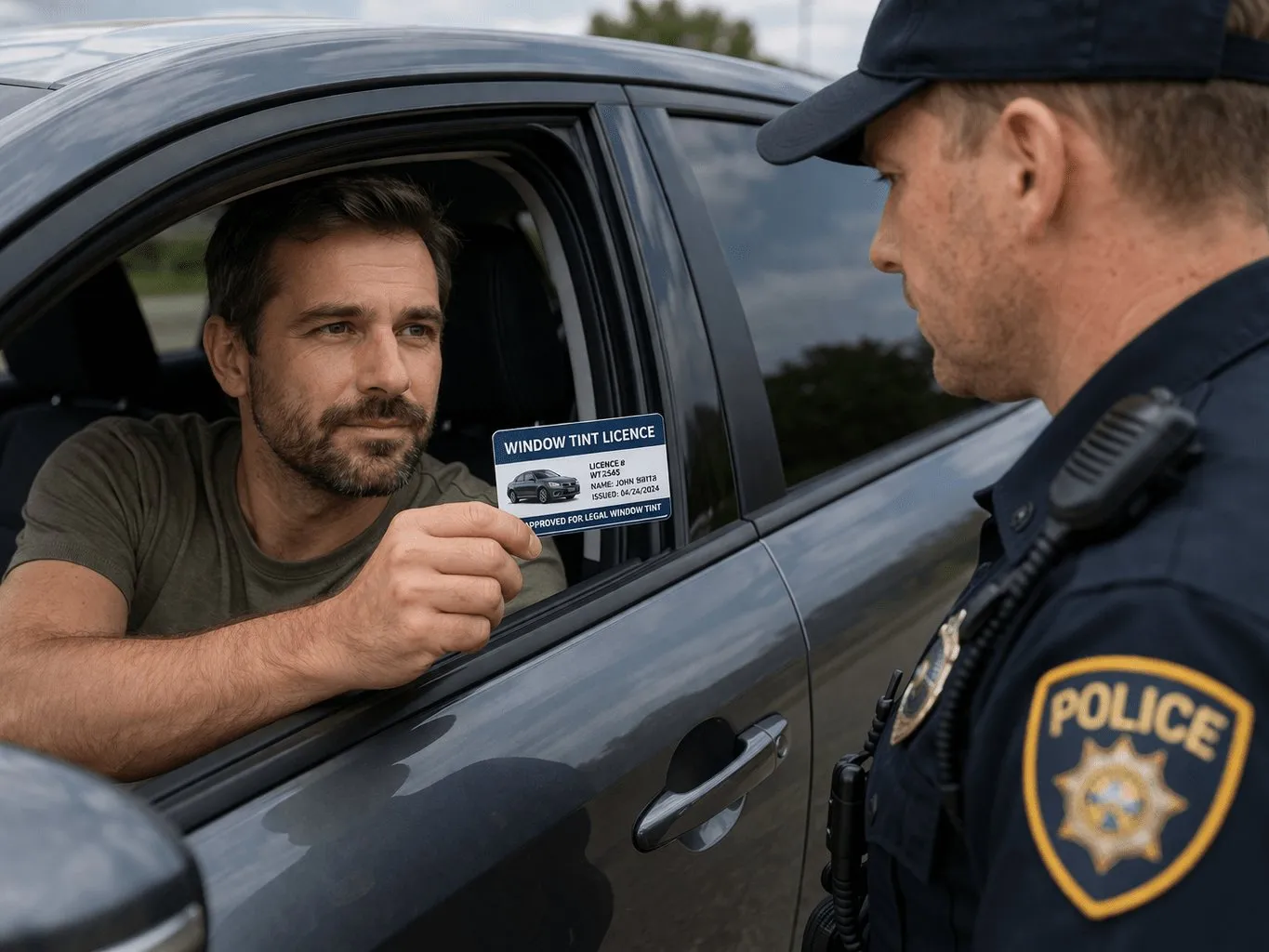
The red and blue lights appear in your mirror. You know your tint is dark. You have about 30 seconds before the officer reaches your window. This is the moment that a medical exemption document in your glovebox makes all the difference, and the moment that not having one creates a problem that costs you time, money, and repeat stops.
A medical exemption for window tint is a legal document signed by a licensed physician that confirms your darker-than-standard tint is medically necessary. When it is properly completed and present in the vehicle, it protects you at a traffic stop in every state that offers one. When it is missing, outdated, or incomplete, it does not protect you at all, even if your condition is real and your need is genuine.
This guide covers exactly what happens when you get pulled over for tinted windows, what a valid medical exemption does during a stop, how to handle it if you already have a ticket, what every state requires when an officer checks your tint, and how to get your documentation before you drive again.
If you need your documentation now, TintedMD connects you with a licensed physician in your state for a same-day evaluation and signed letter. Money-back guarantee.
What Happens When You Get Pulled Over for Tinted Windows?
A tinted window stop follows a predictable sequence. Understanding each step helps you know exactly when and how your medical exemption changes the outcome.
How Officers Detect Illegal Tint
Officers initiate tint stops based on visual observation. Dark tint is visible, especially on front side windows in daylight. Once stopped, the officer typically uses a handheld tint meter, also called a photometer or VLT meter, to measure the exact percentage of visible light passing through the window.
Most patrol units carry one.The meter reading is what matters legally. If it shows a reading below your state’s legal VLT limit, the officer has grounds for a citation. The VLT standard used by states traces back to Federal Motor Vehicle Safety Standard 205 (FMVSS 205), which governs glazing materials and sets the federal baseline that state tint laws build on. Your medical exemption document is what changes the conversation at the stop. Without it, the meter reading is all they need.
What the Officer Is Checking
Officers check two things in a tint stop: the VLT reading from the meter, and whether you have valid documentation that authorizes an exemption. If both are in order (meter shows dark tint, but you produce a valid exemption letter), the stop typically ends with a warning. If only one is present (dark tint, no exemption document), you get a citation.
What the Stop Typically Results In
| You Have a Valid Exemption in the Vehicle | You Do Not Have a Valid Exemption |
|---|---|
| Officer reads meter, sees dark tint | Officer reads meter, sees dark tint |
| You produce the signed physician letter or certificate | No document to show |
| Officer verifies document (license number, VLT, date) | Officer issues citation or fix-it ticket |
| Stop ends with warning in most cases | Fine of $25 to $500+ depending on state and offense number |
| No citation, no court date, no fine | Court date, possible points in some states, registration hold |
| You drive away | You drive away with a problem to resolve |
Non-Moving Violation vs. Moving Violation
In most states, a window tint violation is a non-moving equipment violation. This means no points added to your license and no impact on your insurance rate from the citation itself. But repeat violations in some states can escalate to moving violation territory. And in states like California, an unresolved tint fix-it ticket can lead to a registration hold, which means your car cannot be re-registered until the violation is cleared.
The Five-Step Traffic Stop Sequence for Tinted Windows
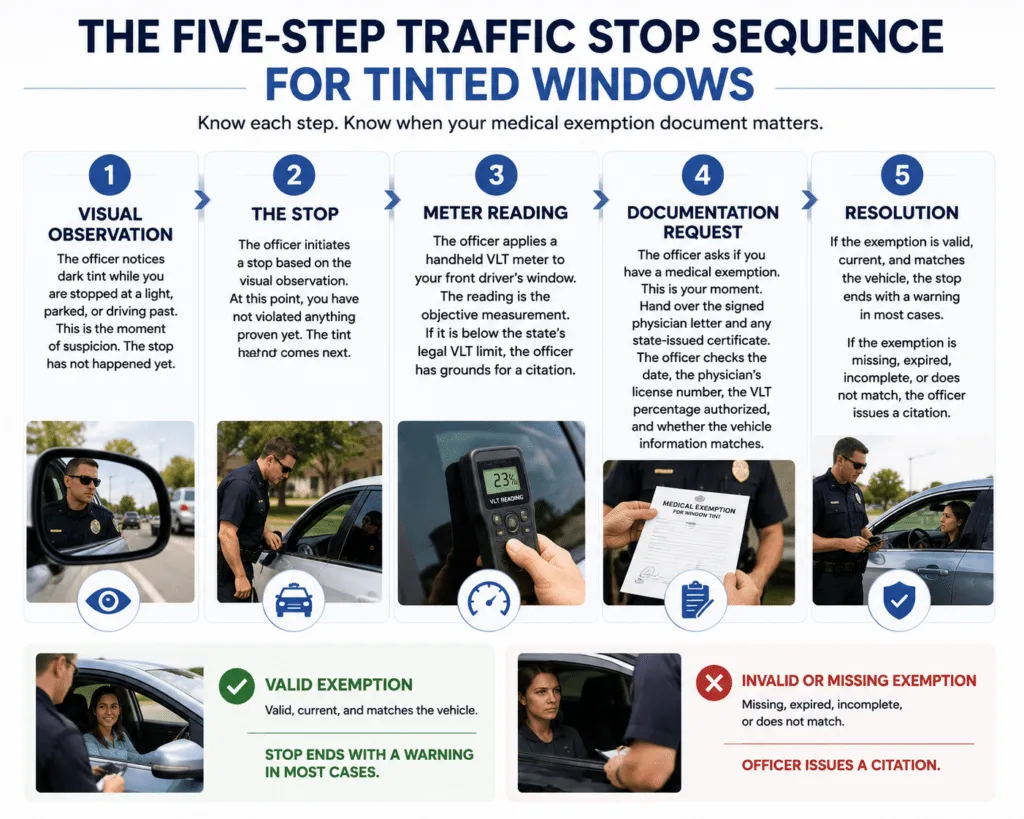
Most tinted window stops follow the same sequence regardless of state. Knowing each step tells you exactly when your medical exemption document needs to appear and what it needs to do.
-
Step 1 - Visual observation: The officer notices dark tint while you are stopped at a light, parked, or driving past. This is the moment of suspicion. The stop has not happened yet.
-
Step 2 - The stop: The officer initiates a stop based on the visual observation. At this point, you have not violated anything proven yet. The tint meter comes next.
-
Step 3 - Meter reading: The officer applies a handheld VLT meter to your front driver’s window. The reading is the objective measurement. If it is below the state’s legal VLT limit, the officer has grounds for a citation.
-
Step 4 - Documentation request: The officer asks if you have a medical exemption. This is your moment. Hand over the signed physician letter and any state-issued certificate. The officer checks the date, the physician’s license number, the VLT percentage authorized, and whether the vehicle information matches.
-
Step 5 - Resolution: If the exemption is valid, current, and matches the vehicle, the stop ends with a warning in most cases. If the exemption is missing, expired, incomplete, or does not match, the officer issues a citation.
Officers in states with electronic exemption registries, such as Florida’s FLHSMV certificate system, can verify your medical exemption through their dispatch system in real time. This makes the verification step faster and reduces the risk of disputes over document authenticity. In states where verification is manual, having the physician’s license number and contact information on the letter helps the officer confirm legitimacy on the spot.
What Is a Medical Exemption and What Makes It Valid at a Traffic Stop?
Not every document that calls itself a medical exemption will protect you at a traffic stop. Officers are not required to accept incomplete, expired, or clearly fraudulent letters. Here is what a legally valid exemption document must contain to actually work during a stop.
What a Valid Medical Exemption Must Contain
-
Physician’s full name, license number, and state of licensure: The officer can verify these against the state medical board database in real time.
-
Your name and vehicle information: In most states, the exemption is tied to a specific vehicle. The letter should match the car you are driving.
-
The qualifying medical condition: Stated in clinical terms. Vague references to ‘sun sensitivity’ are not sufficient in most states.
-
A specific VLT percentage: The letter must state what VLT the physician is authorizing. If the meter reading matches or is lighter than what the letter authorizes, the stop is resolved.
-
Date of issue: Expired letters do not protect you. An officer can and will check the date.
-
Physician signature: Original or compliant electronic signature. Stamped signatures are not accepted in some states.
-
For state-issued certificates: Some states issue a formal certificate or decal in addition to the physician letter. If your state requires this, the certificate must be present alongside the letter.
What the Officer Cannot Demand
Officers cannot require you to show your underlying medical records. The HHS HIPAA Privacy Rule protects your diagnosis details beyond what appears in the exemption letter itself. The medical exemption letter is the only document they are legally entitled to review during a traffic stop. They cannot demand copies of your prescription history, medical records, or test results.
If You Had a Medical Exemption but Forgot It at Home
This is one of the most common situations: you have a valid medical exemption, it is sitting on your desk at home, and an officer is looking at your dark tint. Here is what typically happens and how to handle it.
The Fix-It Ticket Process
Most states offer a correction notice process, also called a fix-it ticket or equipment violation dismissal. When an officer issues this type of citation, you have a set window, typically 30 to 90 days, to appear in court or submit proof that the violation has been corrected or was never a violation in the first place.
This process exists specifically for equipment violations because the state’s goal is compliance, not punishment. A driver who fixes an equipment violation or proves it was never a violation in the first place has done exactly what the system intends. Tint exemptions fit this framework well.
For tint exemptions, this means bringing your valid exemption documentation to the court clerk or traffic court within the allowed window. In many jurisdictions, if the documentation proves the tint was legally exempted at the time of the stop, the citation is dismissed with no fine or reduced to a small administrative fee.
What to Bring to the Court Clerk
Documents to Bring When Resolving a Fix-It ticket:
-
Your signed physician letter or state-issued exemption certificate, original preferred
-
Proof that the letter was valid on the date of the stop (check the issue date and expiration)
-
The vehicle registration confirming the vehicle matches the exemption
-
The tint installer’s receipt or certificate showing the VLT of the installed film
-
Your citation number and any paperwork the officer gave you
Time Limits by State
Most states give you between 30 and 90 days to resolve a fix-it ticket. Do not wait. Some courts require you to appear in person. Others accept a mailed submission. Check your citation for the specific deadline and method. Missing the deadline typically converts the fix-it ticket into a standard fine with no opportunity for dismissal.
What to Do Right Now If You Were Just Pulled Over
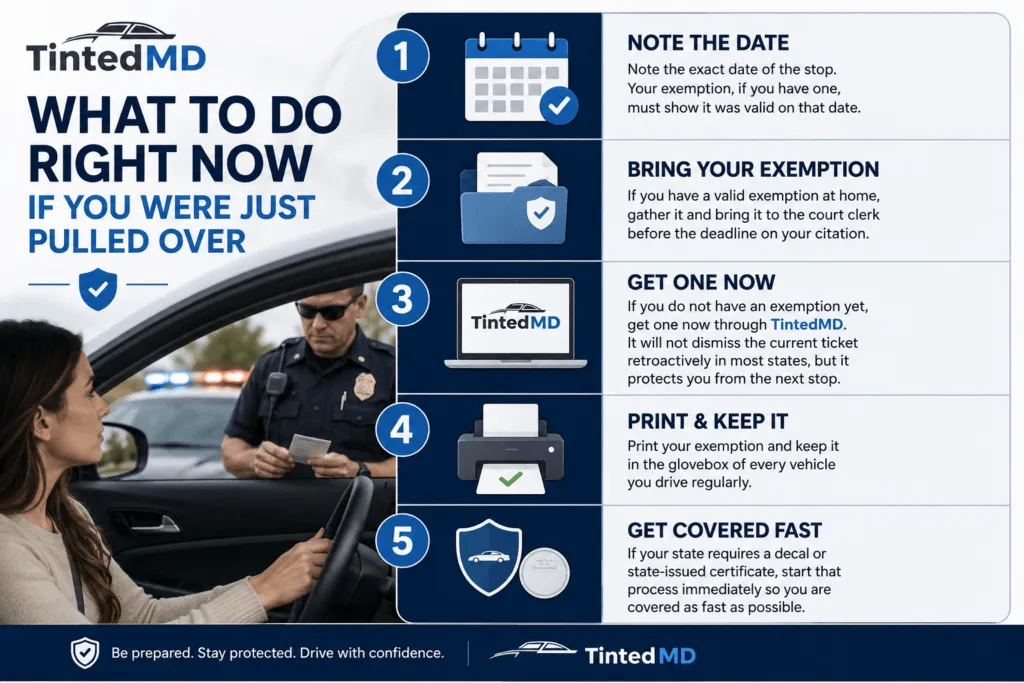
Step 1: Note the exact date of the stop. Your exemption, if you have one, must show it was valid on that date.
Step 2: If you have a valid exemption at home, gather it and bring it to the court clerk before the deadline on your citation.
Step 3: If you do not have an exemption yet, get one now through TintedMD. It will not dismiss the current ticket retroactively in most states, but it protects you from the next stop.
Step 4: Print your exemption and keep it in the glovebox of every vehicle you drive regularly.
Step 5: If your state requires a decal or state-issued certificate, start that process immediately so you are covered as fast as possible.
If You Did NOT Have a Medical Exemption When You Were Pulled Over
If you received a tint citation and do not have a medical exemption at all, the situation is more complicated but still manageable. Here is the honest picture.
Does Getting an Exemption Now Help With Your Existing Ticket?
In most states, no. A medical exemption obtained after the date of the stop does not retroactively cover the violation. The officer cited you for a violation that existed at the time of the stop. Getting an exemption today does not change what was true when you were stopped.
There are narrow exceptions. Some jurisdictions with fix-it ticket procedures allow the officer’s discretion to include cases where the driver demonstrates a medical need even without prior documentation. In these cases, showing a newly obtained exemption to a judge may result in a reduced fine. This is not guaranteed and varies by jurisdiction and judge.
What Happens If You Fight the Ticket
You can contest a tint citation in traffic court. To do so effectively, you would need to demonstrate that the tint was legal at the time of the stop, which requires a valid exemption that predates the stop, that the officer’s equipment was miscalibrated (rare and difficult to prove), or that the tint was factory-installed and covered under a different standard.
Fighting a citation without a prior exemption is difficult. The meter reading is objective evidence. Without a valid medical exemption that predates the stop, your best outcome is typically a reduced fine.
The Cost Comparison: Ticket vs. Exemption
| With a Valid Medical Exemption (Glovebox) | Without a Medical Exemption |
|---|---|
| Stop ends with warning in most cases | $25 to $500+ fine per citation |
| No court date | Court date, time off work, parking fees |
| No registration hold risk | Possible registration hold if unresolved |
| Protects all future stops | Each stop is a new citation risk |
| TintedMD: $89 to $149 one time | Average first offense: $150 to $300 |
| Money-back guarantee | Fine is non-refundable |
| Same-day delivery | Problem continues until resolved |
The financial argument for getting an exemption before the first ticket is not complicated. A TintedMD evaluation runs $89 to $149 depending on the state. A first-offense tint citation in most states runs $150 to $300 in fines alone, before court costs, time off work, and the stress of a court date. In California, an unresolved tint ticket can also trigger a registration hold, meaning your car cannot be re-registered until the violation is cleared. That adds a second layer of cost and inconvenience.
Beyond the financial calculation, consider the cumulative risk. An officer who runs your plates and sees a prior tint citation may be less likely to extend professional courtesy on a second stop. Repeat violations in some states escalate to higher fines. In a handful of states, a third or fourth equipment violation can be treated as a habitual offender matter. Getting a valid medical exemption in place before the first citation is the only way to exit this cycle entirely.
What to Say and Show an Officer During a Tinted Window Stop
The Glovebox Checklist
-
Signed physician letter: Original preferred. Must include physician license number, your name, vehicle, qualifying condition, authorized VLT, date, and signature.
-
State-issued certificate or decal (where required): Florida, Virginia, West Virginia, Alabama, Rhode Island, and others issue formal certificates. These must accompany the physician’s letter.
-
Vehicle registration: Confirms the vehicle matches the exemption.Tint installer invoice: Shows the VLT of the installed film. If the film matches what the letter authorizes, the stop is typically resolved on the spot.
-
Phone photo backup: Keep a photo of your exemption letter on your phone. If the physical copy is missing or damaged, the photo helps while you locate the original.
What to Say to the Officer
When the officer approaches, have your documents ready. Say: ‘I have a medical exemption for the tint. Here is my physician letter and my exemption certificate.’ Hand over the documents along with your license and registration. Do not volunteer information about your medical condition. The letter speaks for itself.
Officers are not entitled to ask about your diagnosis. If asked, you can say: ‘The condition is documented in the letter. My physician certified the medical necessity.’ That is a complete and legally appropriate answer.
What NOT to Say or Do
-
Do not say ‘I have a medical condition’ without producing the document. Verbal claims mean nothing at a traffic stop without paperwork to back them up.
-
Do not offer your actual medical records. You are not required to share them.
-
Do not present a photocopy in a state that requires the original (Texas being the most common example).
-
Do not present an expired letter. An officer who checks the date can still cite you even if your condition is real.
-
Do not present a letter from an out-of-state physician if your state requires the physician to be licensed in your state.
State-by-State: How Medical Exemptions Work During a Traffic Stop
Every state has different rules for how a medical exemption is presented at a traffic stop, what the officer accepts, and whether an original or copy is required. Below is the complete guide for all 50 states and Washington DC.
Complete State Reference: Medical Exemption at a Traffic Stop
| State | Exemption Available | What Officer Accepts | Original or Copy Required |
|---|---|---|---|
| Alabama | Yes | Physician letter + ALEA-issued numbered decal on windshield | Original letter; decal must be displayed |
| Alaska | Yes | Signed physician letter + installer VLT certificate in vehicle | Original letter recommended |
| Arizona | Yes | Signed physician letter carried in vehicle | Copy generally accepted |
| Arkansas | Yes | State-issued certificate from Arkansas State Police + physician letter | Original letter; carry certificate |
| California | Yes | Signed physician letter + DMV approval letter (Form REG 256A process) | Copy accepted; keep both in vehicle |
| Colorado | No | No exemption exists. No document resolves the stop. | N/A |
| Connecticut | Yes | Validated DMV form carried in vehicle | Original form required |
| Delaware | Yes | Completed Form MV495 with physician endorsement | Original required |
| Florida | Yes | State-issued Medical Exemption Certificate (FLHSMV) + physician letter | Original certificate strongly recommended |
| Georgia | Yes | Georgia DPS exemption permit + physician letter | Original permit required |
| Hawaii | No | No formal exemption. Officer may exercise discretion with a letter but no statutory protection. | N/A |
| Idaho | Yes | Physician letter submitted to Idaho Transportation Dept; carry confirmation | Copy generally accepted |
| Illinois | Yes | Illinois SOS exemption certificate + physician letter | Original certificate recommended |
| Indiana | Yes | BMV-issued exemption document + physician letter | Original recommended |
| Iowa | Yes | Iowa DOT confirmation + physician letter | Copy generally accepted |
| Kansas | No | No exemption exists. No document resolves the stop. | N/A |
| Kentucky | Yes | Kentucky Transportation Cabinet certificate + physician letter | Original recommended |
| Louisiana | Yes | OMV-issued confirmation + physician letter | Original letter preferred |
| Maine | Yes | BMV confirmation + physician letter | Copy generally accepted |
| Maryland | Yes | Maryland MVA pre-approval certificate + physician letter | Original certificate required; must predate stop |
| Massachusetts | Yes | RMV exemption document + physician letter | Original recommended |
| Michigan | N/A | No restriction on non-windshield windows. No exemption needed. | N/A |
| Minnesota | Yes | Signed physician letter or notarized affidavit + installer VLT certificate | Original letter recommended |
| Mississippi | Yes | DPS confirmation + physician letter | Original letter preferred |
| Missouri | Yes | DOR confirmation + physician letter | Copy generally accepted |
| Montana | Yes | Signed physician affidavit carried in vehicle. Updated every 2 years. | Original affidavit required |
| Nebraska | Yes | Nebraska DMV certificate + physician letter | Original recommended |
| Nevada | Yes | Nevada DMV confirmation + physician letter | Copy generally accepted |
| New Hampshire | Yes | NH DMV confirmation + physician letter | Copy generally accepted |
| New Jersey | Yes | NJ MVC certificate (renewed every 4 years) + physician letter | Original certificate recommended |
| New Mexico | Yes | Physician statement carried in vehicle | Copy generally accepted |
| New York | Yes | NY DMV Form MV-80W exemption + physician endorsement | Original Form MV-80W required |
| North Carolina | Yes | NC DMV pre-approval certificate + physician letter; must predate installation | Original certificate required |
| North Dakota | Yes | DOT confirmation + physician letter | Copy generally accepted |
| Ohio | Yes | BMV confirmation + physician letter | Original recommended |
| Oklahoma | Yes | Signed physician letter carried in vehicle (Okla. Stat. tit. 47 sec. 12-422) | Original strongly recommended |
| Oregon | Yes | Oregon DMV Form 735-6513 + physician completion | Original form required |
| Pennsylvania | Yes | PennDOT Form DL-599C signed by physician or optometrist | Original form required |
| Rhode Island | Yes | RI DMV-issued decal on driver’s side window + physician affidavit | Original affidavit; decal must be displayed |
| South Carolina | Yes | SC DMV confirmation + physician letter | Original letter preferred |
| South Dakota | Yes | Medical review board authorization + physician letter | Original letter required |
| Tennessee | Yes | Physician certification of medical necessity carried in vehicle | Original letter strongly recommended |
| Texas | Yes | Signed physician letter on letterhead (Tex. Transp. Code sec. 547.613) | ORIGINAL only; copies not accepted by many officers |
| Utah | Yes | Utah Driver License Division confirmation + physician letter | Copy generally accepted |
| Vermont | Yes | VT DMV confirmation + physician letter | Copy generally accepted |
| Virginia | Yes | Virginia DMV-issued exemption decal displayed on vehicle + physician letter | Decal required to be displayed; letter in glovebox |
| Washington | Yes | Signed physician letter or notarized affidavit + installer VLT certificate | Original recommended |
| Washington DC | Yes | Physician letter on official letterhead carried in vehicle at all times | Copy accepted but original preferred |
| West Virginia | Yes | WV DMV-issued decal + physician letter | Decal must be displayed; letter in glovebox |
| Wisconsin | Yes | Wisconsin DOT Form MV2780 + physician signature | Original form strongly recommended |
| Wyoming | Yes | Physician letter submitted to Wyoming DOT; carry confirmation | Copy generally accepted |
Two important notes from the table. First: Colorado, Kansas, and Hawaii have no formal medical tint exemption. In Colorado and Kansas, no document protects you from a citation for dark tint. In Hawaii there is no statutory process, so officer discretion is the only variable. Second: Texas is the strictest state on the original vs. copy question. Texas officers and inspectors commonly refuse photocopies. Carry the original physician letter in every vehicle you drive in Texas.
Common Mistakes That Invalidate Your Medical Exemption at a Traffic Stop
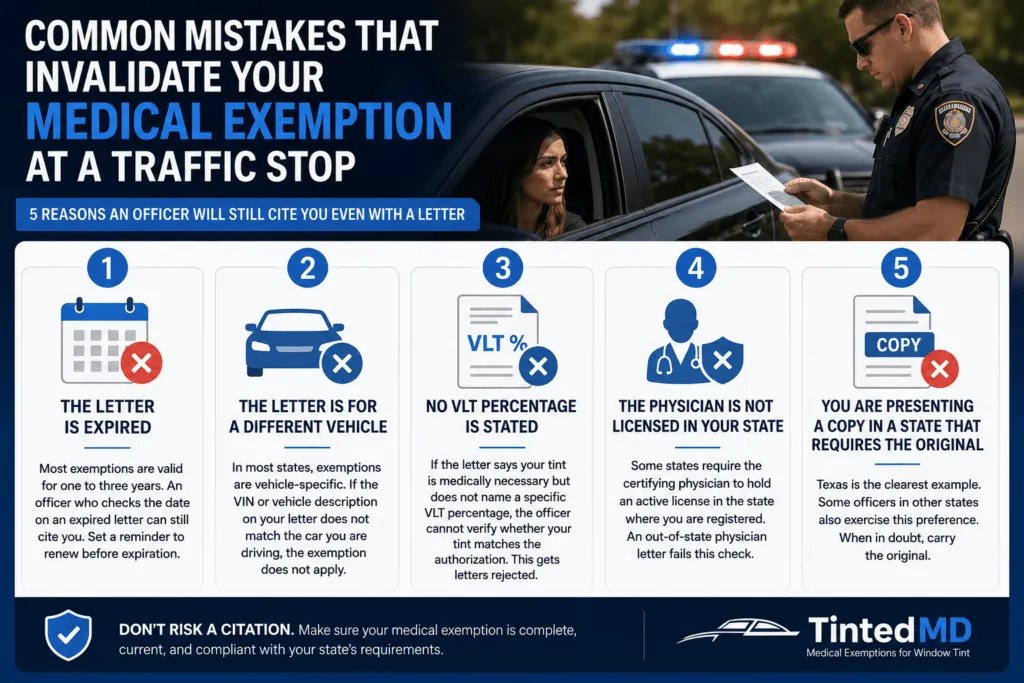
5 Reasons an Officer Will Still Cite You Even With a Letter
-
The letter is expired: Most exemptions are valid for one to three years. An officer who checks the date on an expired letter can still cite you. Set a reminder to renew before expiration.
-
The letter is for a different vehicle: In most states, exemptions are vehicle-specific. If the VIN or vehicle description on your letter does not match the car you are driving, the exemption does not apply.
-
No VLT percentage is stated: If the letter says your tint is medically necessary but does not name a specific VLT percentage, the officer cannot verify whether your tint matches the authorization. This gets letters rejected.
-
The physician is not licensed in your state: Some states require the certifying physician to hold an active license in the state where you are registered. An out-of-state physician letter fails this check.
-
You are presenting a copy in a state that requires the original: Texas is the clearest example. Some officers in other states also exercise this preference. When in doubt, carry the original.
All five of these failure points are addressed in TintedMD’s evaluation process. Physicians on the platform are licensed in the state where the patient applies, complete the VLT percentage field, and produce documentation formatted for each state’s specific stop requirements. Start your TintedMD evaluation today.
What Happens in Traffic Court for a Tinted Window Citation?
If you received a citation and need to appear in court, the process follows a standard pattern for equipment violations. Understanding it helps you prepare and present your medical exemption documentation most effectively.
Before Your Court Date
Gather every document that supports your case. This includes your physician letter or state-issued exemption certificate, proof the letter was valid on the date of the stop if applicable, the vehicle registration confirming the vehicle matches the exemption, your tint installer’s receipt showing the VLT of the film, and the citation itself with all officer notes.
If you obtained your medical exemption after the citation, bring it anyway. Even if it does not dismiss the existing ticket, a judge who sees that you took steps to become compliant often reduces the fine. Courts are primarily interested in whether you are now in compliance, not just in punishing past violations.
What to Say to the Judge
Keep it factual and brief. If you had a valid exemption but lacked it at the time of the stop: ‘Your Honor, I had a valid medical exemption on the date of the stop but did not have the document in the vehicle. I am presenting it now along with proof of the issue date, which predates the citation.’ If you did not have an exemption at all: ‘Your Honor, I have since obtained a medical exemption and am now in compliance. I am requesting a reduction in the fine.’
Do not argue the meter reading unless you have calibration records showing the meter was faulty. That evidence is difficult to obtain and rarely successful without prior documentation requests through the court’s discovery process.
Fix-It Ticket Dismissal at the Court Clerk Window
Many tint citations, especially first offenses, are issued as fix-it tickets that can be resolved before a court appearance. In these cases, you do not need to stand before a judge at all. Bring your valid medical exemption documentation to the court clerk window before your court date. In most jurisdictions, the clerk reviews the documentation, confirms the violation is addressed, and stamps the citation dismissed. A small administrative fee, typically $25 to $50, may apply. This is the fastest and least stressful path to resolving a tint citation when you have valid documentation.
What If the Judge Requires the Tint to Be Removed?
Some judges, particularly for drivers without a medical exemption at all, order the tint removed and require proof of removal before the case is closed. If this happens, get your medical exemption in place immediately through TintedMD, re-tint the vehicle to the authorized VLT level, and return to court with the exemption, the tint installer receipt, and a new VLT meter reading from the installer. Courts that see documented medical necessity typically work with the driver rather than against them.
How to Get Your Medical Exemption Before You Drive Again
If you do not have a medical exemption yet, or yours has expired or has problems, here is the fastest path to being covered.
Step 1: Check Whether Your Condition Qualifies
Common qualifying conditions include lupus, photophobia, albinism, xeroderma pigmentosum, melanoma and skin cancer history, dermatomyositis, vitiligo, porphyria, and severe drug photosensitivity. According to the overview of lupus and UV sensitivity, UV exposure is a documented trigger for lupus flares, which is why it is consistently recognized as a qualifying condition across nearly every state. Some states accept any condition a physician attests creates a medical need for UV protection. Colorado, Kansas, and Hawaii are the exceptions. TintedMD’s state eligibility check confirms your state’s qualifying conditions before you begin.
Step 2: Complete the TintedMD Online Evaluation
The evaluation is done entirely online. A licensed physician in your state reviews your condition through a telehealth consultation. No in-person visit. No travel. No waiting room. The physician determines whether your condition qualifies and completes your state-specific exemption documentation the same day.
Step 3: Receive and Store Your Documentation
Your signed physician letter is delivered digitally, same day. Print it. Keep the original in the glovebox. If your state requires a state form or certificate (such as Florida’s FLHSMV certificate or New York’s Form MV-80W), TintedMD’s documentation is formatted for that next step. Keep a photo of the letter on your phone as a secondary backup.
Step 4: State-Specific Follow-Up Where Required
For states that require submitting a form to a DMV or state agency after receiving the physician letter, that step can typically be done by mail. TintedMD’s documentation includes all required fields for those state-specific submissions. You are not starting the process from scratch after the evaluation. You are completing the last step.
Step 5: What If Your Letter Is Rejected at a Stop?
If an officer rejects your letter for a specific stated reason, such as a missing license number, contact TintedMD immediately. The money-back guarantee covers cases where valid documentation is rejected by a qualified reviewing authority. TintedMD can also issue a corrected letter addressing the specific deficiency the officer or court identified.
How TintedMD Is Different From an Online Letter Mill
Not all medical exemption letters are equal. The market includes websites that sell template letters with no physician involvement, no real evaluation, and no credentials that an officer can verify. These letters fail at traffic stops because officers can check physician license numbers against state medical board databases in real time. A license number that does not exist, belongs to a physician in a different state, or is inactive will be caught on the spot.
TintedMD connects you with physicians who are actively licensed in your state. The evaluation is a real clinical consultation, not a form you fill out and instantly receive a letter. The physician reviews your condition, asks relevant clinical questions, and determines whether your situation meets your state’s qualifying standard. That is what makes the document hold up when it matters most.
Over 100,000 patients have had their window tint exemption documentation completed through TintedMD. The platform is HIPAA-compliant, uses licensed physicians in every state it serves, and backs every letter with a money-back guarantee if the documentation is rejected by a qualified DMV or law enforcement authority.
What About Out-of-State Drivers?
Your home state’s medical exemption is valid in your home state. The moment you cross into another state, that state’s tint laws apply to your vehicle, and your home state exemption has no statutory standing there.
In practice, most officers will review a clearly documented out-of-state exemption and use discretion, especially for drivers passing through or on short trips. The exemption does not legally protect you in another state, but producing a well-documented letter is far better than producing nothing.
If you regularly commute across state lines or spend extended periods in another state, applying for a second exemption in that state is the safest approach. TintedMD serves all states that offer exemptions and can process applications for your commuting state separately from your home state.
What to Carry for Cross-State Travel
-
Your home state physician letter and exemption certificate
-
The physician’s contact information printed on the letter (officers can verify credentials during the stop)
-
An installer receipt showing the VLT of the film (this is universal evidence regardless of state)
-
A brief written statement from your physician explaining the medical need in plain language, alongside the formal letter
The Reality of Cross-State Stops
If you are stopped in another state, the officer will likely run your plates and see a registration from a different state. In most cases, this signals to the officer that you are passing through rather than residing there, which often works in your favor. An out-of-state driver with a well-documented medical exemption letter is far more likely to receive professional courtesy than one with no documentation at all.
The documentation package that works best for cross-state travel is: your home state physician letter and certificate, the physician’s NPI number (which can be verified against the federal NPPES registry by any officer with internet access), and a tint installer receipt showing the exact VLT percentage of the installed film. When the installer’s VLT matches what the physician authorized, you have a complete documented chain that is hard to dispute even in a state without a formal exemption reciprocity agreement.
If you spend significant time in multiple states due to work, family, or seasonal travel, TintedMD can process applications for each state separately. You would carry the relevant state’s documentation when driving in that state. This is the only approach that gives you full statutory protection in each jurisdiction you regularly travel.
Conclusion
Being pulled over for tinted windows is stressful, expensive, and entirely preventable if the right documentation is in your glovebox before it happens. A valid medical exemption signed by a licensed physician in your state, containing the required VLT percentage and physician credentials, is what separates a warning from a citation in every state that offers one.
The math is straightforward. A first tint citation typically runs $150 to $300 in fines plus a court date. A TintedMD window tint exemption letter starts at $89 and is delivered the same day. If you have a qualifying condition, the exemption costs less than the first ticket and protects you from every stop that follows.
Do not wait for the next set of red and blue lights. Get your medical exemption documentation at TintedMD and have it in your glovebox before you drive again. 100,000+ patients helped. Licensed physicians. Same-day delivery. Money-back guarantee.
Frequently Asked Questions
Can a medical exemption get my tinted window ticket dismissed?
If you had a valid medical exemption at the time of the stop and simply did not have it with you, most states allow a fix-it ticket process where producing the document results in dismissal. If you did not have an exemption at all when you were cited, getting one after the fact does not dismiss the ticket in most states. It does protect you from the next stop.
Do I need to show my exemption every time I get pulled over?
Yes. A medical exemption does not prevent a stop. An officer who sees dark tint can still pull you over. The exemption resolves the stop once you produce it. This is why it must be in the vehicle every time you drive, not just on days you remember it.
What happens if the officer says my exemption is not valid?
Ask the officer to identify specifically what is missing or incorrect. Common issues are an expired date, a missing VLT percentage, or a physician whose license the officer cannot verify. Note the officer's stated reason. If you believe your document is valid, contest the citation in court and bring the documentation with supporting evidence of the physician's credentials.
Can I get a medical exemption after already getting a ticket?
Yes, and you should. Getting a medical exemption after a citation does not dismiss the existing ticket in most states, but it prevents the next citation. If you have a condition that qualifies, you should have had the exemption before the stop. Get it now and make sure it is in your vehicle before you drive again.

Meet the author
Nida Hammad
I am a professional writer with over five years of experience creating clear, engaging, and well-researched content. I specialize in medical window tint exemptions and state compliance topics, helping readers understand tint laws and exemption requirements in simple, easy-to-follow language. Currently, I write for TintedMD, where I focus on producing accurate, trustworthy guides to help drivers navigate the medical tint exemption process with confidence.
Get Your Medical Tint Exemption Online in Minutes
Check Your Eligibility