
Renew Your Texas Window Tint Exemption in 2026 — Same-Day Letter, No DMV Visit, Drive Legal Tomorrow
 by Nida Hammad
 Last updated:
Medically reviewed by:
Dr. Matthew Reynolds, MD


Renewing your Texas window tint exemption is simpler than most drivers expect — and faster than any DMV appointment. Texas does not use a state form, does not issue official certificates, and does not require you to visit any government office. The only document you need is a signed physician letter in your glove box. This guide covers when to renew, what changed after the 2025 inspection law, the current Texas tint standards, and how to get a new physician letter the same day without leaving home.
How to Renew Texas Window Tint Exemption: The Step-by-Step Process
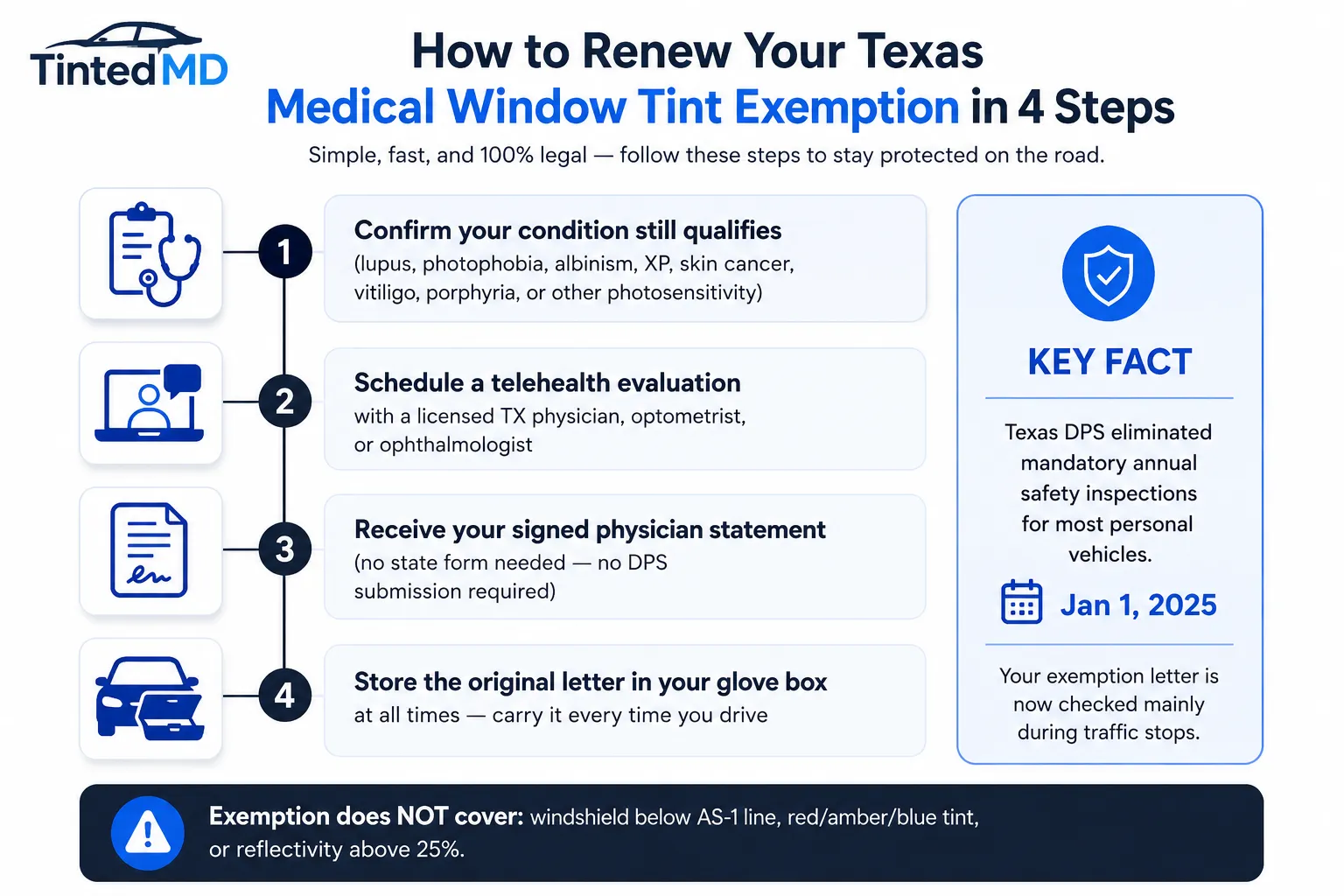
Renewing your exemption involves only you and your healthcare provider. Texas does not have an online renewal system for this process. You do not need to send forms to the state.
Step 1: Make Sure Your Medical Condition Still Qualifies
Texas law allows window tint exemptions for people who need protection from direct sunlight because of a medical condition. These conditions can include lupus, albinism, photophobia, xeroderma pigmentosum, vitiligo, porphyria, a history of skin cancer, and other conditions that make skin or eyes sensitive to sunlight. Your healthcare provider must confirm that your condition is still active and that darker tint is still medically necessary.
Step 2: Schedule a Medical Checkup
Contact your doctor, optometrist, or ophthalmologist for an evaluation. Texas accepts telehealth visits, so you can do this online from home. The provider will review your condition and decide if darker window tint is still medically necessary.
Step 3: Get a New Signed Doctor’s Letter
The Texas Department of Public Safety states that vehicles may be equipped with front window tint darker than the standard 25% requirement if a motorist has a medical exception. To qualify, you must obtain a signed medical exemption statement from a licensed physician or optometrist. The statement must identify the driver or occupant with reasonable specificity and declare that the darker tint is necessary to safeguard their health. You must present this signed doctor’s statement during any vehicle inspection and keep it inside the vehicle to show law enforcement during a traffic stop.
Step 4: Keep the Original Letter in Your Car
Store the original signed letter in your glove box. Some police officers may not accept copies. A photo on your phone is also not sufficient. Always carry the original letter while driving.
That is the complete process. You do not need a DMV appointment. You do not send forms to the state. You do not receive a sticker or certificate from any government agency.
If you want the full picture before you start, see Texas medical tint exemption requirements for a complete breakdown of who qualifies and what’s needed.
When to Renew Texas Window Tint Exemption Documentation
Texas does not give a fixed expiration date for medical window tint exemptions. However, there are clear situations when renewal is needed.
Your Doctor’s Letter Is Dated
Your doctor’s letter includes a date. Even though Texas does not require regular renewal, police officers or inspection stations may question a very old letter. A letter signed many years ago may not reflect your current medical condition or your doctor’s latest opinion. Updating your letter every one to two years helps avoid problems at traffic stops.
Your Condition or Treatment Has Changed
You may need a new letter if your medical condition or treatment has changed. Your old letter may no longer explain your current health needs correctly. A new medical checkup gives you updated documents that match your condition today.
Your Previous Doctor Is No Longer Practicing
If your old healthcare provider has retired or no longer holds a license, your letter could be rejected. Inspection officers can check the doctor’s National Provider Identifier (NPI) number in the federal system.
You Changed Vehicles
If you buy a new vehicle, you may also need updated paperwork. In Texas, the exemption belongs to the driver, not the car. This means your exemption stays with you. But if you install dark tint on a new car, the tint shop may ask to see current medical documents.
If you are ready to renew your physician documentation today, TintedMD connects you with licensed medical providers who handle Texas tint exemption evaluations entirely online.
What the Texas Inspection Law Change Means for Your Exemption
The biggest change for Texas medical window tint exemption holders in 2025 and 2026 is that most personal vehicles no longer need yearly safety inspections. Under Texas House Bill 3297, non-commercial vehicles do not need a safety inspection when renewing registration starting January 1, 2025.
Before this change, the yearly safety inspection was the main time your doctor’s letter was checked. Now that yearly check is gone for most drivers.
Your Exemption Letter Is Less Likely to Be Reviewed at Inspection
Most car owners do not go through a yearly safety check anymore. Your doctor’s letter is now more likely to be checked only if you are stopped by police on the road.
Emissions Testing Still Applies in Some Counties
Some Texas counties require an annual emissions test for non-commercial gasoline vehicles (ages 2 through 24 years old) before they can be registered. Affected areas include Harris, Dallas, Tarrant, Travis, and Williamson counties, among several others.
Under the Texas DPS Vehicle Inspection Program, comprehensive vehicle safety inspections have been completely eliminated for non-commercial vehicles, meaning inspectors will no longer check items like window tinting or require medical exemptions for it. However, annual emissions testing rules still apply to these counties. Beginning November 1, 2026, Bexar County (San Antonio) will be added to the list of required emissions testing regions.
Police Checks Have Not Changed
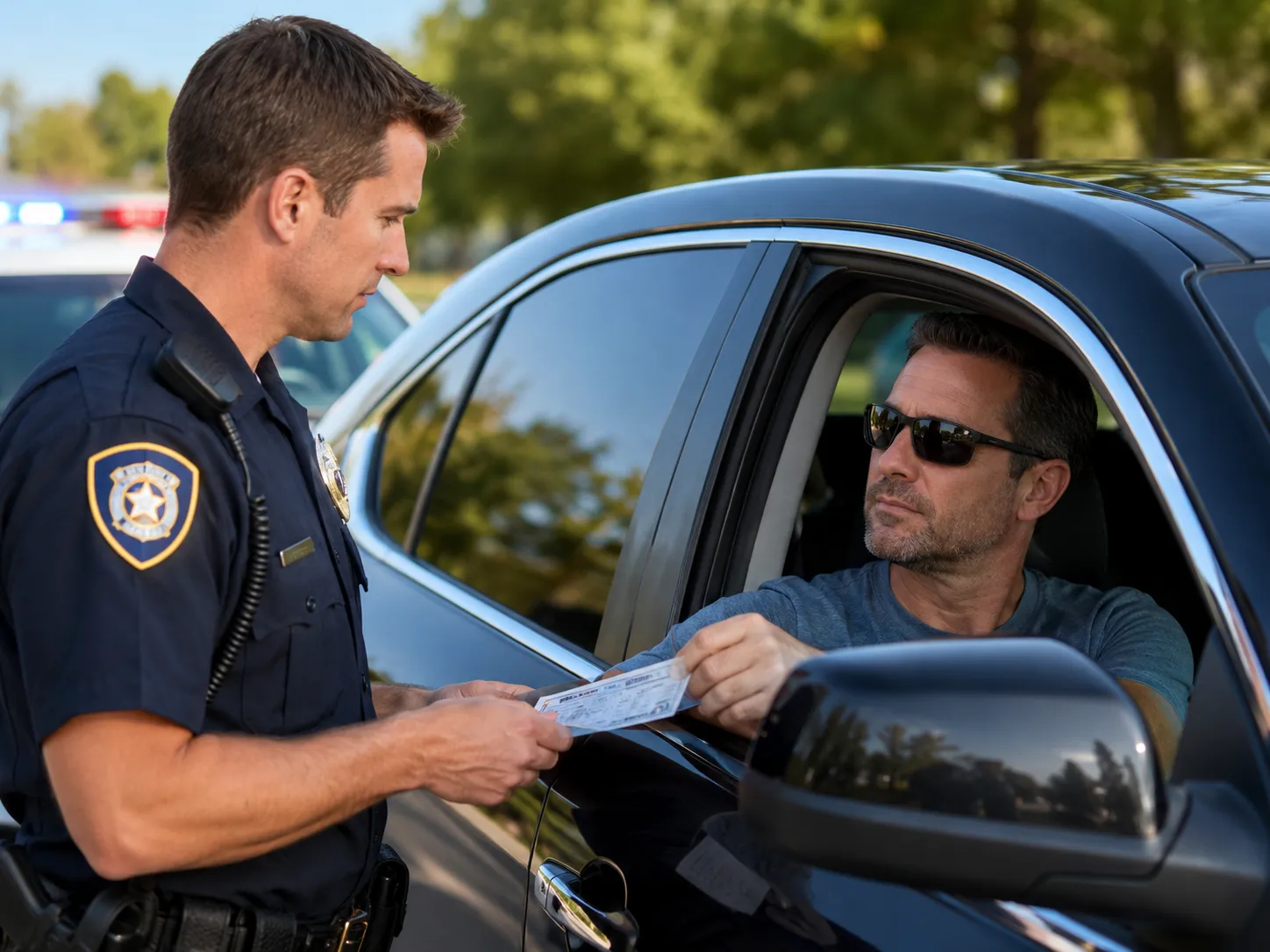
Police officers can still stop you if they think your window tint is too dark. Texas Transportation Code Section 547.613 is still active and has not changed. Whether your tint is legal or not is decided by law enforcement and the courts, not inspection stations.
Even though there are fewer inspections now, you still need a current doctor’s letter in your car at all times.
How to Renew a Texas Window Tint Exemption and Understand State Standards
- The Texas DPS window tint rules state that front side windows must let in at least 25% of light and cannot reflect more than 25% of light.
- A medical exception allows a motorist to have the two front side windows tinted darker than the 25% requirement. To qualify, the driver must keep a signed medical statement from a licensed physician or optometrist inside the vehicle.
- This exception only applies to light transmittance and does not alter the rules regarding prohibited tint colors (red, amber, or blue) or luminous reflectance limits.
- With a medical exemption, doctors usually allow tint between 20% and 35% light transmission on the front side windows. The exact level depends on how serious the medical condition is and the doctor’s judgment.
- The exemption only allows the specific tint level written in the doctor’s letter. The person installing the tint must use a film that matches that exact number.
| Window Position | Standard TX Limit (VLT) | With Medical Exemption | Notes |
|---|---|---|---|
| Front side windows (driver and passenger) | 25% minimum | Below 25% if medically necessary | Most common area affected by exemption |
| Windshield (above AS-1 line or top 5 inches) | 25% minimum, non-reflective | Darker tint in upper strip only | No exemption applies below the AS-1 line |
| Windshield (below AS-1 line) | No tinting allowed | No exemption applies | Exemption cannot override this rule |
| Rear side windows (behind driver) | No restriction | No restriction | No exemption needed |
| Rear window | No restriction if dual mirrors present | No restriction | No exemption needed |
| Reflectivity (all windows) | 25% maximum luminous reflectance | Must still comply | Exemption does not override reflectivity rules |
| Color restrictions (all windows) | No red, amber, or blue tint | Must still comply | Exemption does not override color rules |
Source: Texas DPS Window Tinting Standards; Texas Transportation Code Section 547.613
How Telehealth Works for Renewal of Texas Medical Tint Exemption
Texas allows online doctor visits to get a medical tint exemption. You do not need to go to a clinic in person. A doctor, eye doctor, or specialist licensed in the U.S. can do a video visit and write a valid exemption letter if it follows Texas telemedicine rules.
This is helpful for people who have strong light sensitivity, trouble traveling, or busy schedules. The process works like this:
- Complete a brief online intake form describing your condition and driving needs.
- A licensed healthcare provider reviews your information for medical accuracy and compliance with state requirements.
- If approved, you receive a signed physician statement ready for use during traffic stops and inspections.
Most reviews are completed in 24 to 48 hours. The final document is formatted to meet Texas DPS requirements. You do not need a referral. You usually do not need old medical records unless the doctor asks for them. The focus is on your current symptoms and need for tint.
Common Mistakes When Renewing a Texas Window Tint Exemption
1. Carrying a photocopy instead of the original
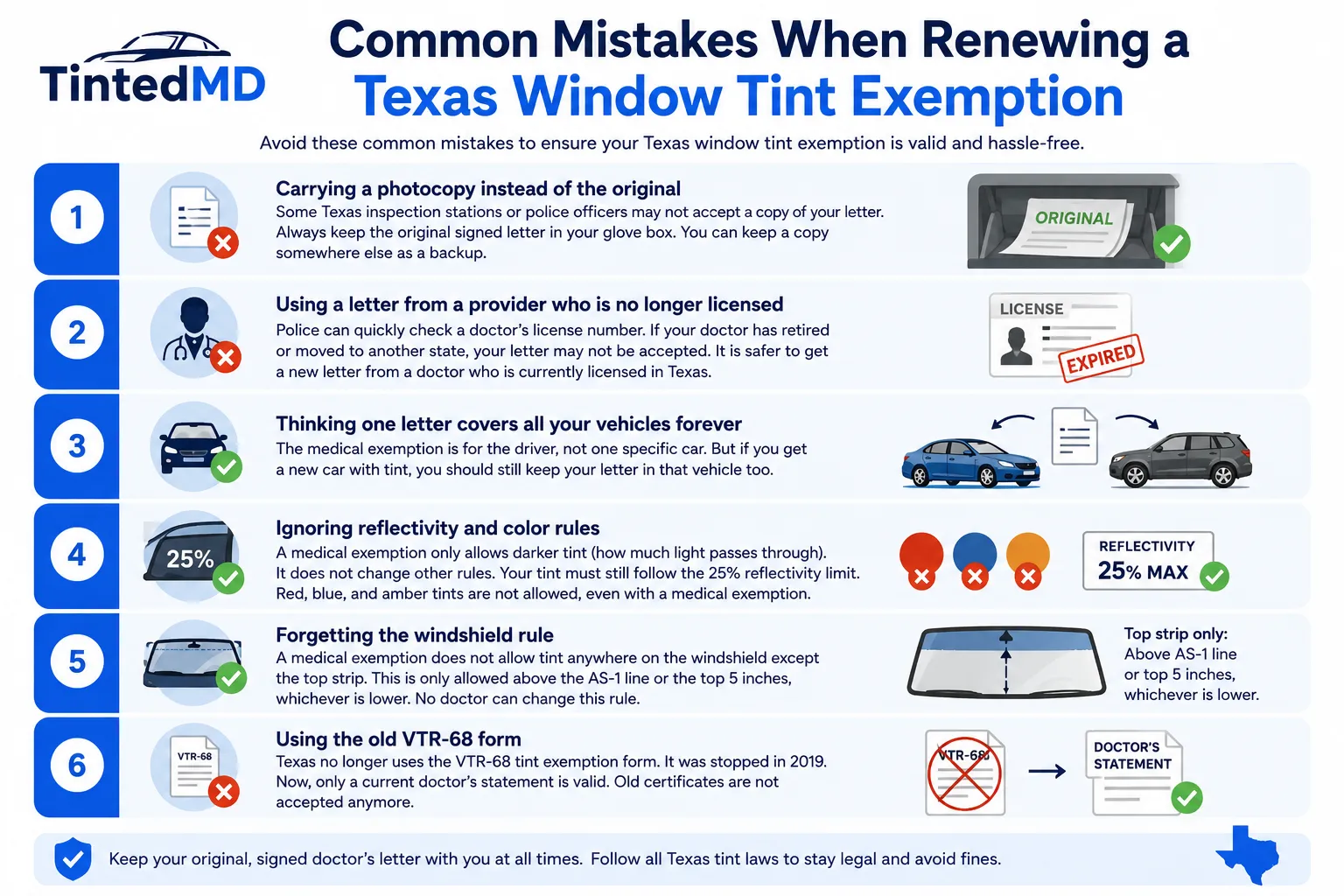
Some Texas inspection stations or police officers may not accept a copy of your letter. Always keep the original signed letter in your glove box. You can keep a copy somewhere else as a backup.
2. Using a letter from a provider who is no longer licensed
Police can quickly check a doctor’s license number. If your doctor has retired or moved to another state, your letter may not be accepted. It is safer to get a new letter from a doctor who is currently licensed in Texas.
3. Thinking one letter covers all your vehicles forever
The medical exemption is for the driver, not one specific car. But if you get a new car with tint, you should still keep your current letter in that vehicle.
4. Ignoring reflectivity and color rules
A medical exemption only allows darker tint — how much light passes through. It does not change other rules. Your tint must still follow the 25% reflectivity limit. Red, blue, and amber tints are not allowed even with a medical exemption.
5. Forgetting the windshield rule
A medical exemption does not allow tint anywhere on the windshield except the top strip above the AS-1 line or the top 5 inches, whichever is lower. No doctor can change this rule.
6. Using the old VTR-68 form
Texas no longer uses the VTR-68 tint exemption form. It was discontinued in 2019. Now, only a current doctor’s statement is valid. Old certificates are not accepted.
Conclusion
To renew your Texas medical window tint exemption, you must keep a current, signed doctor’s letter in your vehicle. Texas does not issue official state forms or certificates. Your doctor’s letter is your proof.
Because most personal vehicles no longer need safety inspections, this letter is now mainly checked during traffic stops rather than inspection stations. Texas Transportation Code Section 547.613 is still active, and you must always carry your proof.
If your medical condition continues, update your doctor’s letter every one to two years. Get a new letter if you change doctors, change your tint level, or if your health condition changes.
Renew your Texas tint exemption onlineand get your physician letter in 24–48 hours.
Frequently Asked Questions
Does Texas require renewing tint waiver on a fixed schedule?
No. Texas does not set a fixed renewal time for medical tint exemptions. There is no official 1-year or 2-year expiry. But old letters may be questioned by officers. It is best to update your letter every 1 to 2 years or when your health changes.
What is the Texas window tint exemption expiration rule?
There is no official expiration date from the state. Your exemption stays valid as long as your medical condition is still present and your doctor's letter is up to date. It may become invalid if the letter is very old or your doctor is no longer practicing.
What form do I need for Texas medical tint renewal?
Texas no longer uses a special state form. A signed letter from a licensed doctor, eye doctor, or specialist is enough. The letter must include your name, the medical need for darker tint, and the provider's license details.
Can I use a telehealth provider for Texas medical tint renewal?
Yes. Texas accepts online doctor visits. The doctor must be licensed in the U.S. and follow Texas telehealth rules. The signed letter from an online visit is legally valid.
Will the new Texas inspection law affect my exemption?
Yes, partly. Since most personal vehicles no longer need yearly safety inspections starting January 1, 2025, your letter will be checked less at inspection stations. But police can still check tint rules during traffic stops, so you must always carry your letter.
Does a Texas medical exemption work in other states?
No. A Texas exemption is not automatically valid in other states. Each state has its own rules. If you travel, check the tint laws for that state before driving with dark tint.
What happens if I get a ticket even with a valid exemption?
You should show your doctor's letter in court to fight the ticket. Even if you passed inspection, you can still be ticketed. The final decision is made by law enforcement or the court. A current doctor's letter is your strongest proof.

Meet the author
Nida Hammad
I am a professional writer with over five years of experience creating clear, engaging, and well-researched content. I specialize in medical window tint exemptions and state compliance topics, helping readers understand tint laws and exemption requirements in simple, easy-to-follow language. Currently, I write for TintedMD, where I focus on producing accurate, trustworthy guides to help drivers navigate the medical tint exemption process with confidence.
Get Your Medical Tint Exemption Online in Minutes
Check Your Eligibility