Window Tint Exemption for New Car: Get Your New Vehicle Legally Covered Today
 by Nida Hammad
 Last updated:
Medically reviewed by:
Dr. Matthew Reynolds, MD


In most states, a medical window tint exemption does not automatically transfer to a new car. You may need a new or updated exemption document tied to the new vehicle, even if your medical condition has not changed. Some states use vehicle-specific certificates, while others rely on physician documentation. Requirements vary by state, so confirm your state’s process before tinting your new vehicle.
You have a qualifying medical condition. You went through the process, got your physician letter, submitted the right form, and got your window tint exemption approved. Your car had legal dark tint, and you could drive with protection. Then you bought a new car — and now you are wondering whether your window tint exemption for a new car carries over automatically.
In most states, it does not. A window tint exemption is tied to a specific vehicle, not to you as a driver. When the vehicle changes, the exemption does not follow. This guide explains exactly how medical tint exemption vehicle change rules work, which states require full reapplication, which states allow some portability, what happens if you drive your new car with dark tint before the new exemption is in place, and how to get your new vehicle covered as fast as possible. If you need to start now, TintedMD’s same-day evaluation covers all qualifying states.
Why Window Tint Exemptions Are Tied to the Vehicle, Not the Driver
Understanding why most states issue exemptions on a per-vehicle basis helps explain the reapplication requirement. The medical tint exemption system was designed to allow DMV reviewers and law enforcement officers to verify that a specific car on the road has documented authorization for its specific tint level.
When a state DMV issues a formal exemption permit, decal, or certificate for a vehicle, that document is connected to the vehicle’s registration record. An officer who stops a dark-tinted car can check the vehicle’s record and see the active exemption. If the exemption were attached to the driver rather than the car, an officer pulling over any dark-tinted vehicle would have no way to verify the authorization without asking the driver.
This system design explains why buying a new car resets the exemption. Your medical condition has not changed. Your need has not changed. But the vehicle, its registration record, and the authorization attached to that record all changed the moment you drove off the lot.
The Two Types of Exemption Systems
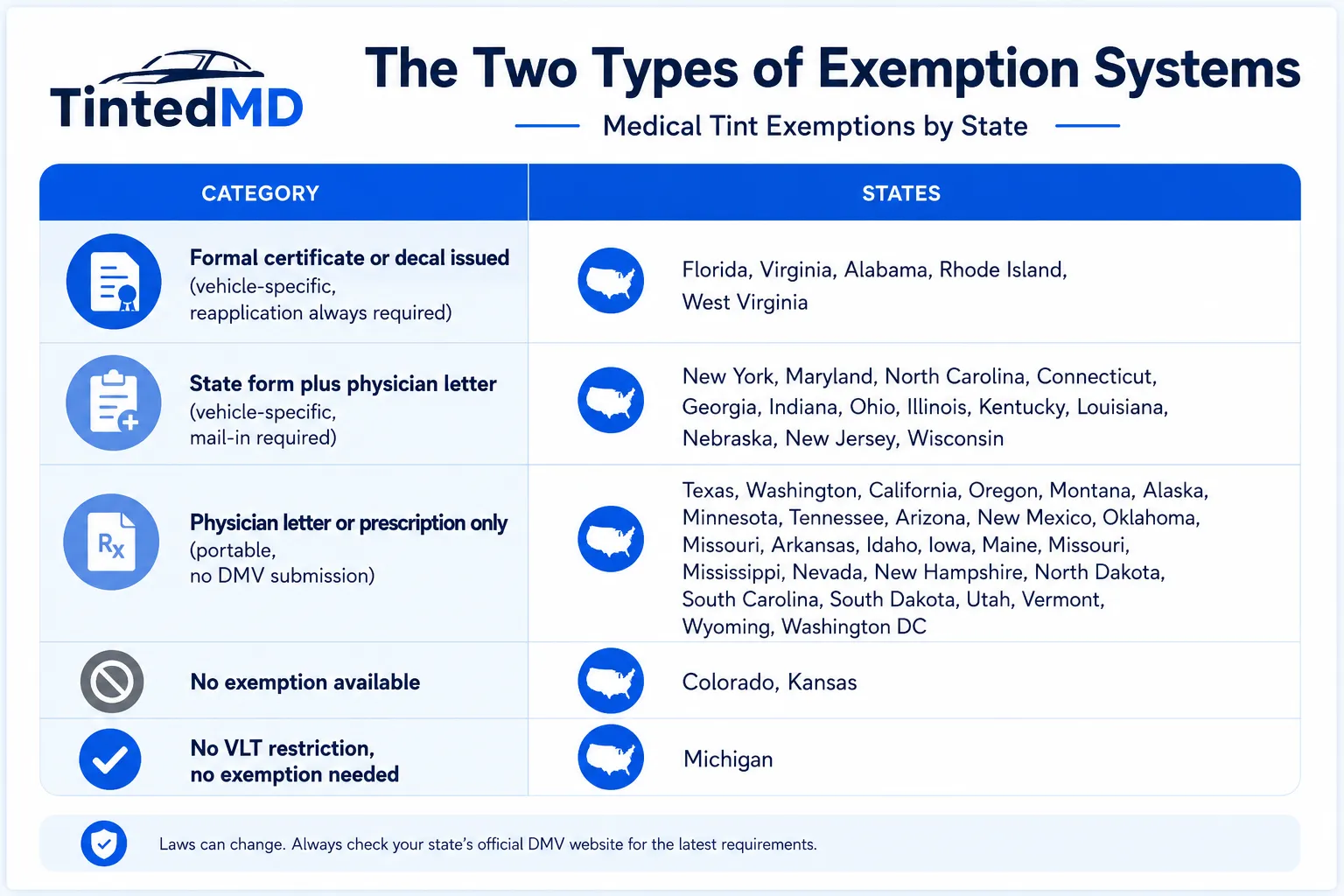
| Category | States |
|---|---|
| Formal certificate or decal issued (vehicle-specific, reapplication always required) | Florida, Virginia, Alabama, Rhode Island, West Virginia |
| State form plus physician letter (vehicle-specific, mail-in required) | New York, Maryland, North Carolina, Connecticut, Georgia, Indiana, Ohio, Illinois, Kentucky, Louisiana, Nebraska, New Jersey, Wisconsin |
| Physician letter or prescription only (portable, no DMV submission) | Texas, Washington, California, Oregon, Montana, Alaska, Minnesota, Tennessee, Arizona, New Mexico, Oklahoma, Missouri, Arkansas, Idaho, Iowa, Maine, Mississippi, Nevada, New Hampshire, North Dakota, South Carolina, South Dakota, Utah, Vermont, Wyoming, Washington DC |
| No exemption available | Colorado, Kansas |
| No VLT restriction, no exemption needed | Michigan |
Do I Need to Reapply for a Tint Exemption on a New Car?
In most states, yes. Here is the state-by-state breakdown of the most important cases.
States Where Reapplication Is Always Required
In states that issue formal certificates, decals, or permit stickers, the exemption is explicitly vehicle-specific. The documentation for your old car does not transfer. Your exemption certificate is void the moment you sell or otherwise transfer the vehicle. You must submit a new application with new vehicle information before driving the new car with dark tint.
- Florida: Submit Form HSMV 83390 with a physician certification to the Florida DHSMV. The certificate is non-transferable to a new vehicle. A new application referencing the new vehicle is required. Note: Some Florida guidance states the certificate travels with the patient, not the vehicle. Confirm the current requirement with FLHSMV before applying.
- Virginia: Virginia’s DMV-issued decal is tied to the specific vehicle. A new decal requires a new application and a new physician letter submitted by mail.
- Alabama: Alabama’s ALEA-issued numbered decal is vehicle-specific. Reapplication required for any vehicle change.
- Rhode Island: The RI DMV issues a decal sticker for the driver’s side window of the specific vehicle. The decal does not transfer.
- West Virginia: WV DMV-issued decal is vehicle-specific. New application required.
- California: Under CVC 26708.2, the exemption is a physician or optometrist signed certificate on official letterhead, carried in the vehicle. There is no state form and no DMV mail submission. The physician’s letter is the full exemption document. For a new vehicle, obtain a new or updated physician letter referencing the new car.
- New York: Form MV-80W is vehicle-specific. A new form endorsed by your physician must be mailed to the NY DMV for the new vehicle.
- Oregon: Form 735-6513 is vehicle-specific. Submit a new form for the new vehicle.
States Where the Physician Letter May Be Portable
In states where the exemption consists only of a physician’s letter carried in the vehicle, there is more potential for portability. These states do not tie the exemption to a VIN or vehicle registration record. The letter documents the patient’s medical need, and some states allow that letter to apply to any vehicle the patient regularly drives.
- Texas: Texas requires a physician’s letter on official letterhead submitted to DPS. Some guidance suggests the letter is patient-based rather than vehicle-based, but the safest approach for a window tint exemption for a new car in Texas is to obtain a new letter referencing the new vehicle.
- Washington State: Washington accepts a physician letter or notarized affidavit plus a tint installer VLT certificate. The letter references the patient’s condition, not a specific vehicle VIN. Portability is more likely in Washington than in certificate states.
- Montana: Montana uses a physician affidavit carried in the vehicle. The affidavit is renewed every two years. Vehicle changes do not automatically void it in all cases, but confirming the current vehicle is referenced is best practice.
- Tennessee, Alaska, Minnesota: These states use physician letters or affidavits without formal state permits. Letters are carried in the vehicle and may be portable, but best practice is to update the letter to reference your current vehicle.
Do Not Assume Portability Without Confirming
Even in physician-letter states where portability is more likely, driving a new car with dark tint on the strength of an old exemption letter that references your previous vehicle creates real risk. If the letter does not match the vehicle you are driving, an officer or DMV reviewer has grounds to question the exemption’s validity. The safest approach in any state is to get a new or updated exemption letter referencing your new vehicle before tinting it.
Does Buying a New Car Mean You Need a New Medical Evaluation?
Not necessarily. Changing vehicles and proving medical eligibility are separate parts of the exemption process. Your state may require a new or updated exemption document for the new vehicle even when your underlying medical condition has not changed.
Depending on your state, you may need updated physician documentation, a new state form, or a new exemption letter that identifies the new vehicle. Other states may allow more portability when the exemption is based primarily on a physician letter.
If your medical condition has changed since your previous exemption, your documentation may also need to reflect that change. Understanding the medical conditions that qualify for a window tint exemption can help you determine whether your current medical need may support an exemption and what documentation may be relevant.
Before assuming your previous paperwork is enough, check your state’s requirements for both the new vehicle and your medical documentation.
What Happens If You Drive Your New Car With Dark Tint Before Reapplying?
This is the most practical risk in a medical tint exemption vehicle change situation. You bought a new car, had it tinted at your authorized level, and have not yet completed the reapplication process for the new vehicle. You are now driving with dark tint that is not covered by a valid exemption.
The legal exposure depends on your state. In states with formal vehicle-specific exemption certificates, driving a new car with dark tint and no current valid exemption for that vehicle is treated the same as driving with illegal tint. In Florida, the Florida DHSMV Procedure RS-48 explicitly states that the medical exemption certificate becomes invalid upon the sale or transfer of the vehicle. An officer who stops you and cannot verify an active exemption for that vehicle can issue a citation. Under Florida Statute 316.2954, a window tint violation is a noncriminal traffic infraction punishable as a nonmoving violation — no points on your license, but a fine and a fix-it order that requires you to resolve the tint situation before the deadline.
The good news: physician documentation for a window tint exemption new car application is typically ready the same day. For states where the physician letter alone is the exemption document, you can be covered the same day you apply. For states requiring a DMV mail-in process, you have the physician letter immediately and the state processing adds days to weeks. In the interim, the physician letter demonstrates your medical need even before the formal state certificate is issued.
Can You Tint a New Car Before Your Exemption Is Approved?
It depends on how your state recognizes medical tint exemptions, but tinting a new vehicle before you have the required exemption documentation can create unnecessary compliance risk.
If your state requires a DMV-issued certificate, decal, or approval before the darker tint is legally authorized, installing the tint first may leave you driving a vehicle that is not yet covered by an active exemption.
The safer approach is to start the exemption process as soon as you have the new vehicle’s information and confirm when your state considers the exemption effective. If your state uses a physician letter as the exemption document, follow that state’s requirements for when the letter becomes valid and what you must carry in the vehicle.
Having a medical need does not automatically make darker tint legal on a new vehicle. The exemption must meet your state’s requirements before you rely on it.
How to Get a Window Tint Exemption for Your New Car
The process for a new car exemption is almost identical to the original application. Your medical condition has not changed, so the evaluation is usually faster the second time. Here is the complete process.
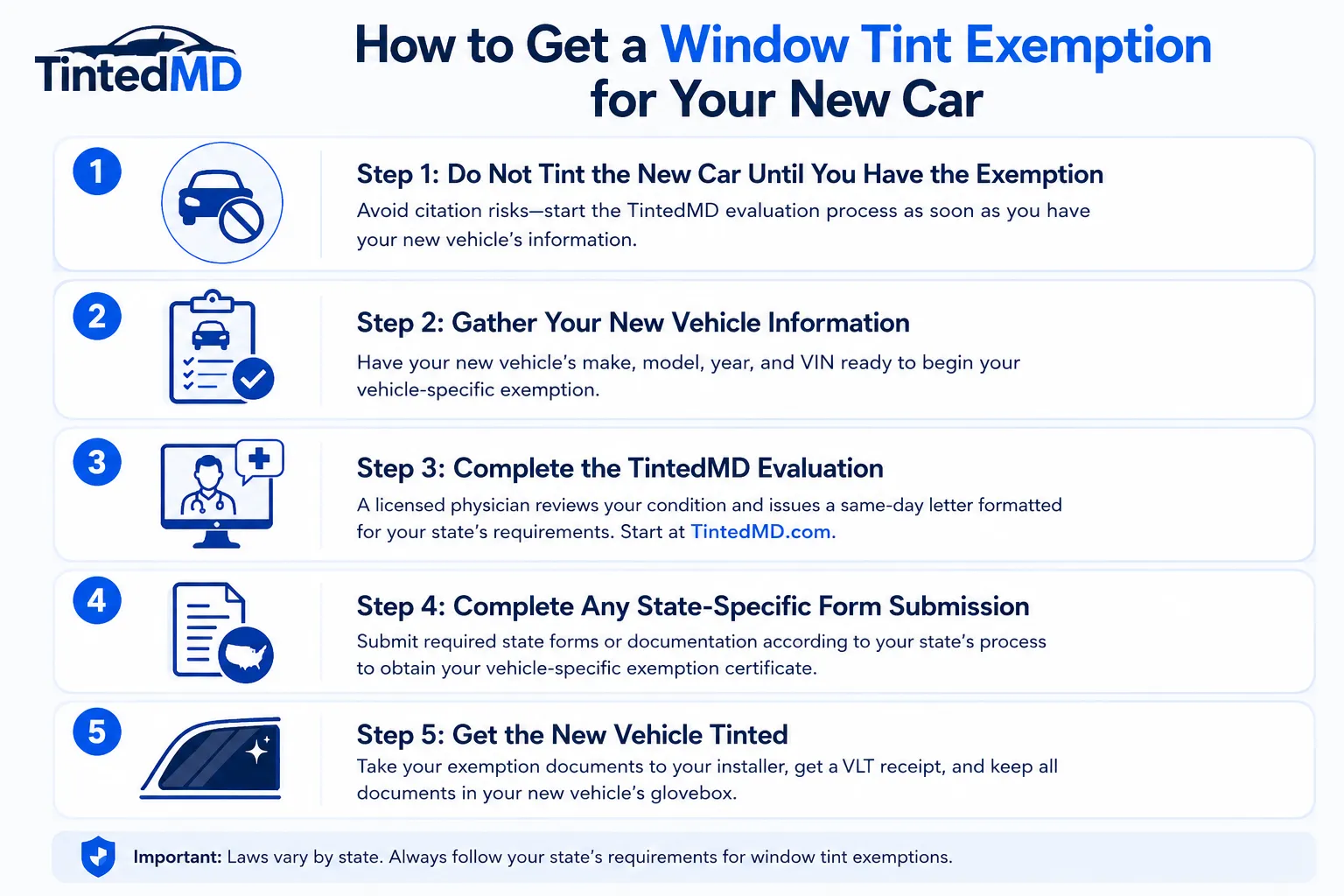
Step 1: Do Not Tint the New Car Until You Have the Exemption
In states requiring formal DMV certification, tinting your new car before the exemption is in place creates citation risk. Start the evaluation process as soon as you have the new vehicle’s information. In most states, same-day physician documentation means you can have the exemption letter before the car ever goes to the installer.
Step 2: Gather Your New Vehicle Information
For the medical tint exemption vehicle change application, you need the new vehicle’s make, model, year, and VIN. You do not need to submit your full medical file again. Returning patients can reference prior evaluations while completing a new vehicle-specific letter.
Step 3: Complete Your Evaluation
A licensed physician in your state reviews your qualifying condition and completes a new physician letter referencing your new vehicle. For window tint exemption new car applications, the letter is formatted for your state’s specific requirements, including any state forms that must be attached. Documentation is delivered the same day. Start at TintedMD.com.
Step 4: Complete Any State-Specific Form Submission
- California: Under CVC 26708.2, no state form exists and no DMV submission is required. The exemption is a signed physician or optometrist certificate on official letterhead, carried in the vehicle at all times. For a new vehicle, obtain a new or updated physician letter. The process is same-day. No mailing, no waiting period.
- Florida: Submit Form HSMV 83390 to FLHSMV by mail with your physician certification and a copy of your vehicle registration. The state issues back Form HSMV 83391 — the exemption certificate. The certificate is vehicle-specific and becomes invalid upon sale or transfer of the vehicle. A new application is required for each new vehicle.
- New York: Mail three items to NY DMV together: the completed Form MV-80W, a photocopy of your NYS vehicle registration, and a copy of the NYS professional license of the physician, physician assistant, or nurse practitioner who completed page 2 of the form. All three are mandatory. Missing any one item will delay processing.
- Texas: New physician letter on official letterhead referencing the new vehicle, submitted to Texas DPS. Carry the original in the vehicle at all times. No photocopies accepted.
- Physician-letter states: New letter referencing the new vehicle. Keep it in the glovebox. Process complete same-day.
Step 5: Get the New Vehicle Tinted
Take your exemption documentation to your installer. Show them the authorized VLT from your new letter. Get a post-installation VLT measurement receipt. Keep the receipt, physician letter, and any state certificate in the glovebox of the new vehicle. Do not carry documents from the old vehicle in the new one. If the documents reference a different VIN, they do not protect the new vehicle.
Get Your New Vehicle Covered. Start Your Online Medical Evaluation.
What to Do With Your Tint Exemption When Selling Your Old Car
When you sell or trade in a vehicle that has authorized medical tint, the transfer window tint exemption question works in two directions. The exemption you held for the old car does not follow you to the new one. But what happens to the tint on the car you are selling?
The Tint Stays, the Exemption Does Not
The window tint film physically remains on the vehicle when you sell it. The new owner inherits the dark tinted windows — but they do not inherit your medical exemption. Your exemption was based on your qualifying medical condition and it is personal to you. The new owner of the vehicle either needs their own qualifying condition and exemption, or they will need to have the tint removed or lightened to comply with the standard legal VLT limit for that state.
In states with formal vehicle-specific exemption systems, your exemption certificate becomes void the moment you transfer the vehicle. Any officer who stops the new owner for dark tint will find no active exemption in the vehicle records. The new owner cannot use your old physician letter or certificate.
Disclosing Tint to Buyers
When selling a vehicle with tint that is darker than the standard legal limit, the responsible approach is to disclose this to the buyer. Inform them that the vehicle has medical-exemption-level tint that is darker than standard, that your exemption does not transfer to them, and that they will need their own qualifying condition and exemption or will need to remove or replace the film.
What Documents Should You Keep in Your New Car?
Once your new vehicle’s exemption is active, keep the documentation required by your state in the vehicle. Depending on the exemption system, this may include:
- A physician’s letter or medical certification
- A state-issued exemption certificate or decal
- A completed state exemption form
- Vehicle registration or other required vehicle documentation
- Any tint or VLT documentation required by your state
The exact documents vary by state. Some states rely on a physician letter carried in the vehicle, while others issue a separate certificate, decal, or approval document.
Make sure the paperwork corresponds to your current vehicle. If your documents reference your previous vehicle, do not assume they automatically protect the new one. Check your state’s requirements before relying on older documentation.
Conclusion
The window tint exemption new car rule is consistent across the vast majority of states: your exemption does not automatically transfer. In states with formal certificates and decals, the exemption is void when the vehicle changes. In physician-letter states, the letter should reference the current vehicle to be fully protected.
The practical solution is straightforward. Before tinting your new car, start a TintedMD evaluation. Your qualifying condition is already established. The physician produces a new vehicle-specific letter the same day. In most states, that letter is the full exemption document and you are covered before the car goes to the installer. In states requiring DMV submission, the letter goes in the glovebox immediately while the formal state process completes.
TintedMD has handled thousands of medical tint exemption vehicle change applications. Same-day physician documentation. Money-back guarantee. Licensed physicians in your state. Get your new vehicle’s Texas tint exemption before the installer touches your windows.
Stay Ahead of Your Renewal. Start Your Online Medical Evaluation
Frequently Asked Questions
Does my window tint exemption automatically carry over to my new car?
In most states, no. Window tint exemptions are tied to the vehicle's VIN and registration, not the driver. When you get a new car, the old exemption is no longer valid for the new vehicle. Some physician-letter-only states have more flexibility, but reapplying for the new vehicle is always the safest approach.
Do I need a new doctor's evaluation, or can I use my previous records?
Your medical condition has not changed, so you do not need a completely new clinical evaluation in most cases. The process for a medical tint exemption vehicle change is typically faster than the original because your qualifying condition is already established. The physician reviews your current situation and completes a new vehicle-specific letter.
How long does reapplication take for a new car?
The physician letter for a window tint exemption new car is ready the same day. In states where the physician letter is the full exemption document, you are covered same-day. In states requiring DMV mail-in submission such as California, New York, Florida, and Oregon, add the state processing time of typically two to four weeks. During state processing, your physician letter documents your medical need.
Can the new owner of my old car use my exemption?
No. Your exemption is personal to you. The new owner of your old car cannot use your physician letter or certificate. Your exemption becomes void when you transfer the vehicle. The new owner will need their own qualifying condition and a new exemption application if they want to keep the dark tint legally.
What if I lease my car and switch to a new lease?
The same rules apply. A window tint permit per vehicle is tied to the specific vehicle's VIN regardless of whether you own or lease it. When your lease ends and you take a new vehicle, you need a new exemption for the new car. The lease return process may also require you to remove dark tint that exceeds the standard legal limit unless the new lessee has their own exemption.
What if I move to a different state and get a new car there?
This is a double reapplication situation. Your old state's exemption is not recognized in the new state, and the new car requires its own window tint exemption application under the new state's rules. Exemption applications can be processed for any qualifying state for your new vehicle.
What information do I need for a new-car window tint exemption?
You may need your new vehicle’s make, model, year, VIN, registration information, and the medical documentation required by your state. Some states also require a specific exemption form or certificate. Check your state’s current requirements to confirm exactly what must be submitted for the new vehicle.
Does my medical condition need to be re-certified for a new car?
Not necessarily. A new vehicle may require updated exemption documentation even when your medical condition has not changed. Depending on your state, you may need a new physician letter, updated certification, or state-specific form. The medical eligibility requirements and vehicle documentation requirements can vary independently

Meet the author
Nida Hammad
I am a professional writer with over five years of experience creating clear, engaging, and well-researched content. I specialize in medical window tint exemptions and state compliance topics, helping readers understand tint laws and exemption requirements in simple, easy-to-follow language. Currently, I write for TintedMD, where I focus on producing accurate, trustworthy guides to help drivers navigate the medical tint exemption process with confidence.
Get Your Medical Tint Exemption Online in Minutes
Check Your Eligibility