How to Get a Medical Window Tint Exemption Without Going to the DMV
 by Nida Hammad
 Last updated:
Medically reviewed by:
Dr. Matthew Reynolds, MD


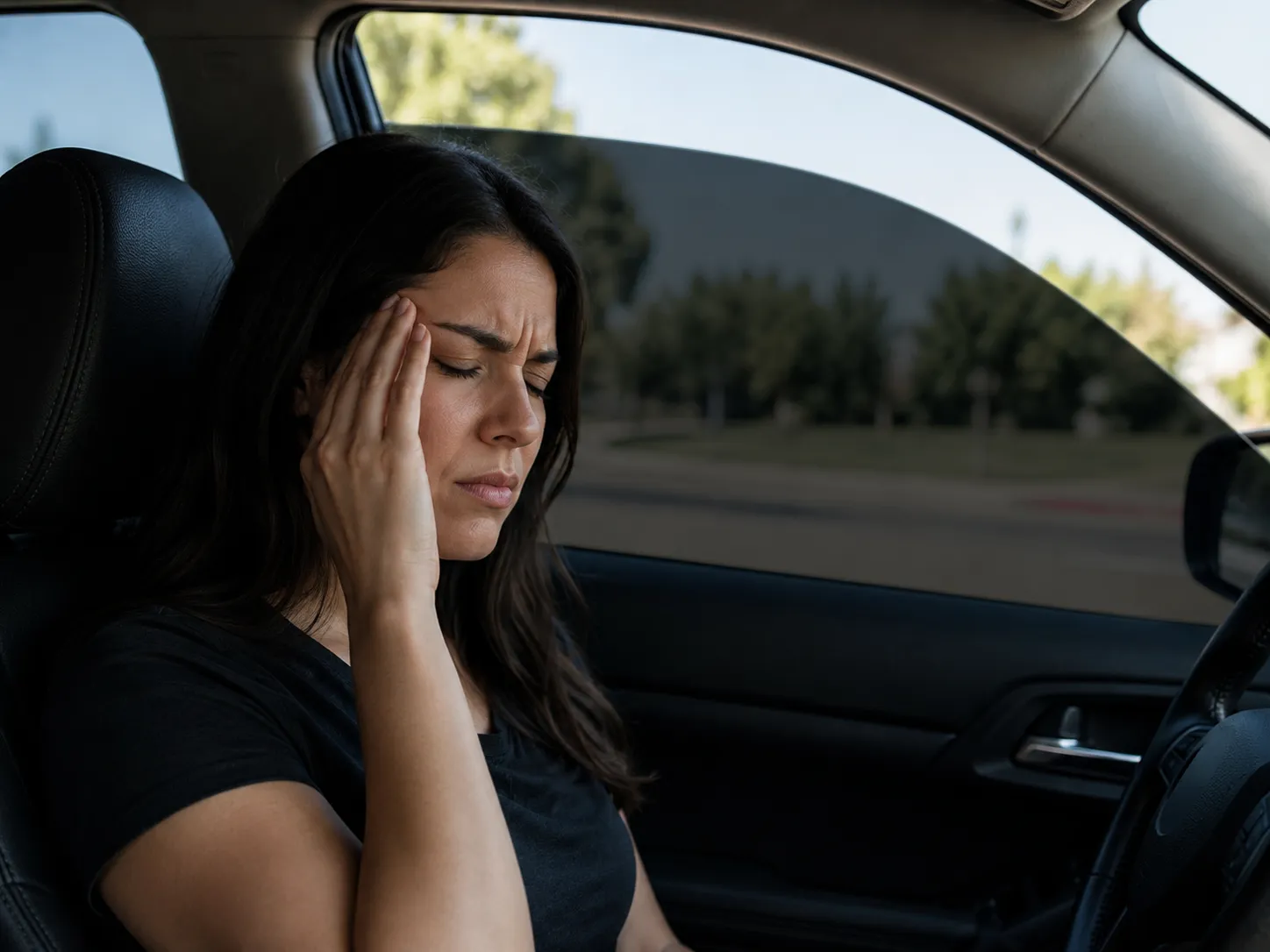
If you have a medical condition that makes sunlight genuinely dangerous or painful, driving without proper window tint is not just uncomfortable. It is a health risk. And getting the documentation to legally protect yourself should not require taking a day off work to sit in a DMV waiting room. The good news is that for most people, it does not have to.
Learning how to get a medical exemption for window tint without going to the DMV is straightforward once you understand how the process actually works. The exemption requires two things: documentation from a licensed physician confirming your medical need, and in some states, a state-specific form. The physician part can be handled entirely online through a telehealth evaluation. The DMV form, where required, can often be downloaded and submitted by mail or through an online portal.
This guide walks through the full process step by step: what conditions qualify, how the telehealth evaluation works, what your physician letter must include, how state requirements differ, and what to do after you receive your documentation.
If you want to skip straight to getting your documentation, TintedMD connects you with a licensed physician who handles everything online. Same-day delivery. Money-back guarantee.
Why You Usually Don’t Need to Visit the DMV First
The standard medical exemption for window tint process is often misunderstood. Many people assume the DMV is the starting point. In most states, it is not. The DMV comes into the picture only after you have your physician documentation. And in some states, such as California, the DMV is not involved at all.
Here is how the process actually flows in most states. A licensed physician evaluates your condition and determines whether your diagnosis qualifies for a window tint exemption under your state’s law. The physician then completes a written certification or letter stating the medical necessity. That document, not anything from the DMV, is what you carry in your vehicle as proof of your exemption.
Some states, including Florida and New York, require an additional step: submitting the physician documentation to a state agency, which then issues a formal permit or certificate. But even in those states, the physician documentation comes first. You cannot apply to the DMV for a window tint exemption without the signed physician letter in hand.
This is exactly why telehealth services like TintedMD exist. The physician step, which has historically required scheduling an appointment, traveling to a clinic, and waiting weeks for paperwork, can now be done from your phone or computer. A licensed physician reviews your information, evaluates your condition, and completes your window tint exemption documentation the same day.
Who Qualifies: Medical Conditions for a Medical Window Tint Exemption
Not every condition qualifies for a medical exemption for window tint. States vary in how broad or specific their qualifying condition lists are. Some states accept any physician-attested medical condition. Others list specific diagnoses. Here are the conditions that appear most often across state laws:
Common Qualifying Conditions by Category
| Autoimmune Conditions | Skin and UV Conditions | Eye and Neurological Conditions |
|---|---|---|
| Lupus (systemic lupus erythematosus) | Melanoma and skin cancer history | Photophobia (light sensitivity) |
| Dermatomyositis | Xeroderma pigmentosum | Ophthalmic disorders with light sensitivity |
| Polymyositis | Albinism | Neurological conditions causing photosensitivity |
| Other autoimmune disorders with sun sensitivity | Severe drug photosensitivity | Post-cataract surgery sensitivity |
| Vitiligo (in some states) | Porphyria | Migraine with light sensitivity (select states) |
Two conditions worth highlighting: lupus is the most commonly approved condition for a window tint exemption across all states because UV exposure is a documented trigger for lupus flares. Photophobia is the second most common, covering anyone whose medical condition causes severe, disabling sensitivity to light. The key is that the condition must create a genuine medical need for sun protection, not just discomfort.
Two states offer no exemption at all: Colorado and Kansas. If you live in either state, no physician letter will change your legal tint limit. In every other state, there is at least a pathway to apply. The TintedMD state guide covers qualifying conditions and requirements for all 48 states that offer the exemption.
If you are unsure whether your condition qualifies in your state, the TintedMD evaluation process includes a review of your state’s specific requirements before the physician completes your documentation.
How to Get a Medical Exemption for Window Tint: Step-by-Step
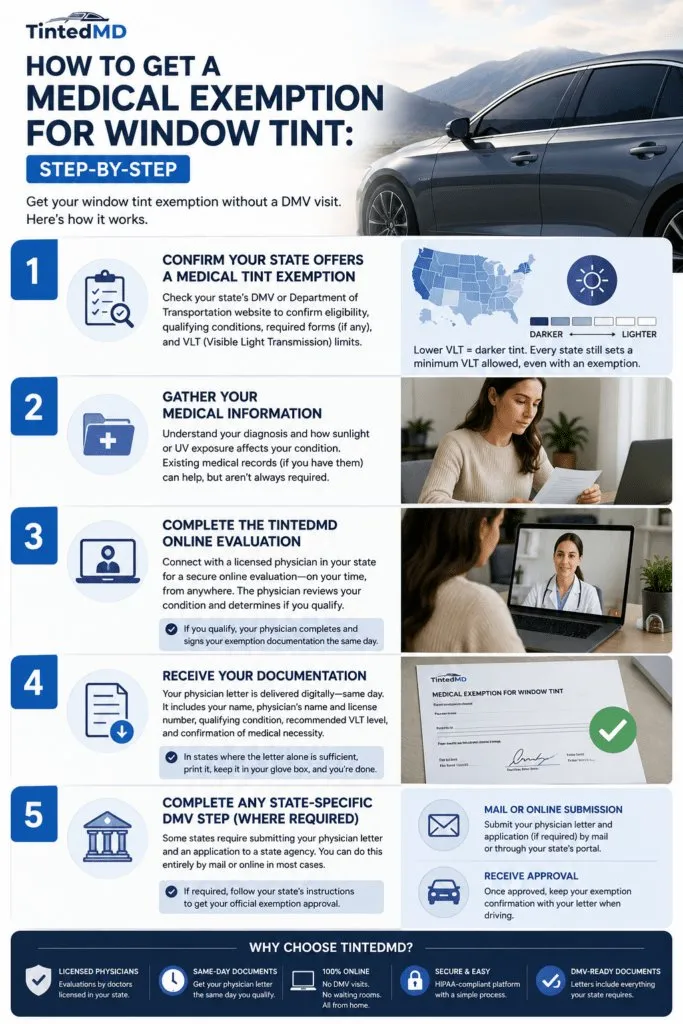
Here is the full process for getting a medical exemption for window tint without a DMV visit, broken into the steps that apply in most states.
Step 1: Confirm Your State Offers a Medical Tint Exemption
Before anything else, verify that your state offers a medical exemption for window tint. As noted, Colorado and Kansas do not. For every other state, check your state’s DMV or Department of Transportation website for the current requirements, including the qualifying conditions list, the required form (if any), and the VLT (Visible Light Transmission) limits that apply with an exemption.
VLT is the percentage of visible light that passes through the window. Lower VLT means darker tint. A 20% VLT allows only 20% of light through. Most state standard laws require front windows to be at 35% VLT or higher. With a medical exemption, states typically allow darker tint, but they still set a floor. No state allows completely opaque tint on front windows, even with a medical exemption.
Step 2: Gather Your Medical Information
You do not need to pull together a full medical record to start the process. What you need is a clear understanding of your diagnosis, when it was first diagnosed, and how sunlight or UV exposure affects your condition. For the telehealth evaluation, you will be asked to describe your symptoms, your condition, and why darker window tint would provide medical benefit.
If you have existing documentation from a treating physician, such as a diagnosis letter, test results, or treatment records, having those available can speed up the evaluation. But they are not always required. TintedMD’s licensed physicians are experienced in evaluating qualifying conditions for window tint exemptions and can assess your situation based on the clinical consultation.
Step 3: Complete the TintedMD Online Evaluation
The evaluation is the core of the process. TintedMD connects you with a licensed physician who is authorized to practice in your state. The evaluation happens entirely online, on your phone or computer, at a time that works for you. There is no waiting room, no travel, and no in-person appointment required.
During the evaluation, the physician reviews your condition, asks about how UV exposure or bright light affects you, and determines whether your situation meets your state’s requirements for a medical tint exemption. If you qualify, the physician completes and signs your exemption documentation the same day.
This is the step that most people get wrong on their own. A physician letter that does not include the right information, such as a specific VLT percentage recommendation, the physician’s license number, or language connecting the condition to driving in a vehicle, will be rejected. TintedMD’s physicians complete these letters regularly and know exactly what your state’s DMV or issuing agency needs to see.
Step 4: Receive Your Documentation
Once the physician completes your evaluation and signs off on your window tint exemption, your documentation is delivered digitally, same day. This is your physician letter. It includes your name, your physician’s name and license number, your qualifying condition, the recommended VLT level, and confirmation of medical necessity.
In states where the physician letter alone is sufficient, you print it, keep a copy in your glove box, and you are done. You can take it to your tint installer or show it to a law enforcement officer if you are pulled over. No DMV visit required.
Step 5: Complete Any State-Specific DMV Step (Where Required)
Some states require an additional submission to a state agency after you have your physician letter. In these states, the physician letter is not the final step.
What Your Physician Letter Must Include
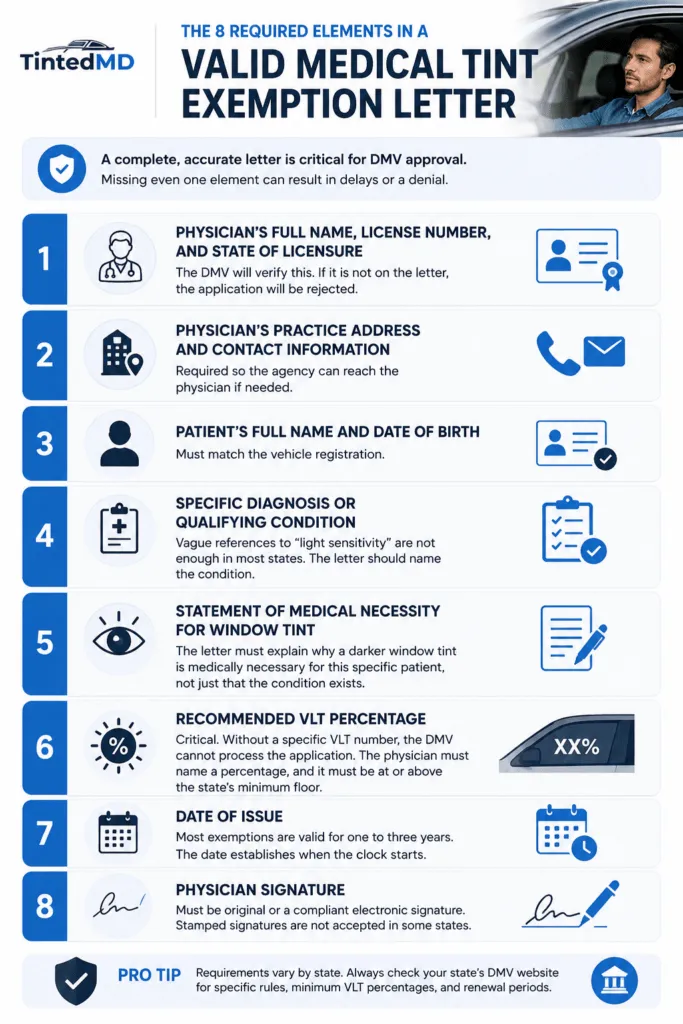
This is the section that most people skip, and it is why so many medical exemption for window tint applications get rejected. The physician letter is the core document. If it is missing required information, the DMV will send it back as incomplete. Here is what must be in it:
Required Elements in a Valid Medical Tint Exemption Letter
-
Physician’s full name, license number, and state of licensure: The DMV will verify this. If it is not on the letter, the application will be rejected.
-
Physician’s practice address and contact information: Required so the agency can reach the physician if needed.
-
Patient’s full name and date of birth: Must match the vehicle registration.
-
Specific diagnosis or qualifying condition: Vague references to ‘light sensitivity’ are not enough in most states. The letter should name the condition.
-
Statement of medical necessity for window tint: The letter must explain why a darker window tint is medically necessary for this specific patient, not just that the condition exists.
-
Recommended VLT percentage: Critical. Without a specific VLT number, the DMV cannot process the application. The physician must name a percentage, and it must be at or above the state’s minimum floor.
-
Date of issue: Most exemptions are valid for one to three years. The date establishes when the clock starts.
-
Physician signature: Must be original or a compliant electronic signature. Stamped signatures are not accepted in some states.
The VLT percentage is the element most commonly left off by physicians who do not regularly write window tint exemption letters. A physician who is familiar with the clinical needs of a lupus patient may not know that the DMV requires a specific number. TintedMD physicians complete this type of documentation regularly for all qualifying states and know exactly what each state’s DMV requires.
State-by-State Guide: Do You Need a DMV Visit?
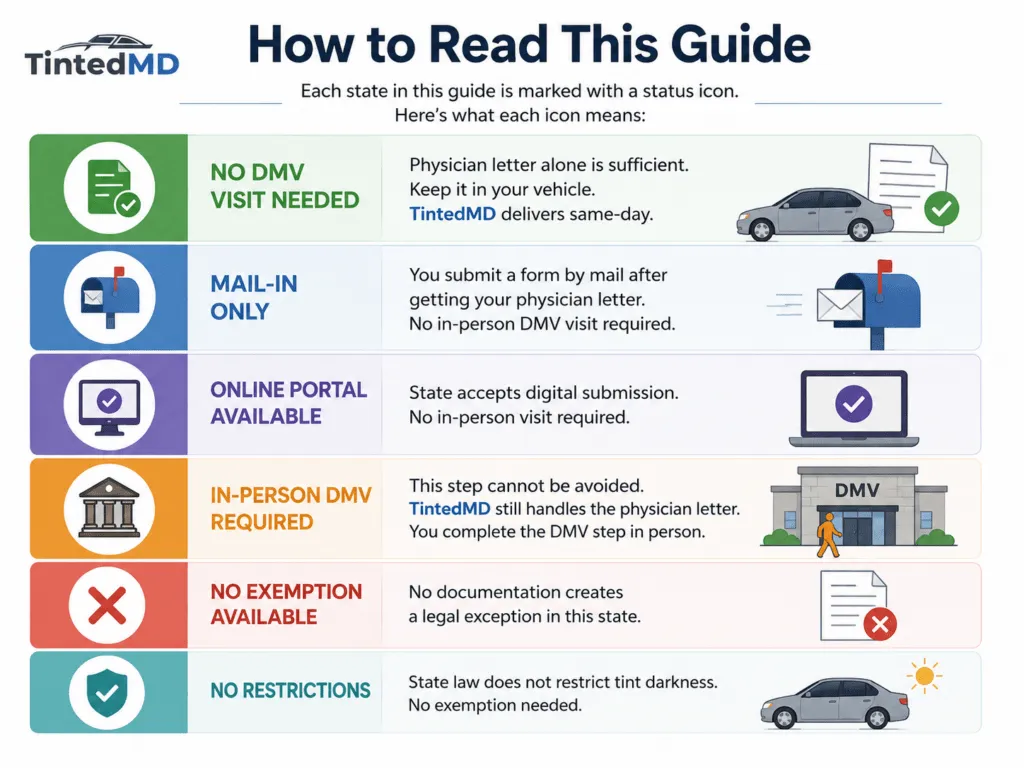
This section answers the core question for every state: do you have to physically visit the DMV to get your medical exemption for window tint, or can you handle it from home? Each entry is labeled clearly. Always confirm current requirements with your state DMV before applying, as statutes and forms change.
Alabama
Mail-in required. The Alabama State Law Enforcement Agency (ALEA) issues exemptions. Your physician writes a letter confirming a qualifying condition such as light-sensitive porphyria. You submit the letter and application to ALEA by mail. ALEA issues a numbered decal for your windshield. TintedMD handles the physician letter. The ALEA submission is by mail, so no in-person DMV visit is required.
Alaska
No DMV visit needed. Alaska accepts a physician letter with no DMV permit or form required. Your TintedMD-issued physician letter and a tint installer certificate showing actual VLT must be carried in the vehicle. The letter must be renewed annually by an Alaska-licensed physician. No trip to any state office required.
Arizona
No DMV visit needed. Arizona accepts a signed physician letter carried in the vehicle. No state form and no DMV submission are required. TintedMD delivers your physician letter same-day. Keep it in your glovebox and you are covered. Telehealth evaluations are accepted as the basis for the letter.
Arkansas
Mail-in only. Arkansas accepts a physician letter for any medical condition attested by a licensed physician. Exemptions are valid for three years. Submit the letter to the Arkansas State Police by mail. A certificate is issued and returned to you by mail. No in-person DMV visit required. TintedMD handles the physician letter.
California
Mail-in only. California requires Form REG 256A submitted with your physician letter to the CA DMV by mail. You can download the form from the CA DMV website. Submit both by mail. The DMV reviews and mails back an approval. No in-person visit required at any point. TintedMD delivers your physician letter same-day. You print the form, attach the letter, and mail it.
Colorado
No exemption available. Colorado does not offer a medical exemption for window tint under any condition. No physician letter, no form, and no state process creates a legal exception. If you need UV protection while driving, clear UV-blocking film (which is not subject to VLT rules) is the only legal option.
Connecticut
Mail-in only. Connecticut allows exemptions for tint below 32% VLT, with 20% VLT as the minimum permitted. A validated form must be submitted to the Connecticut DMV. The form can be submitted by mail. The validated form must be carried in the vehicle at all times after approval. No in-person DMV visit is required. TintedMD handles the physician portion.
Delaware
In-person DMV required. Delaware uses Form MV495 (Application for Medical Waiver of Tinted Window Law), but this form is not available online or by mail. You must visit a Delaware DMV facility in person to obtain the form. TintedMD can still complete your physician letter online so it is ready when you visit. The in-person step to get the form cannot be skipped in Delaware.
Florida
Mail-in only. Florida issues a non-expiring Medical Exemption Certificate for qualifying autoimmune conditions including lupus, dermatomyositis, albinism, vitiligo, and xeroderma pigmentosum. Use Form HSMV 83390 (available for download from FL DHSMV) and have your physician complete the certification section. Mail the completed form to Florida DHSMV with a $6.45 fee. The state mails back the certificate. No in-person visit required. TintedMD delivers your physician certification same-day.
Georgia
Mail-in only. Georgia requires a physician or optometrist to attest that you need shielding from sunlight. Submit the Georgia DPS application form by mail with a $10 fee. The minimum VLT permitted with an exemption is 23%. Exemptions are not granted if adequate protection can be provided by eyewear alone. No in-person DPS visit required. TintedMD handles the physician portion.
Hawaii
No exemption available. Hawaii does not offer a formal medical exemption for window tint. There is no state process, form, or physician letter that creates a legal exception under Hawaii tint law. Clear UV-blocking film is the recommended alternative for patients who need sun protection while driving.
Idaho
Mail-in only. Idaho accepts a physician letter submitted to the Idaho Transportation Department. The form or letter can be mailed. No in-person DMV visit is required. The documentation must be carried in the vehicle after approval. TintedMD delivers your physician letter same-day for mailing.
Illinois
Mail-in only. Illinois processes medical tint exemptions through the Illinois Secretary of State’s office. A licensed physician must certify the condition. Submit the completed form by mail. The exemption certificate or letter must be carried in the vehicle. No in-person office visit required. TintedMD handles the physician certification.
Indiana
Mail-in only. Indiana accepts a physician letter submitted to the Indiana Bureau of Motor Vehicles by mail. The exemption is vehicle-specific and must be renewed periodically. The documentation must be in the vehicle at all times. No in-person BMV visit required. TintedMD delivers your physician letter same-day.
Iowa
Mail-in only. Iowa requires a physician statement submitted to the Iowa Department of Transportation. You can mail the documentation. The documentation must be carried in the vehicle. No in-person DOT visit required. TintedMD handles the physician statement online.
Kansas
No exemption available. Kansas does not offer a medical exemption for window tint under any condition. No physician letter and no state process creates a legal exception. Clear UV-blocking film that complies with Kansas standard tint laws is the only legal option for added sun protection.
Kentucky
Mail-in only. Kentucky accepts a physician letter submitted to the Kentucky Transportation Cabinet by mail. The exemption certificate is mailed back to you. It must be kept in the vehicle. No in-person visit required. TintedMD delivers your physician letter same-day for submission.
Louisiana
Mail-in only. Louisiana processes exemptions through the Office of Motor Vehicles. Submit your physician certification by mail. The exemption must be renewed on the state’s schedule. The documentation must be carried in the vehicle at all times. No in-person DMV visit required. TintedMD handles the physician portion.
Maine
Mail-in only. Maine accepts a physician letter submitted to the Maine Bureau of Motor Vehicles by mail. The documentation must be carried in the vehicle after approval. No in-person BMV visit required. TintedMD delivers your physician letter same-day for mailing.
Maryland
Mail-in only (pre-approval required before installation). Maryland requires formal pre-approval from the Maryland MVA before you install the tint. However, the application is submitted by mail, not in person. Submit the completed MVA medical exemption form with your physician letter by mail. Wait for the mailed approval before having the tint installed. No in-person MVA visit required. TintedMD handles the physician portion.
Massachusetts
Mail-in only. Massachusetts processes tint exemptions through the Registry of Motor Vehicles. Submit your physician letter with the RMV form by mail. The exemption is renewed periodically. The documentation must be in the vehicle. No in-person RMV visit required. TintedMD delivers your physician letter same-day.
Michigan
No exemption needed. Michigan has no standard tint restrictions on non-windshield windows. Any VLT is permissible without any documentation, physician letter, or exemption process. If you live in Michigan, you can tint your windows to any darkness on side and rear windows with no paperwork at all.
Minnesota
No DMV visit needed. Minnesota accepts a physician letter or notarized affidavit with no DMV form or submission required. The signed letter and a tint installer certificate showing actual VLT must be carried in the vehicle. TintedMD delivers your physician letter same-day. No state office visit of any kind required.
Mississippi
Mail-in only. Mississippi processes exemptions through the Department of Public Safety. Submit your physician letter and application by mail. The documentation must be carried in the vehicle after approval. No in-person DPS visit required. TintedMD handles the physician portion.
Missouri
Mail-in only. Missouri accepts a physician letter submitted to the Department of Revenue Motor Vehicle Bureau by mail. The exemption documentation must be in the vehicle at all times. No in-person DMV visit required. TintedMD delivers your physician letter same-day for mailing.
Montana
No DMV visit needed. Montana accepts a signed physician affidavit with no formal DMV permit or state submission required. The affidavit must be in the vehicle at all times and updated every two years. TintedMD delivers your physician letter or affidavit same-day. No state office visit required.
Nebraska
Mail-in only. Nebraska accepts a physician letter submitted to the Nebraska DMV by mail. The exemption certificate is mailed back. It must be kept in the vehicle. No in-person DMV visit required. TintedMD delivers your physician letter same-day for submission.
Nevada
Mail-in only. Nevada processes tint exemptions through the Nevada DMV. Submit your physician statement and application by mail. The documentation must be carried in the vehicle at all times. No in-person DMV visit required. TintedMD handles the physician statement online.
New Hampshire
Mail-in only. New Hampshire accepts a physician letter submitted to the NH Division of Motor Vehicles by mail. The exemption documentation must be in the vehicle. No in-person DMV visit required. TintedMD delivers your physician letter same-day for submission.
New Jersey
Mail-in only. New Jersey processes tint exemptions through the Motor Vehicle Commission. Submit your physician letter and the MVC form by mail. The exemption must be renewed every four years. The certificate must be in the vehicle. No in-person MVC visit required. TintedMD delivers your physician letter same-day.
New Mexico
No DMV visit needed. New Mexico accepts a physician statement carried in the vehicle with no state form or DMV submission required in most cases. The minimum VLT permitted is typically 20%. TintedMD delivers your physician statement same-day. Contact the New Mexico MVD to confirm current requirements before applying.
New York
Mail-in only. New York uses Form MV-80W (downloadable from the NY DMV website). Your physician endorses the form. Mail the completed form to the NY DMV. The DMV processes it and issues the exemption. Qualifying conditions include photophobia, severe drug photosensitivity, and any condition requiring medical shielding from the sun. No in-person DMV visit required. TintedMD completes the physician endorsement same-day.
North Carolina
Mail-in only (pre-approval required before installation). North Carolina requires state pre-approval before you install the tint. Submit the physician certification and NC DMV form by mail. Wait for the mailed approval before installation. No in-person DMV visit required. TintedMD handles the physician certification same-day.
North Dakota
Mail-in only. North Dakota accepts a physician letter submitted to the Department of Transportation by mail. The documentation must be carried in the vehicle. No in-person DOT visit required. TintedMD delivers your physician letter same-day for mailing.
Ohio
Mail-in only. Ohio processes exemptions through the Bureau of Motor Vehicles. Submit your physician statement and BMV form by mail. The exemption is renewed periodically. The documentation must be in the vehicle. No in-person BMV visit required. TintedMD handles the physician statement online.
Oklahoma
Mail-in only. Oklahoma processes tint exemptions through the Tax Commission Motor Vehicle Division. Submit your physician letter by mail. The certificate must be in the vehicle. No in-person visit required. TintedMD delivers your physician letter same-day for mailing.
Oregon
Mail-in only. Oregon requires Form 735-6513, available for download from the Oregon DMV website. Your physician completes the form. Mail the completed form to the Oregon DMV. No in-person DMV visit required. TintedMD physicians complete this Oregon-specific form as part of the evaluation. Keep a copy in the vehicle after submission.
Pennsylvania
Special process: mail or phone. Pennsylvania allows only colorless UV-blocking film, not tinted film, for medical exemptions. The PennDOT Medical Unit processes applications separately from regular DMV services. Contact the PennDOT Medical Unit by phone or mail to obtain the current form. No standard in-person DMV visit required, but you must contact the Medical Unit directly. TintedMD can complete the physician portion of the documentation.
Rhode Island
Mail-in only. Rhode Island DMV issues a decal sticker after reviewing your application. The original application (no faxes accepted) must be mailed within 30 days of the physician’s signature. The physician completes an affidavit section. A fee applies. The decal is applied to the driver’s side window. No in-person DMV visit required. TintedMD completes the physician affidavit same-day.
South Carolina
Mail-in only. South Carolina processes exemptions through the Department of Motor Vehicles. Submit your physician letter and application by mail. The documentation must be in the vehicle. No in-person DMV visit required. TintedMD delivers your physician letter same-day for mailing.
South Dakota
Mail-in with medical review board. South Dakota has no standard exemption statute, but any person with a UV-sensitive condition may submit a physician statement to the state commissioner by mail. The statement is forwarded to the department’s medical review board. If approved, the board recommends authorization. No in-person DMV visit required. The review board process adds time compared to other states. Contact the South Dakota Department of Revenue for current timelines.
Tennessee
No DMV visit needed. Tennessee accepts a physician certification of medical necessity carried in the vehicle. Submit the certification to the Tennessee Department of Revenue by mail or as directed. No standardized single form exists; a physician letter on letterhead is typically sufficient. No in-person state office visit required. TintedMD delivers your physician certification same-day.
Texas
No DMV visit needed. Texas requires a physician letter on official letterhead submitted to the Texas Department of Public Safety, which can be done by mail. No in-person visit is required. Keep the original letter (not a copy) in the vehicle at all times. Telehealth evaluations are explicitly accepted. TintedMD delivers your physician letter same-day. This is one of the cleanest no-DMV-visit states in the country.
Utah
Mail-in only. Utah accepts a physician letter submitted to the Utah Driver License Division by mail. The documentation must be in the vehicle. No in-person DMV visit required. TintedMD delivers your physician letter same-day for mailing.
Vermont
Mail-in only. Vermont accepts a physician letter submitted to the Vermont DMV by mail. The documentation must be in the vehicle. No in-person DMV visit required. TintedMD delivers your physician letter same-day for mailing.
Virginia
Mail-in only. Virginia issues exemption decal stickers after reviewing your application and physician letter. Submit both by mail to the Virginia DMV. The DMV mails back the decal. The decal must be placed on the vehicle and the physician letter kept in the glovebox. No in-person DMV visit required. TintedMD completes the physician letter same-day.
Washington
No DMV visit needed. Washington State accepts a physician letter or notarized affidavit with no DMV submission required. The letter and a tint installer certificate showing actual VLT must be carried in the vehicle at all times. TintedMD delivers your physician letter same-day. No state office visit of any kind required.
Washington DC
No DMV visit needed. Washington DC accepts a letter on official letterhead signed by a physician, physician assistant, ophthalmologist, or optometrist. No separate DC DMV form is required. The letter must be maintained in the vehicle at all times. TintedMD delivers the signed physician letter same-day. This is a straightforward no-DMV-visit jurisdiction.
West Virginia
Mail-in only. West Virginia issues exemption decal stickers after reviewing your physician letter. Submit your letter and application to the WV DMV by mail. The DMV mails back the decal. The decal must be on the vehicle and documentation kept in the vehicle. No in-person DMV visit required. TintedMD completes the physician letter same-day.
Wisconsin
Mail-in only. Wisconsin processes exemptions through the Department of Transportation. Submit your physician letter and DOT form by mail. The documentation must be in the vehicle. No in-person DOT visit required. TintedMD delivers your physician letter same-day for mailing.
Wyoming
Mail-in only. Wyoming accepts a physician letter submitted to the Wyoming Department of Transportation by mail. The documentation must be in the vehicle. No in-person DOT visit required. TintedMD delivers your physician letter same-day for mailing.
One state stands out as the exception: Delaware requires an in-person DMV visit to obtain Form MV495, which is not available for download. For every other state, the physician letter from TintedMD is all you need to begin the process, and the remaining steps are completed by mail, online, or by simply carrying the letter in your vehicle. Start your TintedMD evaluation to get your state-specific physician documentation same-day.
How Long the Exemption Lasts and How to Renew
Most window tint exemptions are not permanent. Here is what to expect in terms of duration and renewal.
-
One to two years: Most common across states. Set a calendar reminder 60 days before expiration so you have time to complete the renewal process without a gap in coverage.
-
Three years: Some states, including Arkansas, issue exemptions valid for three years.
-
Non-expiring: Florida issues non-expiring certificates for certain qualifying autoimmune conditions. Once approved, the certificate does not need to be renewed.
-
Vehicle-specific: In most states, the exemption is tied to a specific vehicle, not the driver. If you buy a new car, you need to apply for a new exemption for that vehicle.
TintedMD handles renewals through the same online process as new applications. If your condition has not changed, the renewal evaluation is typically faster than the original.
What to Do After You Have Your Exemption
Once your medical tint exemption documentation is in hand, here is what comes next.
Get Your Tint Installed
Take your physician letter and any state-issued certificate to a licensed window tint installer. Show them the documentation and confirm the VLT percentage your physician authorized. The installer will apply tint at or above that percentage (lighter or equal, not darker). Do not ask for tint darker than what your physician specified. If you do, the exemption does not cover it, and you could still receive a citation.
The exemption covers the windows specified in the documentation, typically front side windows and sometimes the windshield strip. Rear windows in most states can be tinted to any darkness without an exemption.
Keep the Documentation in the Vehicle
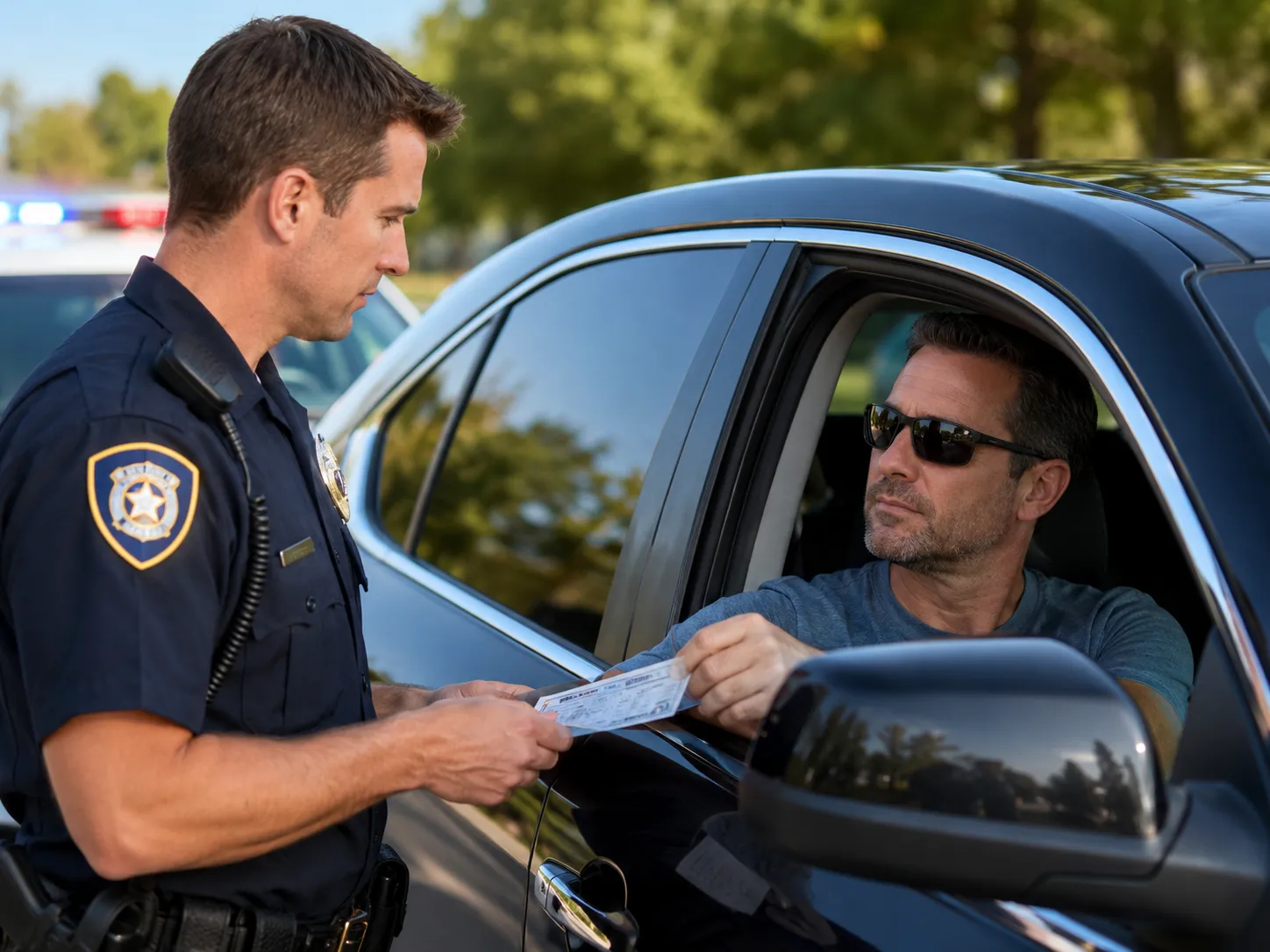
Always carry your exemption documentation in the vehicle. Keep the original or a certified copy in the glove box. If you are pulled over for dark tint, produce the documentation promptly. Officers in most states are familiar with medical tint exemptions, but you should have the document ready rather than explaining verbally.
Some states are stricter about copies. Texas, for example, strongly recommends carrying the original letter rather than a photocopy. Check your state’s specific guidance on whether a photocopy is acceptable.
Crossing State Lines
Your home state’s medical tint exemption applies in your home state. When you drive into another state, that state’s laws apply to your vehicle. Most states do not formally recognize other states’ medical tint exemptions. For short trips, the risk is low. For regular cross-state commuters, applying for a separate exemption in both states provides the clearest legal protection.
Why Applications Get Rejected (And How to Avoid It)
The most common reason a medical exemption for window tint application fails is not the condition. It is the documentation. Here are the five most frequent rejection reasons and how to avoid each one.
| Rejection Reason | How to Avoid It |
|---|---|
| Missing or illegible physician signature | Use TintedMD’s licensed physicians, who complete all required fields and sign appropriately for each state’s requirements |
| No specific VLT percentage stated | The physician must name a specific percentage. TintedMD physicians know each state’s requirements and include the correct VLT number |
| Physician not licensed in the applicant’s state | TintedMD matches patients with physicians licensed in their specific state |
| VLT requested darker than state minimum floor | TintedMD physicians are briefed on state VLT floors before completing each application |
| Using an outdated or incorrect state form | TintedMD tracks current form versions for each state and confirms the right form is used before the evaluation |
If your application has already been rejected, TintedMD can provide a corrected letter that addresses the specific deficiency. Bring the rejection notice to the evaluation and the physician will address the stated issue. Need a letter that passes first time? See how TintedMD works →
How TintedMD Handles the Entire Process Online
TintedMD was built specifically for the medical exemption for window tint process. Here is how the platform works from start to finish.
You begin by selecting your state on the TintedMD website. The platform confirms your state’s requirements upfront, including qualifying conditions, required forms, and VLT limits. This step alone prevents most of the common rejection causes.
You then complete a short intake form describing your condition, your symptoms, and how UV exposure or bright light affects you. A licensed physician in your state reviews your information and schedules a brief telehealth consultation, typically completed the same day you apply.
Ready to start? See how the medical window tint exemption process works →
After the consultation, if you qualify, the physician completes and signs your exemption documentation. The documentation is formatted to your state’s specific requirements, including any state-specific language, form fields, or VLT conventions. It is delivered to you digitally the same day.
More than 100,000 patients have gotten their window tint exemption documentation through TintedMD. The platform is HIPAA-compliant, uses licensed physicians in each state it serves, and backs every application with a money-back guarantee if the documentation is rejected by a qualified DMV for any reason.
Conclusion
Getting a medical exemption for window tint without going to the DMV is not only possible for most people, it is the standard process in most states. The physician documentation is the critical step, and that step can be completed entirely online. What makes the difference between an approved application and a rejected one is whether the physician letter contains the specific information your state requires.
TintedMD handles that step correctly, every time. Licensed physicians in your state, familiar with your state’s exact VLT requirements and form specifications, complete the documentation the same day. More than 100,000 patients have been helped through the platform, with a money-back guarantee if the documentation is not accepted.
If you have a qualifying condition and need darker window tint, you should not be driving without proper protection because the paperwork felt complicated. It does not have to be. Start your TintedMD evaluation today and have your medical exemption for window tint documentation in hand, same day.
Frequently Asked Questions
Do I have to go to the DMV to get a medical window tint exemption?
In many states, no. The process for a medical exemption for window tint starts with physician documentation, which can be completed entirely through a telehealth evaluation. Some states, such as California and Texas, do not require an in-person DMV visit at any point. Others, such as New York and Florida, require submission of a state form after the physician documentation is complete, but that submission can typically be done by mail or through an online portal.
What conditions qualify for a window tint exemption?
Common qualifying conditions include lupus, photophobia, albinism, xeroderma pigmentosum, melanoma and skin cancer history, dermatomyositis, vitiligo, porphyria, and severe drug photosensitivity. Some states accept any condition for which a physician attests medical necessity. Others have specific lists. Colorado and Kansas offer no medical tint exemption under any condition.
How long does it take to get a medical window tint exemption?
Through TintedMD, most patients receive their window tint exemption documentation the same day they apply. The telehealth evaluation and physician sign-off typically happen within a few hours. In states that require a separate DMV submission, the processing time after that varies from a few days to several weeks depending on the state.

Meet the author
Nida Hammad
I am a professional writer with over five years of experience creating clear, engaging, and well-researched content. I specialize in medical window tint exemptions and state compliance topics, helping readers understand tint laws and exemption requirements in simple, easy-to-follow language. Currently, I write for TintedMD, where I focus on producing accurate, trustworthy guides to help drivers navigate the medical tint exemption process with confidence.
Get Your Medical Tint Exemption Online in Minutes
Check Your Eligibility