
Truck Driver Tint Exemption Guide
 by Nida Hammad
 Last updated:
Medically reviewed by:
Dr. Matthew Reynolds, MD


A truck driver tint exemption is a state-issued medical exemption that may allow a commercial driver with a qualifying medical condition to use darker window tint than the standard legal limit. These exemptions are generally available when a licensed healthcare provider documents that reduced sunlight exposure is medically necessary because of a condition such as lupus, albinism, porphyria, severe photophobia, or another medically recognized photosensitivity disorder.
For commercial truck drivers, a medical tint exemption can provide additional protection from prolonged exposure to sunlight during long hours on the road. However, the exemption process varies by state. Each state has its own eligibility requirements, physician certification standards, application forms, permitted tint levels, and renewal rules. Drivers who operate across state lines must also understand that a state medical exemption does not automatically override federal commercial motor vehicle (CMV) window-glazing requirements or the laws of every state they travel through.
This Truck Driver Tint Exemptions Guide explains how medical tint exemptions work for commercial drivers, which medical conditions may qualify, the role of a physician in completing the required documentation, how to submit a state tint exemption form, and what truck drivers should keep in their vehicles to demonstrate compliance during traffic stops or roadside inspections. It also covers state-by-state requirements, telemedicine options for obtaining medical documentation, and important considerations for interstate drivers who want to remain compliant while receiving medically necessary protection from sunlight.
Understanding Medical Window Tint Exemptions for Truck Drivers

Professional drivers spend more time behind the wheel than most people realize. For truck drivers, this means extended exposure to UV radiation and intense sunlight. A truck driver tint exemption allows commercial operators with medical conditions to install darker window tinting than standard legal limits permit. This protection addresses real health risks that develop from cumulative sun exposure during long hauls.
The distinction between cosmetic preference and medical necessity matters here. Standard tinting laws exist for visibility and safety. Medical exemptions recognize that certain conditions create genuine health vulnerabilities that darker tinting can address.
What Makes Truck Drivers Uniquely Vulnerable to UV Exposure
Truck drivers face UV exposure patterns similar to outdoor workers. Hours spent in direct sunlight through windshields and side windows add up quickly. The left side of the body receives the most exposure in North America due to driver positioning.
Research shows this exposure creates measurable health consequences. Skin cancer rates among professional drivers exceed general population averages. Eye damage from prolonged UV exposure accelerates conditions like cataracts and macular degeneration.
According to industry advocacy groups pushing for FMCSA exemptions, driver comfort and health concerns have prompted calls for regulatory changes. The cumulative effect of 8-12 hour driving days creates exposure levels that standard window glass cannot adequately filter.
Conditions that make drivers particularly vulnerable include:
-
Photosensitivity disorders like lupus or albinism
-
Eye conditions including severe photophobia or post-surgical sensitivity
-
Skin conditions worsened by UV exposure such as melanoma history
-
Medication-induced photosensitivity from antibiotics or chemotherapy drugs
How Medical Exemptions Differ from Standard Tinting Laws
Standard vehicle tinting laws set visible light transmission (VLT) requirements for safety. Most states require front side windows to allow 50-70% of light through. These limits help law enforcement see vehicle occupants and maintain driver visibility.
Medical exemptions allow darker tinting based on documented health needs. Approved exemptions typically permit VLT levels between 20-35% for front side windows. This darker tinting blocks more UV radiation and reduces visible light intensity.
The approval process requires formal medical documentation. You need a diagnosis from a licensed physician confirming your photosensitive condition. The doctor must certify that darker window tinting is medically necessary for your health protection.
Understanding how professional driver exemptions work helps you navigate the application process. Each state motor vehicle department handles exemptions differently. Some issue special permits or certificates. Others add notations to driver licenses.
The Legal Framework: State vs. Federal Regulations
Commercial drivers face a complex regulatory environment. State laws govern window tinting for personal vehicles. Federal DOT regulations apply to commercial motor vehicles used in interstate commerce.
This creates potential conflicts for truck drivers. A medical exemption valid in your home state may not be recognized when crossing state lines. Interstate commerce rules add another layer of complexity.
Most states honor medical exemptions from other jurisdictions. However, enforcement varies. Some officers may not be familiar with out-of-state exemption documentation. Carrying proper certification prevents misunderstandings during traffic stops.
The key considerations include:
-
State-issued exemptions apply to vehicles registered in that state
-
Federal regulations do not currently provide blanket exemptions for commercial vehicles
-
Documentation must be readily available during vehicle operation
-
Tinting must still meet minimum visibility standards for safe operation
Balancing medical protection with operational safety requirements is critical. Exemptions exist to protect health without compromising road safety. Proper documentation and compliance with both state and federal rules keep you protected legally and medically.
Medical Conditions That Qualify Truck Drivers for Tint Exemptions
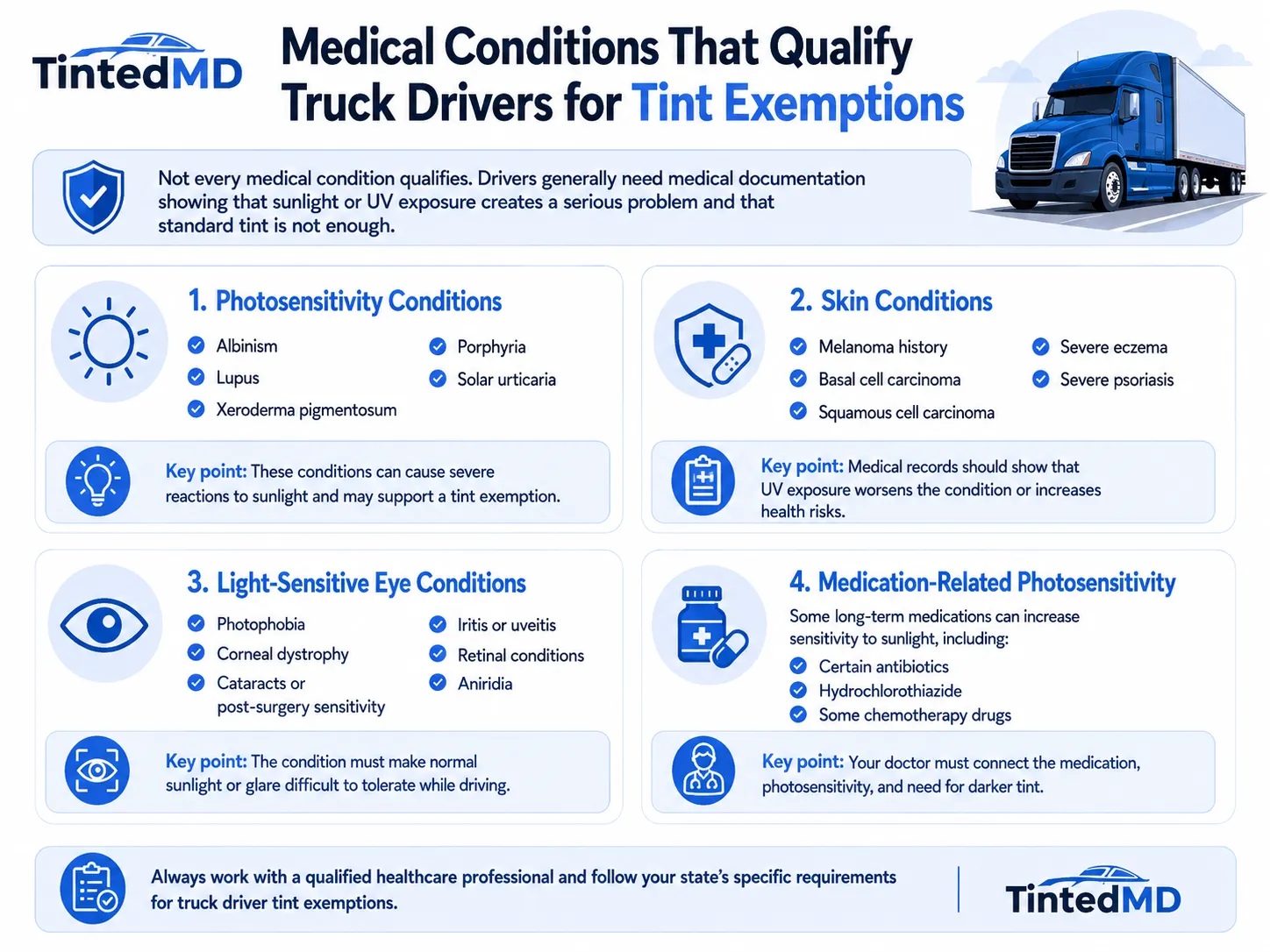
Truck drivers spend long hours behind the wheel. Sunlight exposure during these shifts can trigger serious health problems for those with photosensitive conditions. A truck driver tint exemption protects drivers whose medical conditions make standard window tinting laws unsafe. These exemptions allow darker tints that block harmful UV rays and reduce glare.
Not every condition qualifies. State regulations require documented medical necessity. Your doctor must prove your condition creates a genuine need for enhanced light protection while driving. The approval process varies by location, but qualifying medical conditions for tint exemptions follow consistent patterns across jurisdictions.
Photosensitivity Disorders and Light-Triggered Conditions
Certain genetic conditions make sunlight exposure dangerous. Albinism tops the list of universally recognized qualifying conditions. People with albinism lack melanin, which normally protects skin and eyes from UV damage. Even brief sun exposure causes painful burns and vision problems.
Lupus is another condition that meets medical necessity criteria in all states. This autoimmune disorder makes skin extremely sensitive to UV radiation. Sunlight triggers painful rashes and can worsen internal organ damage. Truck drivers with lupus need maximum UV protection during work hours.
Two rare but serious conditions also qualify:
-
Xeroderma pigmentosum prevents DNA repair after UV exposure, leading to severe skin damage and cancer risk
-
Porphyria causes painful skin reactions when exposed to sunlight, with blistering and scarring
-
Solar urticaria triggers immediate hives and welts from sun exposure
According to medical exemption qualifying conditions databases, these disorders create documented photosensitivity that justifies darker window tints for commercial drivers.
Skin Conditions Requiring UV Protection
Melanoma survivors face elevated skin cancer risk for life. Previous skin cancer diagnosis qualifies drivers for tint exemptions in most states. UV exposure increases recurrence risk, making protection during driving hours medically necessary.
Basal cell carcinoma and squamous cell carcinoma survivors also qualify. These cancers develop from cumulative UV damage. Drivers who’ve had these cancers removed need ongoing protection to prevent new tumors.
Severe eczema and psoriasis can qualify when UV exposure worsens symptoms. Documentation must show that sunlight triggers flare-ups. Your dermatologist needs to confirm that window tinting would reduce symptom severity during driving.
Eye Conditions Causing Severe Light Sensitivity
Photophobia is extreme sensitivity to light. This condition makes normal daylight painful and disabling. Truck drivers with photophobia can’t safely operate vehicles without enhanced light protection.
Corneal dystrophy qualifies when it causes light sensitivity. This inherited condition affects the cornea’s clarity. Bright light creates glare and vision problems that darker tints can reduce.
Cataracts and post-surgical sensitivity also meet criteria. After cataract surgery, many patients experience heightened light sensitivity. This can last months or become permanent. Documentation must show the sensitivity level interferes with safe driving.
Other qualifying eye conditions include:
-
Iritis and uveitis causing inflammation and light sensitivity
-
Retinal conditions where bright light damages remaining vision
-
Aniridia, where the iris is partially or completely absent
Medication-Induced Photosensitivity
Certain medications cause temporary or permanent light sensitivity. Antibiotics like tetracycline and doxycycline increase UV sensitivity. Drivers taking these drugs long-term may qualify for exemptions.
Diuretics used for blood pressure often cause photosensitivity. Hydrochlorothiazide is a common culprit. Your doctor must document that you need this medication long-term and that it creates genuine light sensitivity.
Chemotherapy drugs frequently cause severe photosensitivity. Cancer patients undergoing treatment need protection from UV exposure. This sensitivity can persist months after treatment ends.
Documentation requirements are strict. Your physician must establish both your diagnosis and the specific connection between your condition and the need for enhanced UV protection while driving. Generic letters don’t work. The medical statement must explain why standard tinting levels are insufficient for your condition.
Truck Driver Tint Exemption Rules: State-by-State
Commercial drivers face unique challenges when it comes to window tinting. Long hours on the road mean extended sun exposure. For truck drivers with photosensitivity or other medical conditions, this creates a serious health concern. A truck driver tint exemption allows commercial operators to install darker window tinting than standard legal limits permit. This medical accommodation protects drivers who need enhanced UV and glare protection while maintaining road safety compliance.
Each state manages its own tint exemption program. The rules vary widely across jurisdictions. Some states offer streamlined online applications. Others require in-person visits to motor vehicle departments. Understanding these differences helps commercial drivers plan their exemption applications effectively.
Florida Tint Exemption Form FL DHSMV 83039 Requirements
Florida operates one of the more accessible exemption programs for commercial drivers. The state requires physician certification on DHSMV Form 83039. This form documents the medical necessity for darker window tinting. Physicians must specify the condition and explain why standard tinting limits don’t provide adequate protection.
Florida allows 28% VLT for approved medical exemptions. This represents a significant reduction from the standard 28% front side window requirement. The darker tinting provides meaningful relief for drivers with photosensitivity conditions. Processing typically takes 2-4 weeks from submission to approval.
The application process starts with a medical evaluation. Your physician completes Form 83039 with specific details about your condition. You then submit the completed form to your local DHSMV office. The department reviews the medical documentation and issues an exemption certificate if approved. This certificate must be carried in your vehicle at all times.
Ohio Tint Exemption Form Requirements
Ohio window tint requirements are governed by Ohio Revised Code § 4513.241 and Ohio Administrative Code Rule 4501-41-03. Under the standard rules, windshields must allow at least 70% visible light transmission (VLT), while front-side windows must allow at least 50% VLT. These limits apply generally and are not specific medical thresholds. Back-side and rear windows are not subject to a specific VLT restriction under these provisions. Unlike some states with formal medical tint exemption programs, Ohio does not currently establish a dedicated BMV medical exemption form, standardized application process, or fixed approval timeline in these regulations.
Some truck drivers may carry physician documentation confirming a qualifying condition, such as lupus, photophobia, or another photosensitivity disorder. However, Ohio law does not clearly establish whether a physician’s statement alone provides a formal exemption from the state’s VLT limits or simply serves as supporting medical documentation during an enforcement encounter. Because requirements may change, truck drivers seeking a medical tint exemption should contact the Ohio BMV to verify current requirements, documentation, and any applicable approval process before installing darker tint.
California Tint Exemption Form CA DMV Requirements
California operates a streamlined medical exemption system directly under California Vehicle Code (CVC) § 26708. The state does not use Form REG 256 for medical tinting requests, nor does it require prior application to the DMV. Instead, drivers must obtain a signed letter or certificate directly from a licensed physician, dermatologist, or optometrist. Physicians must document the qualifying medical condition and specify the need for protection from direct sunlight.
California sets clear window glazing limits based on state law rather than individual DMV case reviews. Standard front side windows must allow at least 70% VLT. Under the medical exemption provision in CVC § 26708(d)(2), drivers carrying valid medical documentation are permitted to use darker front-side tinting down to 35% VLT. This allows drivers with severe photosensitivity to receive enhanced UV and heat protection while remaining within statutory limits.
There is no 4–8 week processing timeline in California because the DMV Medical Review Unit does not pre-evaluate these requests. Exemption status takes effect as soon as the physician issues the documentation. Drivers are required to keep the signed physician statement inside the vehicle at all times to demonstrate legal compliance during traffic stops or roadside inspections. Drivers should periodically update their medical letter with their doctor to ensure continuous legal coverage.
Texas Tint Exemption Requirements
Texas operates a direct physician-certified exemption system governed by Texas Transportation Code § 547.613(e). The state does not use a Form, nor does the Texas Department of Public Safety (DPS) require drivers to submit applications. Instead, drivers must obtain a signed statement from a licensed physician or optometrist on official letterhead identifying the individual and stating that darker window tinting is medically necessary to safeguard their health.
Texas law sets a baseline limit requiring front side windows to allow at least 25% Visible Light Transmission (VLT) for standard drivers. A valid medical exemption permits qualifying drivers to install tinting darker than 25% VLT on front side windows. This enhanced level provides strong UV protection and glare reduction, benefiting commercial drivers with severe photosensitivity. Rear side windows and the back window may already be tinted to any level without needing a medical exemption.
The exemption takes effect immediately upon obtaining the physician’s signed documentation. Drivers must carry the original signed medical statement inside the vehicle at all times to demonstrate compliance to law enforcement officers during traffic stops or routine safety inspections.
New York Tint Exemption Form NY DMV Requirements
New York operates a structured medical exemption system through the state DMV. The state requires physician certification on Form MV-80W. This form is specific to medical window tinting requests and requires a licensed physician to document a qualifying diagnosis such as lupus, albinism, porphyria, or photophobia and justify the medical necessity for sun protection.
New York sets a standard baseline legal limit requiring windows to allow at least 70% Visible Light Transmission (VLT). An approved medical exemption allows qualifying drivers to install tinting darker than 70% VLT on side and rear windows. This exemption provides critical ultraviolet radiation and glare protection for drivers with severe photosensitivity who cannot tolerate standard glass transmission levels.
Processing typically takes 4 to 8 weeks through the NY DMV Medical Review Unit. The department reviews all physician documentation and may request further clarification before approval. Once approved, the DMV issues an official exemption sticker or certificate that must be maintained with the vehicle to verify legal compliance during traffic stops and annual vehicle inspections.
Truck Driver Tint Exemption Rules: Northeast States
Northeast states have different window tint laws and medical exemption rules. In most states, a licensed physician or optometrist must confirm that darker tint is medically needed. Some states require drivers to carry medical documents, while others issue a permit, sticker, or approval from the DMV. The legal tint level also varies by state, so truck drivers should check the current rules before installing darker window tint.
Connecticut
Connecticut requires at least 35% VLT on the front and back side windows under its standard tint rules. A medical exemption may allow tint as dark as 20% VLT when the driver has approved medical documentation. Drivers should keep the required physician documentation in the vehicle. The 32% figure should not be used as the medical exemption limit because it is not supported by the current rules.
Massachusetts
Massachusetts requires 35% VLT on the windshield and side windows under its standard rules. Drivers with a medical need may apply for a tint exemption through the Massachusetts RMV. A physician must certify the medical need, and the RMV provides an exemption sticker. State law does not set one fixed VLT limit for the medical exemption, so the approved tint level may depend on the medical need and RMV approval.
Maine
Maine generally requires at least 35% VLT on front side windows, while back and rear windows can have darker tint. Drivers with a qualifying medical condition may apply for an exemption through the Maine State Police with physician certification. Because renewal rules are not clearly stated in the available sources, drivers should confirm the current renewal requirements with the Maine State Police Traffic Division.
New Hampshire
New Hampshire has stricter standard tint rules than many nearby states. Front side windows generally must allow at least 70% VLT. A medical exemption may allow front side windows to have tint as dark as 35% VLT when the driver meets the state’s medical requirements and provides physician certification.
New Jersey
New Jersey does not allow aftermarket tint on the windshield or front side windows under its standard rules, subject to limited exceptions. Drivers with a qualifying medical condition may apply for an MVC medical exemption. The approved tint level is based on the physician’s certification and MVC approval, rather than a single legal percentage. The application requires detailed medical information, including the light wavelength that causes the driver’s photosensitivity. An approved exemption is generally valid for 48 months.
Pennsylvania
Pennsylvania generally requires at least 70% VLT on vehicle windows under its standard tint rules. Drivers with a qualifying medical condition may apply for a medical exemption using Form DL-38. A physician must certify the medical need, and the exemption does not set one universal VLT level for every applicant. Drivers should also confirm whether the approved exemption applies to darker tint or requires a specific type of UV-filtering film.
Rhode Island
Rhode Island generally requires 70% VLT under its standard window tint rules. This percentage should not be presented as the medical exemption limit. A medical exemption may allow darker tint when a physician documents that reduced light transmission is medically necessary. The physician indicates the level of tint needed on the DMV application, so the approved VLT can vary based on the driver’s medical condition.
Vermont
Vermont generally does not allow aftermarket tint on the windshield or front side windows under its standard rules. Drivers with a qualifying medical condition may apply for an exemption through the Vermont DMV using Form VN-022. A physician must recommend the needed VLT level on the application. Vermont law does not establish a fixed 32% VLT medical exemption limit, so that figure should not be used unless confirmed by the DMV.
Truck Driver Tint Exemption Rules: Southeast States
Southeast states have different rules for medical window tint exemptions. Most states require a licensed physician or qualified medical provider to confirm that darker tint is medically necessary. However, the approved tint level, application process, required documents, and permit rules vary by state. Truck drivers should check the current state requirements before installing tint below the standard legal limit.
Alabama
Alabama generally requires at least 32% VLT on front side windows under its standard tint rules. This 32% limit applies to drivers without a medical exemption. Alabama’s medical waiver may allow a physician-certified driver to use darker tint when medically necessary. The state does not set one fixed VLT level for the medical waiver. Instead, the required level is supported by the physician’s medical statement and applicable state requirements.
Arkansas
Arkansas generally requires at least 25% VLT on front and back side windows. Drivers with a qualifying medical condition may seek an exemption with a signed statement from a physician. Arkansas law does not set one universal VLT level for every medical exemption. The approved level depends on the medical need and the state’s requirements.
Georgia
Georgia generally requires at least 32% VLT under its standard window tint rules. This number should not be confused with the medical exemption requirement. Georgia’s official exemption process requires a physician to explain why the driver’s medical condition requires a specific reduction in visible light. The medical exemption is based on documented medical need rather than simply applying the standard 32% limit.
Kentucky
Kentucky generally allows 35% VLT on front side windows, with different limits for back side and rear windows. Information about medical tint exemptions in Kentucky is not consistent across available sources. Some sources reference a limited medical waiver with physician certification, while others indicate that Kentucky does not provide a general medical tint exemption. Drivers should confirm the current requirements with the Kentucky State Police before relying on a medical exemption.
Louisiana
Louisiana updated its window tint rules in August 2025. The minimum VLT for front and back side windows is now 25%,replacing the older 40% requirement. Louisiana also has specific rules for medical exemptions. In some cases, the exemption may extend to the registered owner’s spouse or qualifying family member. Drivers should review the current state requirements before applying.
Mississippi
Mississippi generally requires at least 28% VLT for front side, back side, and rear windows. A medical exemption requires a signed affidavit from a qualified physician or optometrist. Approved drivers receive a state-issued certificate that must be displayed as required by state law. Mississippi does not set one fixed alternate VLT level for all medical exemptions.
North Carolina
North Carolina generally requires at least 35% VLT for applicable windows. Drivers with a qualifying medical condition may apply through the NCDMV medical review process. Approved exemptions require a compliance sticker on the lower-left corner of the rear window. Drivers can have up to two permits, and a permit may be valid for up to five years. As of December 1, 2025, window tint is no longer part of the North Carolina safety inspection. Drivers should still follow all tint and exemption requirements while operating the vehicle.
South Carolina
South Carolina generally requires at least 27% VLT on front side windows. A medical exemption may be available when a physician provides a written prescription stating that darker tint is medically necessary. State law does not provide one clear alternate VLT level for every medical exemption. Drivers should confirm the approved tint level and documentation requirements before installation.
Tennessee
Tennessee generally requires at least 35% VLT on front side windows. Drivers with a qualifying medical condition may seek an exemption with a signed statement from a physician explaining the medical need. The state does not establish one universal VLT level for all medical exemptions. Drivers should also confirm whether special rules apply to their commercial vehicle before installing darker tint.
Virginia
Virginia’s standard front side window limit is 50% VLT, not 35%. A medical exemption can allow front side windows to have tint as dark as 35% VLT when approved by the Virginia DMV. The application uses DMV Form MED-20, Sun-Shading Medical Authorization Application, which must be certified by an approved medical professional. The exemption also has specific windshield requirements, including 70% VLT across the windshield or 35% VLT within the permitted top section.
West Virginia
West Virginia generally requires at least 35% VLT on front side windows. Drivers with a qualifying medical condition may apply for a physician-certified tint exemption. Approved drivers may receive an exemption decal or certificate for the vehicle. Because the state does not clearly establish one alternate VLT level for every medical exemption, drivers should confirm the current requirements with the West Virginia Division of Motor Vehicles before installing darker tint..
Truck Driver Tint Exemption Rules: Midwest States
Midwest states show moderate variation in exemption requirements.
Illinois
Illinois requires 35% VLT on front side windows as the standard legal limit under 625 ILCS 5/12-503. This is the normal tint limit, not a special medical exemption level. A physician must certify a qualifying condition, such as lupus, DSAP, albinism, or documented light sensitivity caused by a traumatic brain injury. The medical exemption allows qualifying drivers to use tint darker than 35% VLT. The physician specifies the appropriate level of darkness, and the medical certification must be renewed every four years.
Indiana
Indiana requires 30% VLT on side and rear windows under Ind. Code 9-19-19-4. This is the standard requirement, not the medical exemption limit. A licensed physician or optometrist must certify the qualifying medical condition. Indiana does not set one fixed VLT level for medical exemptions. The medical professional determines the appropriate tint level. The exemption may apply to the vehicle owner or a habitual passenger, but it does not transfer when the vehicle is sold.
Iowa
The claim that Iowa allows a 35% VLT medical exemption appears to be outdated or incorrect. Iowa’s standard front-side window requirement has been reported at 70% VLT, with some recent reports pointing to changes toward 50%. More importantly, Iowa reportedly stopped accepting new medical tint exemption applications after July 4, 2012. Previously approved exemptions may remain valid, but there does not appear to be an active process for new applicants. Therefore, 35% VLT should not be listed as Iowa’s current medical exemption limit.
Kansas
Kansas requires 35% VLT as its standard window tint limit. This is the general legal requirement, not a confirmed medical exemption level. Sources disagree about whether Kansas currently offers a medical tint variance. Some sources say Kansas has no medical exemption, while others describe a physician certification process with no fixed VLT limit. Because of this conflict, verify the current rule with the Kansas Department of Revenue, Division of Vehicles before stating that 35% VLT is a medical exemption limit.
Michigan
Michigan’s tint rules are different from those in many other states. Under MCL 257.709, aftermarket tint on front windows is generally prohibited, while the law limits window reflectivity to 35%. Reflectivity and VLT are different measurements, so 35% reflectivity should not be described as 35% VLT. Michigan allows medical exemptions for qualifying conditions, including conditions such as lupus, photosensitivity, and melanoma. A physician or optometrist must provide the required documentation, and the exemption can allow front-window tint. The exemption is generally valid for up to two years.
Minnesota
Minnesota requires 50% VLT minimum on front side windows under Minn. Stat. §169.71. This is the standard limit that applies without a medical exemption. It should not be described as the VLT level provided by the exemption. A medical exemption allows qualifying drivers to use darker tint than the normal 50% limit. The exact level depends on the medical documentation and is commonly reported in the 20% to 35% VLT range.
Missouri
Missouri requires 35% VLT on front side windows under RSMo 307.173. This is the standard limit, not a single medical exemption level. A physician or optometrist can authorize darker tint when a medical condition requires it. The prescription must generally be dated within the previous year. Missouri does not set one VLT level for every medical exemption, although some sources report that approved tint can be as dark as 20% VLT. The permitted level depends on the patient’s medical need.
North Dakota
North Dakota’s medical tint rules are unclear, and available sources provide conflicting information. Some sources report that the state no longer allows medical tint exemptions, while others describe an active physician certification process. North Dakota’s standard front-side VLT requirement has also reportedly changed from 50% to 35% as of August 2025. This makes the original 50% VLT claim outdated regardless of the medical exemption question. Check with the North Dakota Department of Transportation for the current rule.
Nebraska
Nebraska does not appear to provide a medical window tint exemption under its current statutes. Some detailed tint law sources specifically state that Nebraska statutes do not specify medical exemptions and list the state among those without a medical tint variance program. Because of this, the claim that Nebraska allows 35% VLT for medical exemptions is likely incorrect. If 35% appears in a state tint chart, it should be checked to determine whether it refers to a standard tint requirement rather than a medical exemption.
South Dakota
South Dakota is also commonly listed among states that do not currently provide medical tint variances. Therefore, a claim that the state allows 35% VLT for medical exemptions is questionable. The confusion may come from the state’s standard front-side window requirement, which is separately reported at around 35% VLT. The standard limit and a medical exemption are not the same thing.
Wisconsin
Wisconsin’s standard window tint requirement is 50% VLT under Wis. Stat. §305.34. This is the general legal limit and should not be presented as the medical exemption level. When a medical exemption applies, darker tint may be allowed. Sources commonly report a medical limit of around 35% VLT, meaning the exemption allows qualifying drivers to go darker than the normal 50% VLT requirement.
Truck Driver Tint Exemption Rules: Southwest States
Arizona
Arizona’s standard front-side-window VLT limit is 33%, and this rule applies to all drivers. Arizona also allows a medical tint exemption under A.R.S. § 28-959.01. The Arizona Department of Transportation (ADOT) Motor Vehicle Division handles the exemption through Form 40-1511. Certification may come from an MD, DO, naturopathic medical doctor, or ophthalmologist. An approved medical exemption can allow darker tint on the side and rear windows. It does not allow tint below the AS-1 line on the windshield. The approved VLT depends on the medical certification. Correction: 33% is the standard limit for everyone, not a medical exemption limit.
Colorado
Colorado does not offer a medical exemption for window tint. The state’s tint law, C.R.S. § 42-4-227, does not include a medical waiver. The 27% VLT limit is a standard requirement that applies to the front, back, and rear windows for all drivers. A doctor’s note does not allow a driver to use darker tint than the legal limit. Correction: Remove the claim that Colorado permits 27% VLT with medical documentation. Colorado does not recognize a medical window tint exemption.
New Mexico
New Mexico has a 20% VLT minimum for front-side windows, making it one of the darkest standard tint limits in the country. This 20% limit applies to all drivers and is not a medical exemption limit. New Mexico also has a separate medical exemption process. Qualified drivers may be allowed to use tint darker than the standard 20% limit if they meet the exemption requirements. Correction: State clearly that 20% is the standard limit for everyone, while a medical exemption may allow darker tint.
Nevada
Nevada’s standard front-side-window VLT limit is 35% under NRS 484D.440. This rule applies to all drivers, not just those with medical exemptions. Nevada also offers a medical tint exemption that requires physician certification and is handled through the Department of Public Safety using Form DO-200. An approved medical exemption can allow tint darker than 35% VLT. Some sources report approved exemptions as low as about 20% VLT, but the exact level depends on the exemption. Correction: 35% is the standard limit, not the medical exemption limit.
Oklahoma
Oklahoma requires at least 25% VLT on the front-side, back-side, and rear windows under Okla. Stat. tit. 47, § 12-422. This standard applies to all vehicles and drivers, not only people with medical exemptions. Oklahoma also allows a medical tint exemption. A licensed physician or optometrist can provide the required signed statement, which may allow tint darker than the standard 25% limit. Correction: 25% is the general legal limit, not a medical exemption requirement.
Utah
Utah’s current standard front-side-window VLT limit is 35%, not 43%. The 35% rule took effect on May 22, 2022, making the 43% figure outdated. This standard limit applies to drivers generally. Information about Utah’s medical tint exemption is conflicting. Some sources say Utah does not allow medical exemptions, while others claim an exemption may allow 20% to 35% VLT. Correction: Use 35% as the current standard limit and verify any medical exemption claim directly with the Utah DMV before publishing it.
Truck Driver Tint Exemption Rules: West/Pacific States
Alaska
Alaska allows medical exemptions for window tint under 13 AAC 04.223. However, the exact VLT limit for a medical exemption is not clearly confirmed by reliable sources. Some sources list different VLT levels, including tint as light as 70% for certain medical approvals.
Alaska’s standard tint limits and medical exemption requirements can vary by window type. Before publishing a specific VLT number, check the current requirements with the Alaska DMV to make sure the information is accurate.
Hawaii
Hawaii does not currently appear to offer a medical exemption for window tint. Several sources list Hawaii among the states that do not have a medical tint exemption or variance program.
Hawaii should not be listed as allowing 35% VLT with medical documentation. Drivers should follow the state’s standard window tint rules unless the Hawaii DMV confirms a specific medical exemption.
Idaho
Idaho’s standard front-side window VLT limit is generally listed around 32% to 35%, depending on the window and the specific rule. Idaho also allows a medical exemption under Idaho Code § 49-944(4).
Some sources list medical exemption limits of 75% VLT for the windshield and 20% VLT for other windows. Because sources differ, check the current requirements with the Idaho DMV before publishing a specific medical exemption VLT.
Montana
Montana’s standard front-side window VLT minimum is 24%. This is one of the darkest standard tint limits in the country and applies to drivers in general, not only those with a medical exemption.
Montana also allows a medical exemption with physician certification. An approved exemption may allow darker tint than the standard 24% limit, depending on the driver’s medical needs and the state’s requirements.
Oregon
Oregon’s standard front-side window VLT limit is about 35%. The state also has strict limits on window reflectivity. Oregon allows a medical exemption for qualifying drivers who need darker window tint.
The 35% VLT figure is the standard legal limit, not a medical exemption limit. Any medical exemption should be described separately and should not be presented as a fixed 35% VLT allowance.
Washington
Washington’s standard front-side window VLT minimum is 24% under RCW 46.37.430. This is the general legal limit for drivers and is not a medical exemption-specific number.
Washington also allows a medical tint exemption with physician documentation. An approved exemption can allow tint darker than the standard 24% limit, based on the medical authorization and state requirements.
Wyoming
Wyoming’s standard front-side window VLT minimum is generally listed at about 27% to 28%. This is the standard legal limit for drivers and is not specific to medical exemptions.
Wyoming also allows medical exemptions that may permit darker tint. The exact VLT allowed under a medical exemption should be confirmed with the Wyoming DMV before publishing a specific percentage.
Truck Driver Tint Exemption Rules: Mid-Atlantic/Other
Delaware
Delaware’s standard front-side window VLT minimum is 70%, making it one of the strictest tint limits in the country. This 70% limit applies to drivers in general and is not a medical exemption limit. Delaware does allow a medical window tint exemption with physician certification.
A medical exemption can allow darker tint than the standard 70% limit. Some sources place medically approved tint in the 20% to 35% VLT range, depending on what the physician authorizes. The exact VLT level can vary by case, so 35% should not be presented as Delaware’s standard or fixed medical limit.
Maryland
Maryland’s standard front-side window VLT minimum is 35% under Md. Code, Transp. § 22-406. This 35% limit applies to all drivers and is not a medical exemption limit. Maryland also allows a medical exemption for qualifying drivers who need darker window tint.
A medical exemption can allow tint darker than the standard 35% limit. Some sources list medically approved tint in the 20% to 35% VLT range. The specific medical exemption form should be confirmed with the Maryland Motor Vehicle Administration (MVA) before publication.
District of Columbia
The District of Columbia has a 70% VLT minimum for front-side windows, not 35%. Rear windows are not subject to the same limit, while back-side windows have a 50% VLT requirement. The 70% front-side limit is the standard rule for drivers.
DC also has a medical tint exemption process. Drivers can submit a Vehicle Tint Waiver Request with physician certification through the DC DMV Inspection Station. An approved waiver can allow darker tint than the standard limit.
Mid-Atlantic Tint Standards, Forms, and Renewal Rules
Delaware, Maryland, and the District of Columbia do not share a uniform 35% VLT standard. Delaware and DC have a 70% front-side window limit, while Maryland has a 35% limit. Medical exemptions can allow darker tint, but the rules and approved levels differ by jurisdiction.
The exact exemption forms, renewal periods, and processing times also vary. Claims that medical exemptions in this region are valid for two years or take three to five weeks to process should be confirmed with the appropriate motor vehicle agency before publication
| State | Minimum VLT | Allow Exemption to Truck Drivers? | Form Number |
|---|---|---|---|
| Alabama | 32% | Yes | |
| Alaska | 70% | Yes | |
| Arizona | 33% | Yes | 40-1511 |
| Arkansas | 25% | Yes | |
| California | 70% | Yes | REG 256A |
| Colorado | 27% | No | |
| Connecticut | 35% | Yes | |
| Delaware | 70% | Yes | MV495 |
| Florida | 28% | Yes | HSMV 83390 |
| Georgia | 32% | Yes | |
| Hawaii | 35% | No | |
| Idaho | 35% | Yes | |
| Illinois | 35% | Yes | |
| Indiana | 30% | Yes | |
| Iowa | 70% | No | |
| Kansas | 35% | No | |
| Kentucky | 35% | No | |
| Louisiana | 25% | Yes | |
| Maine | 35% | Yes | |
| Maryland | 35% | Yes | |
| Massachusetts | 35% | Yes | |
| Michigan | No fixed VLT | Yes | |
| Minnesota | 50% | Yes | |
| Mississippi | 28% | Yes | |
| Missouri | 35% | Yes | |
| Montana | 24% | Yes | |
| Nebraska | 20% | No | |
| Nevada | 35% | Yes | DO-200 |
| New Hampshire | No tint | Yes | |
| New Jersey | No tint | Yes | |
| New Mexico | 20% | Yes | |
| New York | 70% | Yes | MV-80W |
| North Carolina | 35% | Yes | |
| North Dakota | 50% | No | |
| Ohio | 50% | No | |
| Oklahoma | 25% | Yes | |
| Oregon | 35% | Yes | 735-6513 |
| Pennsylvania | 70% | Yes | DL-38 |
| Rhode Island | 70% | Yes | |
| South Carolina | 27% | Yes | |
| South Dakota | 35% | No | |
| Tennessee | 35% | Yes | |
| Texas | 25% | Yes | |
| Utah | 43% | No | |
| Vermont | No tint | Yes | |
| Virginia | 50% | Yes | MED-20 |
| Washington | 24% | Yes | |
| Washington, D.C. | 70% | Yes | |
| West Virginia | 35% | Yes | |
| Wisconsin | 50% | Yes | MV2780 |
| Wyoming | 28% | Yes |
Universal Application Requirements Across All States
Getting a truck driver tint exemption starts with understanding what every state demands. The process varies by location, but core requirements stay consistent. You need proper medical documentation, physician certification, and completed application forms. Missing any piece can delay or deny your exemption.
Most states charge fees between $10 and $75 for processing. Some waive fees for medical exemptions. Renewal timelines differ too. Some states issue permanent exemptions while others require annual or biennial renewal.
Core Documentation Every State Requires
Every state requiring formal exemptions needs specific paperwork. You can’t skip steps or substitute documents. The system is strict because it protects both drivers and public safety.
Here’s what you must provide:
-
Valid driver’s license with current address
-
Vehicle information including make, model, year, and VIN
-
Proof of vehicle registration and insurance
-
Completed state-specific application form
-
Payment for processing fees (unless waived)
According to New Jersey MVC medical sunscreen requirements, applications must include all vehicle details and current license information. Missing data triggers automatic rejection.
Physician Certification Standards
Your doctor’s certification is the most critical document. All states need physician certification on official letterhead. The letter must include the physician’s license number and signature. Generic notes or verbal confirmations don’t work.
The certification must state:
-
Your specific medical diagnosis with ICD-10 codes where applicable
-
How your condition creates photosensitivity or UV vulnerability
-
Why window tinting is medically necessary for safe driving
-
Recommended tint darkness level (VLT percentage)
Vague descriptions fail. Saying “light sensitivity” isn’t enough. Your doctor must explain the medical mechanism. For truck drivers with photosensitivity, this means documenting how prolonged sun exposure during commercial driving worsens your condition.
Medical Records and Diagnosis Proof
States want proof beyond a doctor’s letter. You need medical records showing your diagnosis history. Recent records work best, typically from the past 12 months.
Required medical documentation includes:
-
Diagnostic test results confirming your condition
-
Treatment history and medication records
-
Specialist evaluations if your condition requires one
-
Photos or clinical notes documenting skin or eye damage from UV exposure
The Virginia DMV medical authorization procedures specify that physicians must attach supporting medical records to certification letters. This prevents fraudulent applications and confirms genuine medical need.
Application Form Completion Guidelines
Application forms look simple but require precision. One error can send your application back. Read instructions twice before filling anything out.
Complete these sections carefully:
-
Personal information matching your driver’s license exactly
-
Vehicle details matching your registration documents
-
Physician information including full name, license number, and contact details
-
Signature and date fields (never leave blank)
Some states accept online submissions while others require mailed paper forms. Check your state’s specific process. Digital submissions often process faster but paper applications work everywhere. Keep copies of everything you submit for your records.
Step-by-Step Application Process for Truck Driver Tint Exemptions
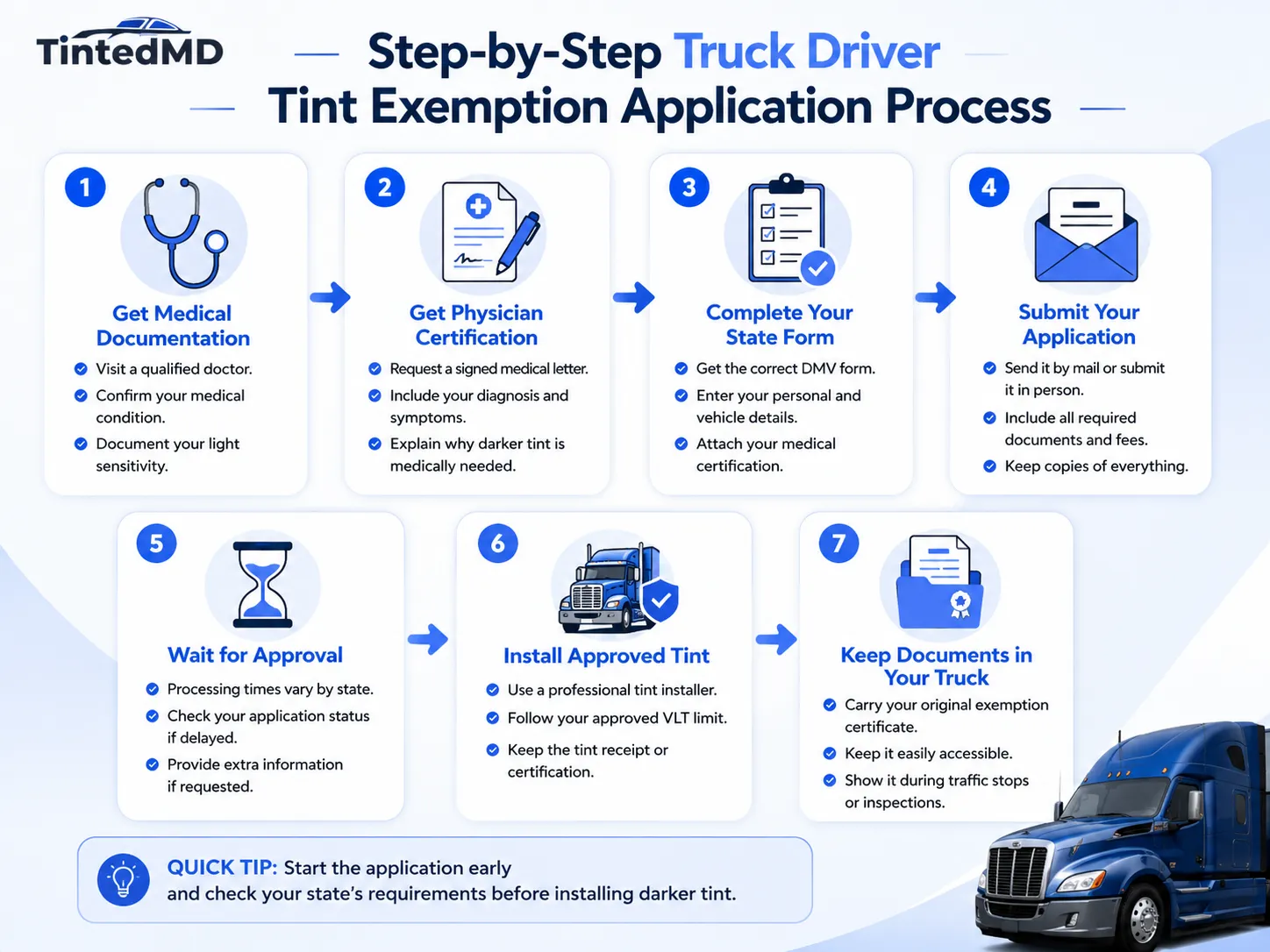
Getting a truck driver tint exemption takes planning. You need medical proof and state approval. The process varies by location but follows a clear path. Start early to avoid delays.
Step 1: Obtain Medical Diagnosis and Documentation
Schedule an appointment with your doctor. A dermatologist, ophthalmologist, or primary care physician can document your condition. They’ll assess whether you have a photosensitive disorder that qualifies.
Your doctor will examine your symptoms. They’ll note how light affects your eyes or skin. This creates the medical foundation for your exemption request.
Step 2: Request Physician Certification Letter
Ask your doctor for a detailed letter on official letterhead. The letter must explain your diagnosis clearly. It should describe your symptoms and why window tinting is medically necessary.
The certification needs specific language. Your physician should state that darker tinting protects your health while driving. This letter becomes your primary supporting document.
Services like medical exemption certification through licensed physicians can simplify this step. They connect you with doctors experienced in writing these letters.
Step 3: Complete State-Specific Application Forms
Download the application from your state’s DMV website. Each state uses different forms. Some require notarization or witness signatures.
Fill out every section completely. Include your personal information, vehicle details, and driver’s license number. Attach your physician’s certification letter to the application.
Step 4: Submit Application with Supporting Documents
According to the Tennessee exemption application process, you’ll need to submit by mail or in person. Include all required documents in one package. Pay the processing fee as specified by your state.
Double-check your submission before sending. Missing documents cause delays. Keep copies of everything you submit for your records.
Step 5: Wait for Approval and Receive Certificate
Processing times range from two to eight weeks. This depends on your state’s workload. Some states process faster than others.
Follow up if you don’t hear back within the expected timeframe. Call the DMV or motor vehicle department. Ask about your application status and whether they need additional information.
Step 6: Install Compliant Window Tinting
Take your approval certificate to a professional installer. Choose someone familiar with medical window tint exemption requirements. They’ll know the exact specifications your state allows.
The installer will apply film that meets your exemption limits. They’ll provide documentation showing the tint percentage. Keep this paperwork with your certificate.
Step 7: Maintain Documentation in Vehicle
Keep your original exemption certificate in your truck at all times. Store it in an accessible location like your glove box. Carry backup copies in case the original gets damaged.
Law enforcement may ask to see your exemption during traffic stops. Having it ready prevents complications. Some states require you to display the certificate on your windshield.
Truck Driver Tint Exemption: Out-of-State Traffic Stops
When an officer stops you for window tinting in another state, stay calm. Present your medical exemption immediately. Explain that you have a documented medical condition requiring darker tinting. Most officers will review your paperwork and let you proceed.
However, some officers may still issue a citation. They might not be familiar with medical exemptions. Or they may question whether your home state exemption applies in their jurisdiction. If this happens, accept the citation without argument. You can contest it later with proper legal support.
Document the stop thoroughly. Note the officer’s name, badge number, and jurisdiction. Take photos of your documentation and the citation. This information helps if you need to fight the ticket. Many citations get dismissed when drivers present comprehensive medical documentation in court.
The practical recommendation is clear. Get exemptions in your home state and any states where you drive regularly. Maintain excellent documentation. Be prepared to explain your medical necessity professionally. This approach minimizes risk while protecting your health needs as a commercial driver with photosensitivity or other qualifying conditions.
Choosing the Right Window Tint for Medical Protection and DOT Compliance
Getting a truck driver tint exemption is only the first step. You also need to choose window film that protects your health without compromising safety. The wrong film can fail inspections or create visibility problems. The right one blocks harmful rays while keeping you legal on the road.
Understanding VLT Percentages and UV Rejection Ratings
VLT (Visible Light Transmission) measures how much light passes through your window film. Lower numbers mean darker tint. A 20% VLT blocks 80% of visible light. A 50% VLT blocks only half.
Here’s what matters for truck drivers with medical exemptions. According to the New York DMV, standard front side window limits sit at 70% VLT in many states. With a medical window tint exemption for commercial drivers, you can go darker. Most exemptions allow 20-35% VLT on front side windows.
But VLT isn’t the whole story. UV rejection rating is separate and more important for medical protection. Quality films block 99%+ of UV radiation even at higher VLT percentages. This protects your skin and eyes from damage during long hauls.
Don’t confuse darkness with protection. A cheap dark film might have low VLT but poor UV blocking. A premium ceramic film can have 35% VLT and still block nearly all UV rays. For medical needs, UV rejection matters more than darkness.
Ceramic vs. Dyed vs. Metallic Films for Medical Use
Three main film types exist, and they perform very differently for medical protection:
-
Ceramic films: Top choice for truck drivers with photosensitivity. They block 99% of UV radiation and reject infrared heat without metal content. No interference with GPS, toll readers, or radio signals. They cost more but deliver the best medical protection.
-
Dyed films: Budget option that darkens windows but offers weak UV protection. UV rejection often drops to 40-60%. Not recommended for medical exemptions where UV blocking is the primary goal.
-
Metallic films: Good UV and heat rejection but contain metal particles. These can interfere with electronic toll collection systems and radio signals. For commercial drivers crossing state lines, this creates practical problems.
Ceramic films win for DOT window tinting regulations compliance. They protect your health without creating equipment interference issues. The investment pays off in comfort and safety over years of driving.
Balancing Medical Protection with Visibility Requirements
Even with an exemption, you can’t go too dark. Extremely dark tinting below 15% VLT compromises night driving visibility. You need to see pedestrians, road signs, and hazards in low light conditions.
Target 20-35% VLT on front side windows where your exemption applies. This range provides meaningful glare reduction and UV protection while maintaining safe visibility. For rear windows, 15-20% VLT works if your state permits it.
Professional installation with warranty protects your exemption status. Poor installation causes bubbling, peeling, or uneven coverage. These defects can invalidate your exemption during inspections. Choose installers experienced with commercial vehicles who understand state by state tint exemption requirements.
Test your visibility before finalizing the installation. Sit in the driver’s seat at dusk and check your sight lines. You should see clearly through side windows and mirrors. If visibility feels compromised, go one shade lighter. Safety comes first, even with medical needs.
Common Truck Driver Tint Exemption Challenges and Solutions
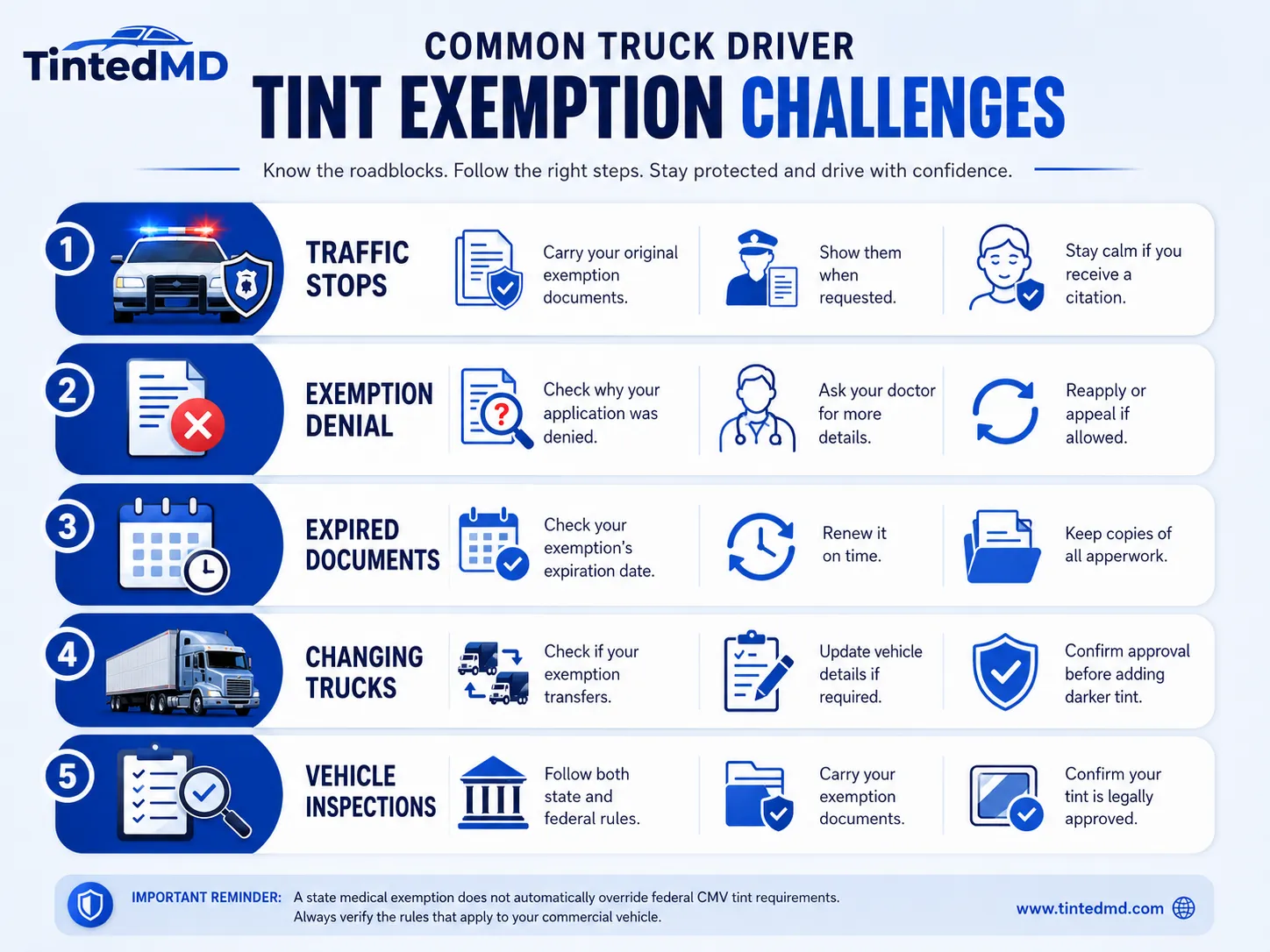
Getting a truck driver tint exemption can help you meet your medical needs while driving, but the process does not always end after approval. You may still face questions during traffic stops, application denials, vehicle changes, or paperwork issues. Knowing how to handle these common problems can help you avoid unnecessary delays, fines, and compliance issues.
Dealing With Law Enforcement During Traffic Stops
Keep your original truck driver tint exemption certificate or required medical documentation in your truck at all times. A digital copy may not be accepted during a roadside inspection or traffic stop. Store the original in a safe and easy-to-reach place, such as the glove box, along with your vehicle registration and other important documents.
If an officer asks about your darker window tint, calmly explain that you have a valid medical tint exemption. Show the required documentation when requested. Do not argue about the tint level or exemption rules at the roadside. If you receive a citation even though you believe your exemption is valid, keep the citation and document the details. You may need to contact your state agency or a qualified traffic attorney for help.
Handling a Truck Driver Tint Exemption Denial
Not every truck driver tint exemption application is approved on the first attempt. A denial may happen because medical information is incomplete, the wrong form was used, or the physician did not provide enough details about the medical need.
Start by reviewing the reason for the denial. Ask your physician to provide clearer information about your condition, symptoms, and need for reduced light exposure if allowed by your state. Check whether your state offers an appeal or reconsideration process before submitting a new application. Always follow the current state requirements rather than assuming the same rules apply nationwide.
Keeping Your Medical Documentation Updated
Medical documentation is an important part of many tint exemption programs. Some states require a specific form, while others accept a signed statement or certificate from a qualified medical provider. The document may also need to identify your medical condition and explain why standard window tint does not provide enough protection.
Check your exemption’s expiration date and renewal requirements. Do not wait until the last minute to renew an expired document. Keep copies of your application, medical certification, exemption certificate, and related state correspondence. Having these records available can make future renewals much easier.
Managing Your Tint Exemption When Changing Trucks
Changing trucks can affect your truck driver tint exemption. Some states connect the exemption to a specific vehicle, while others may require updated vehicle information or a new application. Your existing approval should not automatically be assumed to cover a replacement or newly assigned truck.
Before installing darker tint on a new truck, contact the appropriate state agency and confirm whether your exemption transfers. If an updated certificate or application is required, complete it before using tint that falls below the standard legal limit. Keep your updated exemption paperwork with your new vehicle documents.
Avoiding Problems During Commercial Vehicle Inspections
Commercial truck drivers may face both state tint laws and federal commercial vehicle requirements. This makes it important to confirm that your truck driver tint exemption actually applies to your specific vehicle and window position. A state medical exemption does not necessarily remove federal requirements that apply to commercial motor vehicles.
Before using darker tint, check the rules that apply to your truck, route, and type of operation. Keep your exemption documents available during inspections and make sure your tint matches the approved requirements. When state and federal rules appear to conflict, verify the requirements with the relevant transportation authority before installing or changing your window tint.
Conclusion
You now know how medical window tint exemptions work for commercial drivers. This guide covered state regulations, application requirements, and DOT compliance rules. You learned about telemedicine options that save time. You discovered how to manage exemptions across state lines. You explored ceramic tint options that meet medical needs and legal standards.
The path forward is clear. Start with proper medical documentation from a licensed physician. Choose quality ceramic tint that blocks UV rays without breaking state laws. Keep your exemption paperwork accessible during every trip. Combine your truck driver tint exemption with other sun protection methods for best results.
Don’t let photosensitive conditions put your health and career at risk. Tinted MD connects you with licensed physicians who understand commercial vehicle medical tint laws and can help you get approved fast. Take the first step today to protect your health on every mile of road ahead.
Frequently Asked Questions
What medical conditions qualify for a truck driver tint exemption?
Photosensitivity disorders like lupus or albinism qualify for exemptions. Eye conditions including severe photophobia or post-surgical sensitivity also meet requirements. Skin conditions worsened by UV exposure such as melanoma history qualify. Medication-induced photosensitivity from antibiotics or chemotherapy drugs makes drivers eligible. Each condition requires documentation from a licensed physician. The doctor must explain how darker tinting addresses your specific medical need. States review applications based on documented health vulnerabilities that standard window glass cannot adequately filter.
How dark can window tint be with a medical exemption for commercial drivers?
Approved exemptions typically permit VLT levels between 20-35% for front side windows. This darker tinting blocks more UV radiation than standard legal limits. Most states require front side windows to allow 50-70% of light through without exemptions. The exact darkness allowed depends on your state's regulations. Your medical documentation determines the approved tint level. Doctors specify the VLT percentage needed to protect your condition. The exemption certificate lists the exact darkness level you can legally install.
Do truck driver tint exemptions work across state lines?
Each state sets its own rules for medical window tint exemptions. What works in Texas won't fly in California. Application processes differ between states. Required documentation varies by jurisdiction. For drivers who cross state lines, this creates confusion about what's legal and where. You need to understand regulations in every state you drive through. Some states honor out-of-state medical exemptions while others don't. Carry your exemption certificate and medical documentation when crossing state borders to show law enforcement.
How long does it take to get approved for a truck driver tint exemption?
Approval timelines stretch from days to months depending on your state. Some states process applications quickly with complete documentation. Others require multiple review stages that extend processing time. You must submit medical documentation from a licensed physician first. The state reviews your application and supporting documents. Processing speed depends on application volume and state resources. Plan ahead before installing darker tint on your commercial vehicle. Don't install tinting before receiving official approval to avoid violations.
Can I use telemedicine to get the required medical documentation for a tint exemption?
Telemedicine options save you time off the road for medical appointments. Some states accept documentation from telemedicine consultations. Others require in-person examinations from licensed physicians. Check your state's specific requirements before scheduling a virtual appointment. The doctor must provide detailed documentation of your condition. They need to explain how darker tinting addresses your medical need. Telemedicine works best for follow-up documentation or condition updates. Initial diagnoses may still require in-person evaluation depending on state rules.
What should I do if law enforcement stops me while driving with medical tint across multiple states?
Carry your exemption certificate and medical documentation at all times. Show officers your approved exemption immediately when stopped. Explain that you have a medical condition requiring darker tint. Keep copies of your documentation in multiple locations in your truck. Some officers may not recognize out-of-state exemptions initially. Stay calm and provide all requested paperwork. Your documentation should include the doctor's contact information. Officers can verify your exemption if needed. Know the tinting laws for states you regularly drive through.
Do truck drivers need a doctor's note for a window tint exemption?
In most cases, truck drivers need medical documentation from a licensed physician or qualified healthcare provider to apply for a window tint exemption. Depending on the state, this may be a specific DMV tint exemption form, physician certification, or medical statement explaining the driver's qualifying condition and why additional protection from sunlight is medically necessary. Requirements vary by state, so drivers should use the appropriate official form and follow their state's application process.
Can a Medical Tint Exemption Be Used on a Commercial Truck?
A medical tint exemption may be available for a commercial truck, but state approval does not automatically override federal commercial motor vehicle (CMV) requirements. Truck drivers must comply with applicable federal glazing standards as well as the tint laws of the state where the vehicle is registered and operated. Before installing medical tint, drivers should confirm that the requested tint level is permitted for their specific CMV and obtain any required state documentation.

Meet the author
Nida Hammad
I am a professional writer with over five years of experience creating clear, engaging, and well-researched content. I specialize in medical window tint exemptions and state compliance topics, helping readers understand tint laws and exemption requirements in simple, easy-to-follow language. Currently, I write for TintedMD, where I focus on producing accurate, trustworthy guides to help drivers navigate the medical tint exemption process with confidence.
Get Your Medical Tint Exemption Online in Minutes
Check Your Eligibility