
Does a Tint Exemption Work in Another State? | TintedMD
 by Nida Hammad
Last updated:
Medically reviewed by:
Dr. Matthew Reynolds, MD


Does a Tint Exemption Work in Another State? The short answer is: not automatically. Your home state’s medical window tint exemption does not transfer to another state. Most states do not accept medical tint documents issued by another state.
Each state sets its own limits for how dark window tint can be. Each state also decides whether to accept medical exemptions from other states. These different rules can put you at risk of traffic stops and fines when you travel or move.
This guide explains how medical tint exemptions work across state lines. You’ll learn which states may accept out-of-state documents. You’ll also learn what documents to carry when driving in different states and what steps to take when moving to another state. This can help you protect yourself legally and avoid penalties while keeping the medical protection you need.
How Does Medical Tint Exemption Work in Another State?

Window tint laws are set by individual states, not the federal government. This means each state has control over its own rules, requirements, and enforcement. There is no national standard for medical tint exemptions. This makes things more complex when drivers travel or move to another state.
Why Each State Issues Its Own Exemptions
States set vehicle rules through their own traffic laws. Medical exemptions are part of these rules because window tint can affect vehicle safety and how well law enforcement can see inside a vehicle.
Each state sets its own medical conditions, document requirements, and approval process. A medical condition that qualifies for an exemption in one state may not qualify in another. For example, Georgia requires applicants to submit specific medical documents from a physician that meet the state’s requirements.
The Legal Framework Behind Tint Regulations
State lawmakers create vehicle laws that set basic limits for window tint darkness. These limits are usually measured by Visible Light Transmission (VLT), which shows how much light can pass through the window.
These laws may also allow state DMVs or medical boards to approve exceptions for people with documented medical needs.
The rules aim to balance public safety with real medical needs. Law enforcement needs to see inside vehicles during traffic stops. At the same time, people with photosensitivity conditions may need window tint to reduce UV exposure.
What Your Exemption Certificate Actually Authorizes
Your certificate is a legal document that changes how vehicle tint laws apply to your car. It usually states which windows can be tinted, how dark the tint can be, and when the certificate expires.
Most exemptions require a doctor’s proof of a qualifying condition, such as photosensitivity, lupus, or albinism. The certificate usually protects you only in the state that issued it. This is why it is important to know each state’s exemption rules and whether other states recognize them when you travel or move.
Interstate Recognition: Which States Honor Out-of-State Exemptions
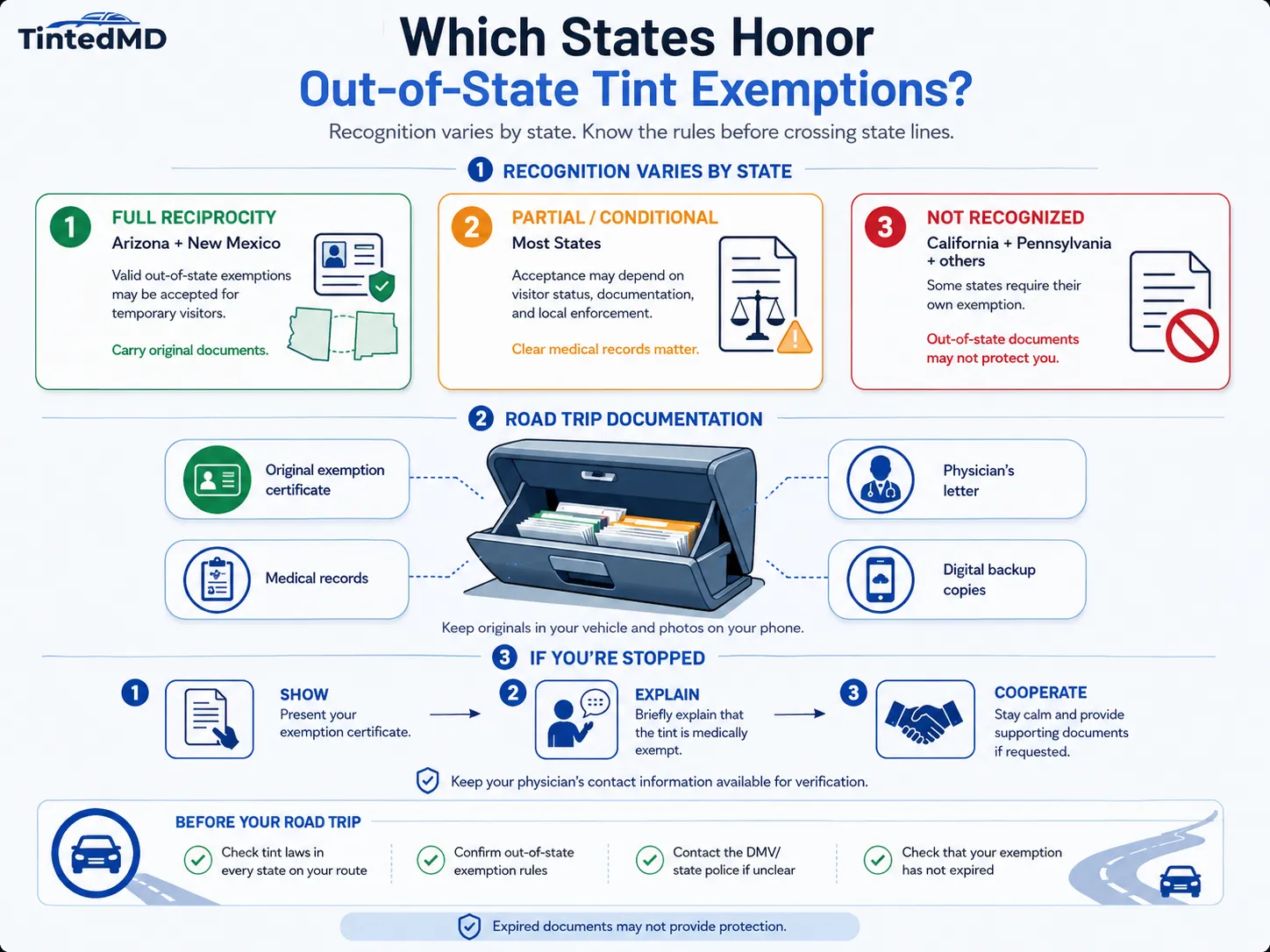
No universal agreement exists between states for medical tint exemptions. Each state decides how it handles documents issued by another state. This means rules can vary widely when you drive across state lines.
States with Full Reciprocity Policies
Very few states fully recognize medical tint exemptions from other states. Arizona and New Mexico recognize valid out-of-state exemptions for temporary visitors. However, you must carry the original documents.
These states usually accept exemptions when the medical condition is clearly documented and the tint level is within a reasonable range. Understanding window tint laws by state helps you identify which jurisdictions may accept your existing exemption.
States with Partial or Conditional Recognition
Most states fall into this category. In these states, law enforcement officers may decide whether to accept an out-of-state exemption during a traffic stop. Officers may accept exemptions from temporary visitors but may issue citations to new residents who have not obtained local documents.
Clear and complete medical documents can affect whether an officer accepts an out-of-state exemption. A properly prepared exemption certificate with clear physician documentation is usually more helpful than a handwritten note. Many drivers who work with TintedMD find that complete documentation can reduce enforcement issues when traveling across state lines.
According to the Ceramic Pro tint law guide, states with stricter tint regulations are less likely to recognize exemptions from states with more permissive standards.
States That Do Not Recognize External Exemptions
California, Pennsylvania, and several other states require you to obtain their specific exemption even if you already have one from another state. These jurisdictions treat out-of-state exemptions as invalid for enforcement purposes.
New residents face the strictest requirements, typically needing to apply for local exemptions within 30 to 90 days of establishing residency. Failure to do so results in citations regardless of your previous state’s documentation. state-by-state tint law comparison goes into more depth on this.
Traveling Through Multiple States: What You Need to Know
Crossing state lines with a medical tint exemption requires preparation. Each state enforces its own tint laws, and officers may not recognize your documentation without proper context.
Documentation Requirements for Interstate Travel
Always carry your original exemption certificate when driving to another state. Keep your physician’s letter and medical records in your glove box.
Save digital copies on your phone as a backup. Take clear photos of all documents so you can show them quickly if needed.
Virginia’s sun-shading rules require proper medical documents. These documents help officers confirm your exemption during a traffic stop. Keeping extra copies also protects you if you lose the originals while traveling.
How to Handle Traffic Stops in Other States
If an officer stops you for window tint, show your exemption certificate right away. Briefly and politely explain your medical condition.
Many officers may give warnings instead of tickets for out-of-state medical exemptions, especially when you have clear documents. Stay calm and cooperate during the stop.
TintedMD helps drivers understand how to prepare documents for travel. Keep your physician’s contact information with you in case the officer needs to verify your exemption.
Planning Road Trips with Medical Tint Exemptions
Check the tint laws in every state on your route before you leave. Enforcement rules can vary from state to state.
Contact the state police or DMV before your trip to ask about their rules for out-of-state exemptions. Some states have specific guidance for visitors who have medical needs.
Check exemption renewal requirements before long trips to ensure your certificate remains valid throughout your journey. An expired exemption offers no legal protection, even in your home state.
Relocating to a New State: Transferring Your Tint Exemption

Moving to a new state with a medical window tint exemption needs careful planning. Your current exemption will not automatically transfer. You need to know your new state’s rules to stay compliant.
When You Must Apply for a New Exemption
Most states require new residents to get a local exemption within 30 to 90 days after becoming a resident. The deadline varies by state, so check your new state’s DMV rules as soon as you move.
Your old state’s exemption may give you temporary protection during the move. Some states may recognize it for a short time. But do not rely on this without checking the rules first.
According to the New York DMV, residents must provide medical documents from a licensed doctor with their application.
The Application Process in Your New State
You will need new medical documents that meet your new state’s rules. Each state has its own rules about which conditions qualify and what doctors must include in the paperwork.
Some states accept medical records from your previous doctor. Others may require you to see a local doctor. Contact your new state’s DMV before moving to learn the exact requirements and avoid delays.
Timeline and Documentation Requirements
Processing times vary by state. Some applications may be approved right away, while others can take several weeks. Plan ahead and apply early to avoid a gap in legal protection.
Fees for new exemptions can range from free to more than $100, depending on the state. Include this cost in your moving budget so you can complete the process without delays.
Legal Risks and Consequences of Non-Compliant Tint
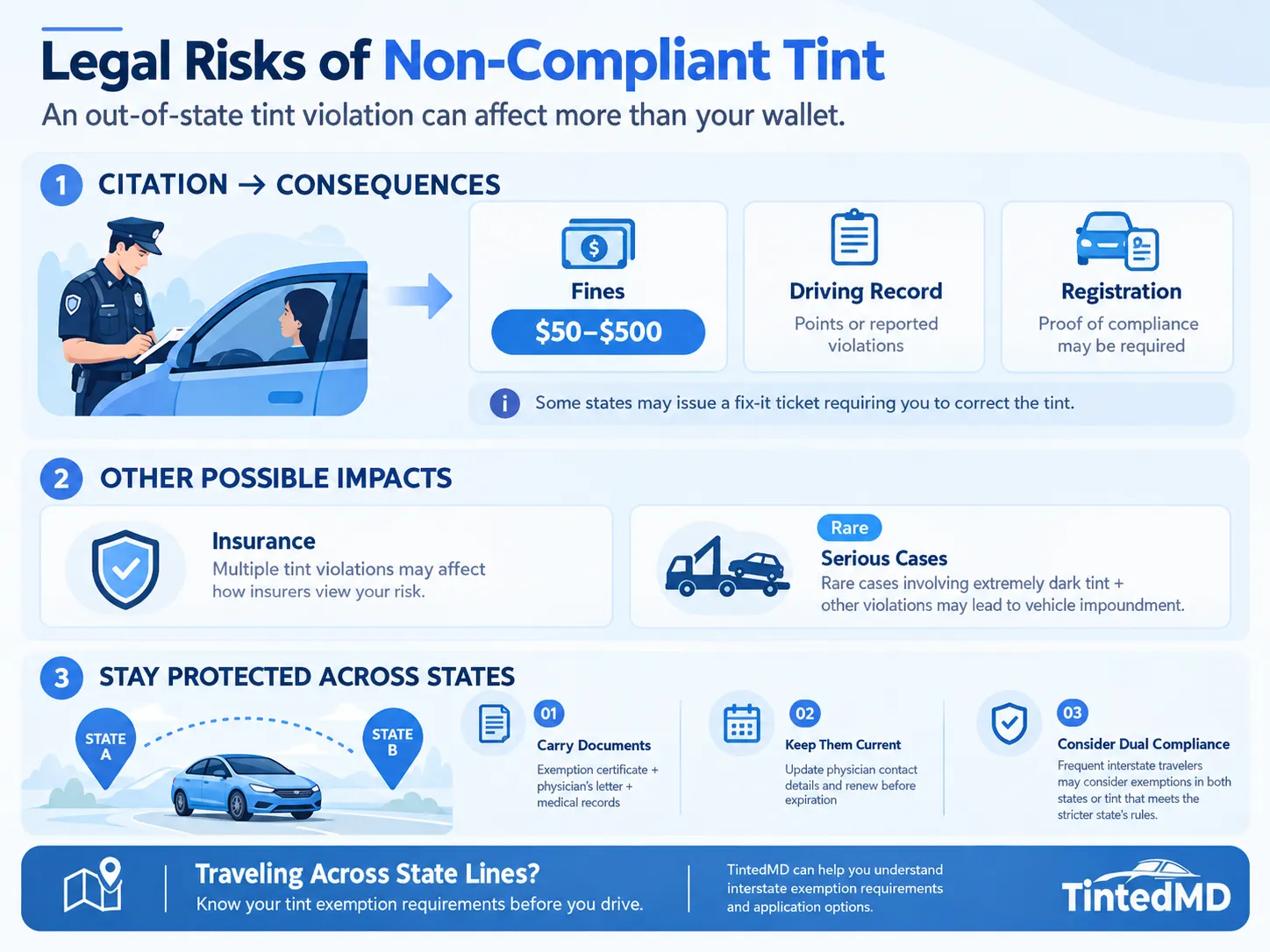
Driving with window tint that does not meet another state’s laws can lead to legal penalties. These may affect your money, driving record, and vehicle registration. Even if your home state gave you a valid exemption, police in another state may not accept it.
What Happens If You’re Cited in Another State
Tickets for illegal window tint often come with fines of $50 to $500, depending on the state. Some states treat tint violations as fix-it tickets. This means you may need to remove the tint and show proof that you fixed the problem to avoid the fine.
Repeated violations may lead to higher fines, points on your license, or vehicle registration problems. An out-of-state tint ticket may also affect your driving record in your home state. This can happen through agreements that allow states to share driving violation information.
Understanding the financial impact of citations versus exemption costs helps you make informed decisions about compliance.
Insurance and Registration Implications
Insurance companies may view tint violations as equipment infractions that could impact your rates. While a single citation rarely causes rate increases, multiple violations signal risk to insurers.
Some states flag vehicles with tint violations during registration renewal, requiring proof of compliance before issuing new tags. This creates complications if you’re registered in one state but cited in another.
Criminal vs. Civil Violations
Most tint violations are civil infractions handled through fines. However, in rare cases, extremely dark tints combined with other violations can result in vehicle impoundment.
Law enforcement may escalate charges if tint interferes with officer safety during traffic stops or if it’s part of a pattern of equipment violations. These situations remain uncommon but carry more serious consequences than standard citations.
Best Practices for Multi-State Compliance
Managing tint exemptions across state lines requires careful attention to documents and state laws. Following these steps can help you avoid citations and stay protected wherever you drive.
Maintaining Valid Documentation Across Jurisdictions
Keep your original exemption certificate, physician’s letter, and medical records in your vehicle at all times. Keep copies in more than one place, such as your glove box, wallet, and phone.
Make sure your physician’s contact information is up to date on all documents. Under the Massachusetts tinted glass waiver process, law enforcement may need to verify your medical documents during a traffic stop.
Renew your exemption before it expires to avoid gaps in coverage. Most certificates must be renewed every one to three years, depending on your state’s rules.
When to Consider Dual Exemptions
If you often travel between two states for work or family, getting an exemption in both states can provide more legal protection. This can reduce uncertainty during traffic stops and lower your risk of citations.
If you travel often, consider using tint that meets the stricter state’s requirements. This can make it easier to follow the rules when crossing state lines. However, it may mean using lighter tint than your medical condition ideally requires.
Working with TintedMD for Interstate Solutions
TintedMD helps you understand which states may recognize your current exemption and can assist with applications in other states. Professional exemption services can make the document process easier and help you meet different state requirements.
The service connects you with qualified physicians who understand each state’s medical requirements. This can be especially helpful when you move or become a resident of a new state with different tint laws.
Conclusion
Whether a Tint Exemption Work in Another State depends on where you travel and how long you stay there. There is no federal reciprocity agreement, so each state may apply its own rules when you enter. The best protection is to carry complete medical documents and check the specific laws of states you visit regularly.
If you plan to travel for a long time or move to another state, start by gathering your medical records and physician’s contact information. Check if your destination state recognizes out-of-state exemptions for visitors. If you are moving, start the application for a new exemption within your first month of residency. These steps can help prevent citations and reduce stress about your legal status.
If you need help understanding tint exemption rules across state lines, TintedMD can help. We can also help you get the right documents for multiple states. We make the process easier and help you stay protected wherever you drive.
Frequently Asked Questions
Does a tint exemption work in another state?
Not automatically. Window tint laws are set by each state, and most states do not accept a medical tint exemption issued by another state. Some officers or agencies may show leniency, but acceptance is never guaranteed, so check the rules of every state you plan to drive in.
Can I be pulled over in another state for dark window tint even with a medical exemption?
Yes. If your tint is darker than the visiting state's legal limit and that state does not recognize your exemption, an officer can stop you and issue a citation. Carrying your exemption paperwork and a physician's letter gives you something to show, but the officer or court decides whether to accept it.
How does a medical tint exemption work in another state if I'm only traveling through?
Driving through a state does not place you outside its laws, so its tint rules can still apply. A few states give visiting vehicles some leniency if they follow their home state's rules, while others do not. Look up the tint laws for each state on your route before you leave.
What documents should I carry when driving across state lines with tinted windows?
Carry a copy of your home state's exemption certificate, a signed letter from your physician describing the medical need, and your vehicle registration. It also helps to have the tint percentage (VLT) of your windows and your doctor's contact details. Keep these in the vehicle so you can show them quickly during a traffic stop.
What should I do with my tint exemption if I move to a new state?
Contact the new state's DMV or highway safety agency as soon as you move to learn its tint limits and medical exemption process. In most cases you will need to apply for a new exemption with updated medical documentation. If the new state denies it, you may have to replace your tint with a legal shade.
Can I apply for a medical tint exemption in a state where I don't live?
Usually not. Most states require the applicant to be a resident or to have the vehicle registered there, and many require a form completed by a licensed physician. Check the requirements with the state's motor vehicle agency before you apply.
What happens if I get a ticket for dark tint in another state while holding a medical exemption?
The ticket may be a fine, a fix-it order, or both, depending on the state. You can usually bring your medical documentation to court and ask for a reduction or dismissal, though the result is up to the judge. If the state does not accept out-of-state exemptions, you may need to remove the tint or apply for that state's own exemption to avoid repeat citations.

Meet the author
Nida Hammad
I am a professional writer with over five years of experience creating clear, engaging, and well-researched content. I specialize in medical window tint exemptions and state compliance topics, helping readers understand tint laws and exemption requirements in simple, easy-to-follow language. Currently, I write for TintedMD, where I focus on producing accurate, trustworthy guides to help drivers navigate the medical tint exemption process with confidence.
Get Your Medical Tint Exemption Online in Minutes
Check Your Eligibility