If you’re dealing with a medical condition that makes sun exposure painful or dangerous, darker window tints can provide crucial protection while driving. However, most states have strict tint laws that limit how dark your windows can be. Fortunately, many states offer medical exemptions that allow qualifying individuals to install darker tints than normally permitted.
This comprehensive guide walks you through everything you need to know about how to get window tint exemption in 2026, including qualifying conditions, the application process, state-specific requirements, and modern telehealth options that make getting your exemption faster and more convenient.
What is a Window Tint Medical Exemption?

A window tint medical exemption is a legal permit that allows individuals with specific medical conditions to install window tint darker than their state’s standard legal limits. These exemptions recognize that certain health conditions require additional protection from sunlight and UV radiation while driving.
Standard window tint laws vary by state but typically restrict how much light must pass through vehicle windows, measured as Visible Light Transmission (VLT) percentage. For example, many states require at least 35% VLT on front side windows, meaning 35% of visible light must pass through the glass.
Medical exemptions override these standard restrictions, allowing patients with qualifying conditions to install significantly darker tints—sometimes as low as 5% VLT on certain windows. However, these exemptions always require proper documentation from a licensed medical professional and registration with your state’s motor vehicle department.
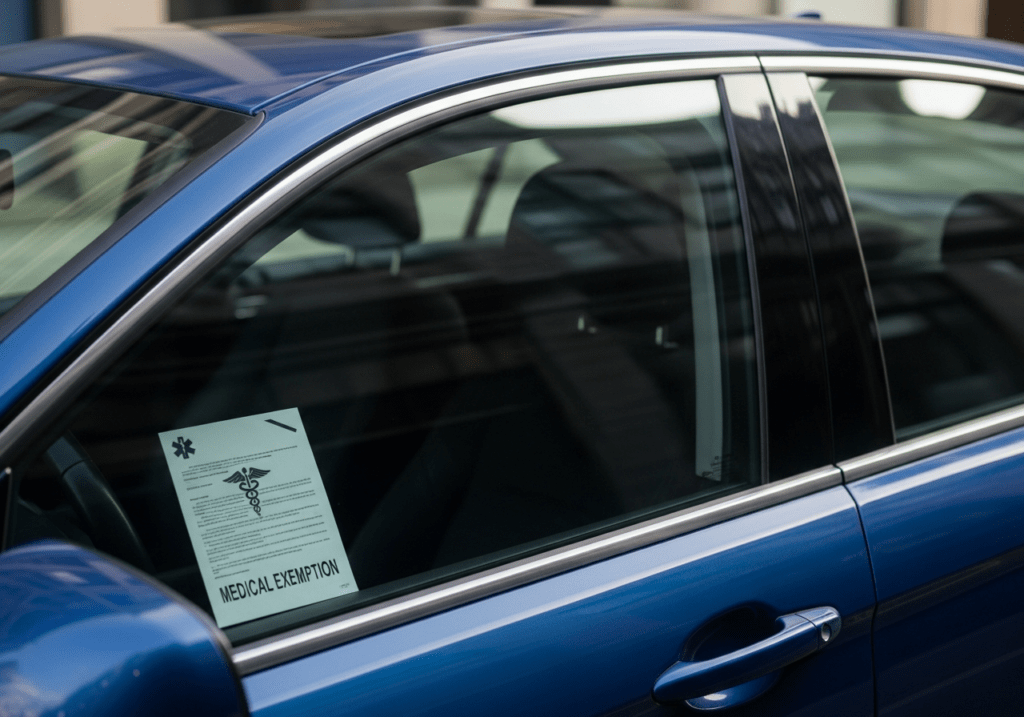
The exemption typically comes in the form of a certificate or letter on official medical letterhead that you must carry in your vehicle at all times. Law enforcement officers can request to see this documentation during traffic stops to verify your tint is legally authorized.
Who Qualifies for a Medical Exemption?

Not everyone can obtain a window tint medical exemption—states require legitimate medical conditions that are aggravated by sunlight or UV exposure. While specific qualifying conditions vary by state, the most commonly accepted medical reasons include:
Photosensitivity Disorders: Conditions that cause extreme sensitivity to light, including solar urticaria, polymorphous light eruption, and chronic actinic dermatitis. These disorders can cause painful skin reactions, rashes, or even blistering when exposed to sunlight.
Lupus (Systemic Lupus Erythematosus): This autoimmune disease causes severe photosensitivity, and UV exposure can trigger dangerous flare-ups. Many lupus patients are specifically advised by their rheumatologists to minimize sun exposure.
Skin Cancer History: Individuals with a history of melanoma, basal cell carcinoma, or squamous cell carcinoma often qualify, as reducing UV exposure is critical for preventing recurrence.
Albinism: People with albinism lack melanin pigmentation and are extremely vulnerable to sun damage and skin cancer, making darker window tints medically necessary.
Medications Causing Photosensitivity: Certain medications, including some antibiotics, diuretics, and chemotherapy drugs, can make skin hypersensitive to sunlight as a side effect.
Eye Conditions: Serious photophobic conditions like corneal dystrophies, severe cataracts, or ocular albinism may qualify in some states, though requirements vary.
Porphyria: This rare group of disorders affects the skin or nervous system and can cause severe reactions to sunlight exposure.
Your physician will need to certify that your condition genuinely requires protection from sunlight beyond what standard tint laws provide. States typically won’t approve exemptions for minor complaints or convenience, the medical need must be documented and significant.
5-Step Process to Obtain a Window Tint Exemption

Step 1: Verify Your State Allows Medical Exemptions
Not all states offer medical exemptions for window tint, so your first step is confirming whether your state has this program. Currently, most states do allow medical exemptions, but the process and requirements differ significantly.
Visit your state’s DMV or motor vehicle department website and search for “window tint medical exemption” or “window tint waiver.” Look for official information about the application process, qualifying conditions, and required documentation. Some states have straightforward online resources, while others may require calling the DMV directly.
If your state doesn’t offer medical exemptions, unfortunately you’ll need to comply with standard tint laws regardless of your medical condition. In these cases, consider alternative sun protection methods like UV-blocking films that meet legal limits or prescription eyewear.
Step 2: Gather Medical Documentation
Once you’ve confirmed your state allows exemptions, compile documentation of your medical condition. This should include medical records, diagnosis statements, prescription medications, and any specialist reports that demonstrate your photosensitivity or sun-related health issues.
Having thorough documentation ready before your doctor’s appointment streamlines the process and helps your physician write a comprehensive exemption letter. If you’ve been treated by multiple specialists, gather records from all relevant providers.
Step 3: Schedule an Appointment with a Licensed Physician
You’ll need an examination and written certification from a licensed medical doctor (MD) or doctor of osteopathic medicine (DO). In most states, nurse practitioners and physician assistants cannot write window tint exemption certificates, though some states do accept these providers.
During your appointment, the physician will review your medical history, examine your condition, and assess whether a window tint exemption is medically justified. Be prepared to discuss how sunlight affects your condition and why standard window tints are insufficient for your needs.
The doctor will then write an official letter or complete a state-specific exemption form. This document must include your name, the medical condition requiring the exemption, the physician’s license number and signature, and typically a statement certifying that darker window tints are medically necessary.
Telehealth Option: Online telemedicine platforms now offer virtual appointments specifically for window tint medical exemptions. These virtual consultations are typically faster and more affordable than traditional in-person visits, with most appointments completed within 24-48 hours.
Step 4: Submit Documentation to Your State DMV
Take your physician’s letter and any required application forms to your state’s motor vehicle department. Some states allow online or mail submissions, while others require in-person visits. Check your state’s specific requirements to avoid delays.
You’ll likely need to provide:
- The original signed medical certificate from your physician
- A completed state application form
- Valid driver’s license or identification
- Vehicle registration information
- Application fee (typically $10-$50)
Some states issue an official exemption certificate that you must carry in your vehicle, while others simply add a notation to your driver’s license or vehicle registration. Make sure you understand what documentation you need to carry to prove your exemption is valid.
Step 5: Install Your Window Tint and Maintain Documentation
After receiving approval, you can have your windows tinted to the specifications allowed under your exemption. Choose a reputable tint installer who understands medical exemption requirements and can ensure your installation complies with your state’s approved limits.
Even with an exemption, there are usually still some restrictions. For example, many states prohibit tinting the windshield beyond a certain strip at the top, or require minimum VLT percentages on front windows even with an exemption.
Always carry your exemption documentation in your vehicle. If you’re stopped by law enforcement, you’ll need to present this certificate along with your license and registration. Failing to produce valid exemption documentation can result in citations.
Exemptions typically need renewal every 1-3 years depending on your state, so mark your calendar and complete the renewal process before expiration to avoid legal issues.
State-by-State Requirements | How to Get Window Tint Exemption

Requirements for obtaining and maintaining window tint medical exemptions vary significantly by state. Here’s a comparison of the top 10 most-searched states for this information:
| State | Medical Exemption Allowed | Qualifying Conditions | Required Documentation | Exemption Fee | Renewal Period |
| California | Yes | Lupus, photosensitivity, skin cancer history | Physician letter on letterhead, signed statement | No fee | Must reapply if condition changes |
| Florida | Yes | Any condition causing photosensitivity | Completed form by licensed physician | $10 | No expiration if permanent condition |
| Texas | Yes | Documented medical need for sun protection | Physician certification form | $10 | Annual renewal required |
| New York | Yes | Light-sensitive conditions approved by physician | Medical exemption form signed by MD | $10 | Must be renewed with physician updates |
| Illinois | Yes | Photosensitive medical conditions | Physician-signed medical exemption certificate | $50 | Typically every 2 years |
| Pennsylvania | Yes | Photosensitivity, lupus, albinism, skin conditions | Medical certification form with diagnosis | $10-$20 | Varies by condition permanence |
| Georgia | Yes | Conditions requiring reduced light exposure | Signed physician statement with diagnosis | $15 | Must reapply every 3 years |
| North Carolina | Yes | Medical necessity certified by ophthalmologist | Specific NC medical exemption form | No fee | Annual renewal required |
| Arizona | Yes | Photosensitive or light-aggravated conditions | Physician affidavit with medical reasoning | $10 | Renewal every 2-3 years |
| Ohio | Yes | Light-sensitive medical conditions | Completed exemption application with MD signature | $20 | Renewal required every 2 years |
Important Notes:
- Requirements frequently change, so always verify current rules with your state DMV
- Some states have stricter physician requirements (MD only vs. accepting DO or specialists)
- Exemption limits vary—most states still prohibit extremely dark windshield tints even with exemptions
- A few states like Michigan and New Hampshire have limited or no medical exemption programs
Before proceeding with your application, visit your specific state’s motor vehicle department website or call their customer service line to get the most current requirements and downloadable forms.
How Telehealth Services Simplify the Exemption Process
Traditional methods of obtaining window tint exemptions often involve scheduling appointments weeks in advance, taking time off work, and paying high consultation fees. Telehealth platforms have revolutionized this process by offering convenient, affordable online consultations specifically designed for window tint medical exemptions.
The Telehealth Process:
1. Online Booking: Schedule a virtual appointment at your convenience through a telemedicine platform. Most services offer same-day or next-day availability, dramatically faster than traditional medical appointments.
2. Virtual Consultation: Connect with a licensed physician via video call from your home or office. The consultation typically lasts 10-15 minutes, during which the doctor will review your medical history, ask about your condition, and assess whether you qualify for an exemption.
3. Medical Records Review: Upload relevant medical documentation, prescription information, or specialist reports through the secure patient portal. The physician reviews these materials to verify your qualifying condition.
4. Exemption Certificate Issuance: If approved, the physician prepares an official medical exemption letter on professional letterhead, complete with their license number, signature, and detailed medical justification. Most services provide this documentation within 24-48 hours.
5. State-Compliant Documentation: Reputable telehealth platforms ensure the exemption letter meets your specific state’s requirements, including proper formatting, required language, and physician credentials.
Benefits of Telehealth for Window Tint Exemptions:
- Speed: Get your exemption certificate in 1-3 days instead of weeks
- Convenience: No travel required, flexible scheduling including evenings and weekends
- Cost-Effective: Typically $150-$250 compared to $300-$500 for traditional doctor visits
- State Compliance: Physicians familiar with state-specific requirements
- Accessibility: Particularly valuable for those in rural areas without easy access to specialists
Is Telehealth Right for You?
Telehealth works best if you have clear documentation of your qualifying condition, such as existing medical records, prescriptions, or specialist diagnoses. If you’re unsure whether you qualify or need a new diagnosis, a traditional in-person appointment may be more appropriate.
Make sure the telehealth service you choose employs physicians licensed in your state, as this is typically required for window tint exemptions. Reputable services will verify state licensure before scheduling appointments.
Expected Timeline and Costs for Window Tint Medical Exemptions
Understanding the complete timeline and cost breakdown helps you plan appropriately and budget for the exemption process.
Timeline Breakdown:
Week 1: Schedule and complete physician appointment (traditional: 1-3 weeks wait time; telehealth: 24-48 hours)
Week 2: Receive medical exemption certificate and submit application to DMV (processing time: immediate to 2 weeks depending on state)
Week 3: Receive approval and schedule window tint installation (installation: 2-4 hours)
Total Expected Timeline:
- Traditional route: 3-6 weeks from start to finish
- Telehealth route: 1-2 weeks from start to finish
Cost Breakdown:
Medical Consultation: $150-$500
- In-person specialist visit: $300-$500 (may be covered by insurance)
- Primary care physician: $150-$300
- Telehealth service: $150-$250 (typically not covered by insurance)
State Application Fee: $0-$50
- Most states charge $10-$20
- Some states like California have no fee
- Illinois charges up to $50
Window Tint Installation: $200-$600
- Standard vehicle (4-5 windows): $200-$400
- Larger vehicles or premium films: $400-$600
- Medical-grade UV-blocking films may cost more
Total Expected Investment: $350-$1,150
Many people find that investing in the exemption is worthwhile given the long-term health protection and reduced risk of skin damage or condition flare-ups. If you have a chronic condition requiring permanent sun protection, this one-time investment provides years of safer driving.
Some health insurance plans may cover the physician consultation if your doctor codes it as a medical necessity related to your underlying condition rather than specifically for a tint exemption. Check with your insurance provider before scheduling.
Common Mistakes to Avoid When Applying for Window Tint Exemptions
Many applicants encounter delays or rejections due to avoidable errors. Here are the most common mistakes and how to prevent them:
Using Unsigned or Improperly Formatted Documents: State DMVs are strict about formatting requirements. Make sure your physician’s letter includes all required elements: your full name, specific diagnosis, medical justification, physician’s printed name and signature, license number, and contact information. Missing any of these elements can result in rejection.
Applying in a State That Doesn’t Recognize Your Exemption: Window tint exemptions are typically state-specific and may not be honored if you move or drive in other states. If you relocate, you’ll need to reapply in your new state. When traveling, carry your medical documentation but be aware that other states’ law enforcement may not recognize your exemption.
Installing Tint Before Receiving Approval: Always wait for official DMV approval before having your windows tinted. If you install illegal tint and then get denied for an exemption, you’ll need to remove the tint and pay removal costs. Some states require proof of exemption approval before installation.
Exceeding Exemption Limits: Medical exemptions have limits,you can’t install completely blacked-out windows even with an exemption. Most states still require minimum VLT percentages and prohibit dark windshield tints except for a small strip at the top. Make sure your installer understands your exemption’s specific limits.
Failing to Renew on Time: Many states require exemption renewals every 1-3 years. Set calendar reminders well in advance of your expiration date. Driving with an expired exemption is the same as having illegal tint, and you can be cited even though you previously had valid documentation.
Not Carrying Documentation in Vehicle: Your exemption certificate must be in your vehicle whenever you’re driving. Keep it with your registration and insurance documents. Consider making a laminated copy to prevent damage, but always have the original or state-issued certificate as required by your state.
Frequently Asked Questions
Can I get a medical exemption for existing health conditions that my doctor diagnosed years ago?
Yes, as long as your condition is still active and your physician can certify that it currently requires sun protection. You’ll need a current medical certificate, old diagnoses must be re-certified by a physician within a specific timeframe (usually within the past year).
Will my window tint exemption be honored in other states?
Generally no. Window tint exemptions are state-specific permits and other states are not required to honor them. If you frequently travel across state lines or move to a new state, you may need to comply with that state’s standard tint laws or apply for a new exemption.
Can I get an exemption for my windshield?
Most states allow very limited windshield tinting even with medical exemptions, typically restricting dark tint to a small strip at the top (4-6 inches). Some states prohibit any windshield tint beyond factory-installed shading regardless of medical need due to safety concerns about driver visibility.
What happens if I’m pulled over with medical exemption tint?
Present your exemption certificate along with your license and registration. Law enforcement officers are trained to verify tint exemptions. As long as your documentation is current and your tint complies with your exemption specifications, you should not receive a citation.
Do insurance companies cover window tint medical exemptions?
Health insurance typically doesn’t cover the window tint installation itself, but may cover the physician consultation if properly coded as treatment for your underlying medical condition. Check with your insurance provider before scheduling your appointment.
Can I apply for an exemption for someone else’s vehicle?
Generally no. Exemptions are granted to individuals, not vehicles. However, if you regularly drive multiple vehicles (such as a personal car and a work vehicle), some states allow you to register multiple vehicles under one exemption certificate.