DMV Rejected My Tint Exemption: Fix the Exact Problem and Get Approved This Time
 by Nida Hammad
 Last updated:
Medically reviewed by:
Dr. Matthew Reynolds, MD


DMVs may reject a medical window tint exemption application because of incomplete forms, missing physician documentation, incorrect vehicle information, or state-specific requirements that weren’t met. A window tint medical exemption may be available if a licensed physician determines medical necessity. Eligibility varies by state, so reviewing your state’s requirements before submitting can help avoid preventable delays.
Most medical window tint exemptions get rejected for five fixable paperwork errors, not because the applicant doesn’t qualify. A missing physician signature, diagnosis language that doesn’t connect your condition to UV sensitivity while driving, a doctor not licensed in your state, a requested VLT below your state’s minimum, or the wrong form version. That’s it. Fix any one of those and you resubmit a complete package. No new doctor visit required. No starting over. The same condition that qualified you yesterday still qualifies you today, the DMV just needs the paperwork to say so correctly.
You went through the process. You saw a doctor. You filled out the forms. And now the DMV has come back with a rejection on your window tint exemption. If that has happened to you, you are not alone. And if you are trying to avoid it happening in the first place, you are asking exactly the right question.
A medical exemption for window tint lets drivers with qualifying health conditions install darker tint than state law normally permits. Conditions like lupus, photophobia, albinism, photosensitive porphyria, and certain skin cancers can make unfiltered sunlight genuinely dangerous. The exemption exists for a real reason. But the paperwork standards are strict, and small errors in the paperwork are the most common reason for rejection.
This guide covers the five most common reasons a window tint exemption gets rejected, exactly how to fix each one, what the reform process looks like, and how TintedMD helps patients get their exemption approved correctly the first time without multiple trips to the DMV or the doctor’s office.
If you want to skip straight to the solution, TintedMD connects you with a licensed physician who completes your exemption paperwork to state standards, with same-day delivery.
How the Window Tint Exemption Process Actually Works
Before getting into what goes wrong, it helps to understand the standard process for a window tint exemption. Most states follow the same basic structure, though the specific forms and rules vary.
In most states, you need three things to get a medical window tint exemption approved. First, you need a doctor’s signed letter confirming your diagnosis and the medical need for darker tint. Second, you need to submit a state-specific form form (often along with your vehicle registration). Third, in some states, you carry the certification in your vehicle and do not need any further DMV action. In others, the DMV issues a formal permit or sticker after reviewing your form.
Two states, Colorado and Kansas, do not offer medical exemptions for window tint at all, regardless of diagnosis. If you live in either of those states, UV-blocking clear film is the only legal option for additional sun protection.
New York is a clear example of a state with a defined qualifying condition list. According to the New York DMV medical exemptions, qualifying conditions include lupus, photophobia, albinism, and any condition causing severe photosensitivity where shielding from the sun is medically required.
The exemption, once approved, is usually tied to a specific vehicle. If you buy a new car, you usually need to reapply. And most exemptions must be renewed periodically, typically every one to three years, though some states like Florida issue non-expiring certificates for certain qualifying conditions. For state-specific rules, the TintedMD state guide covers current rules across all qualifying states.
The 5 Most Common Reasons a Window Tint Exemption Gets Rejected
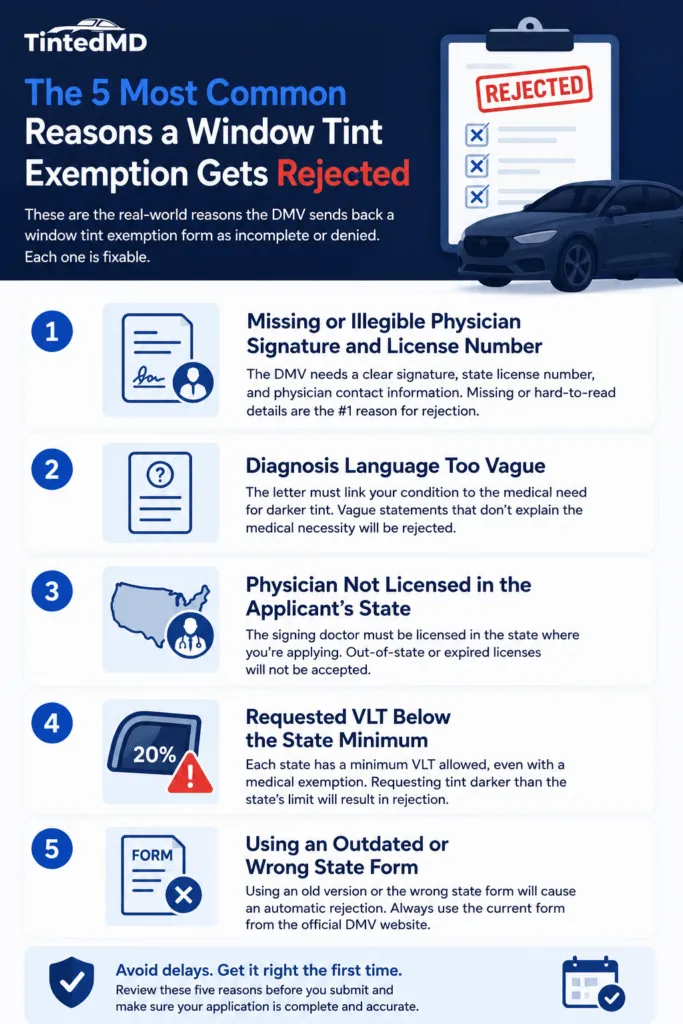
These are the real-world reasons the DMV sends back a window tint exemption form as incomplete or denied. Each one is fixable. But understanding which one applies to your situation tells you exactly what to correct before resubmitting.
Reason 1: Missing or Illegible Physician Signature and License Number
This is the single most common reason for rejection, across virtually every state. The DMV needs to verify that the certification came from a licensed medical professional. If the signature is hard to read, if the license number is missing, or if the physician’s contact information is not on the letter, the form will be returned.
The fix is straightforward but requires going back to the physician. The signed letter must include the physician’s full printed name, their state medical license number, their practice address, and a clear signature. For a medical exemption for window tint, the physician’s credentials are not optional detail. They are the core of what makes the letter valid.
Washington DC is a clear example. The DC DMV medical waiver requires a letter on official letterhead signed by a physician, physician assistant, ophthalmologist, or optometrist. Any missing credential detail makes the letter invalid.
How to fix it:
- Contact your physician’s office and explain that the DMV rejected your form specifically because of missing or illegible credentials. Most offices will correct this quickly.
- Ask for a new signed letter that includes: the physician’s full printed name (not just a signature), their state medical license number, their practice address, and a legible wet or digital signature.
- If you are using TintedMD, forward the DMV rejection notice through the patient portal. The reviewing physician will issue a corrected certification with all required credentials on the same business day.
- Do not use correction fluid or add handwritten notes to the original form. A corrected letter on official letterhead is the only accepted fix in most states.
- Time to fix: 1 to 2 business days with your original provider. Same day with TintedMD.
Reason 2: Diagnosis Language Too Vague
The second most common reason is a doctor letter that names a condition but does not connect it to the specific medical need for darker window tint. The DMV is not a medical office. They cannot interpret that lupus means UV sensitivity unless that connection is spelled out explicitly in the letter.
A letter that says ‘Patient has lupus and should avoid sun exposure’ is often not enough. A letter that says ‘Patient has systemic lupus erythematosus (ICD-10 code M32.9), a condition in which UV radiation directly triggers disease flares, including photosensitivity reactions that cause skin lesions, fatigue, and joint inflammation. Medical grade window tinting at X% VLT is medically necessary to prevent UV-triggered symptom exacerbation during vehicle use’ gives the DMV exactly what it needs.
Many doctors are simply not familiar with what the DMV needs in a window tint exemption letter. They write a standard clinical note instead of the specific, vehicle-context paperwork the state requires. TintedMD physicians understand this distinction and complete the certification with the specific language each state uses. Need a DMV-approved exemption letter? See how TintedMD works →
If your application was denied, the fastest fix is to reapply with a physician letter that meets your state’s requirements.
How to fix it:
- Bring your DMV rejection notice to your next physician visit. Show the physician exactly what the DMV said was missing. Most DMVs will indicate that the medical necessity connection to vehicle use was not established.
- Ask your physician to revise the letter to include: the ICD-10 diagnostic code for your condition, an explanation of how your condition causes UV or light sensitivity specifically, a statement that this sensitivity creates a medical risk during vehicle use, and the recommended VLT percentage for adequate protection.
- A useful template sentence for the physician: “Patient has [diagnosis, ICD-10 code], a condition in which [UV radiation / bright light] directly triggers [specific symptom]. Standard vehicle glass provides insufficient UV protection for this patient’s condition, and window tint at no more than [X]% VLT is medically necessary to prevent [specific health consequence] during normal vehicle use.”
- If your original physician is not familiar with DMV medical tint documentation, TintedMD physicians complete this paperwork daily and understand exactly what language each state’s DMV accepts.
Time to fix: Varies with your physician’s availability. Same day with TintedMD.
Reason 3: Physician Not Licensed in the Applicant’s State
Some states require that the signing doctor be licensed in the state where the exemption is being applied for. A letter from an out-of-state specialist, a telehealth provider licensed only in another state, or a doctor whose state license has lapsed will not satisfy this requirement.
This is one of the more complicated rejection reasons because it requires finding a locally licensed provider and starting the paperwork process again. TintedMD works with physicians licensed in each state it serves, which is why the TintedMD eligibility check asks for your state upfront before matching you with the appropriate licensed provider.
How to fix it:
- Verify whether your state requires in-state physician licensure for tint exemption forms. Most do, but some states accept out-of-state providers. Check your state DMV’s official exemption page or call the DMV medical review unit directly.
- If your state requires in-state licensure, you need a new certifying physician licensed in your state of residence. This means either scheduling with a local physician who can complete the exemption paperwork, or using a telehealth service that is licensed in your specific state.
- TintedMD’s intake flow asks for your state upfront and matches you with a physician holding an active license in that state. This is the reason TintedMD asks for your state before anything else; it is the single most overlooked requirement in the exemption process.
- Make sure the corrected letter clearly states the physician’s state of licensure alongside their license number.
Time to fix: Depends on scheduling a local appointment. Same day with TintedMD (licensed in each state it serves).
Reason 4: Requested VLT Below the State Minimum
Most states that offer a window tint exemption still set a floor on how dark the tint can go, even with medical paperwork. In many states, that absolute minimum is 20% VLT (Visible Light Transmission). Requesting tint darker than the state’s floor, even with a doctor’s letter, will result in rejection or a reduced approval.
VLT stands for Visible Light Transmission. It measures the percentage of light that passes through the window. Lower VLT means darker tint. 5% VLT is nearly opaque limo tint. 70% VLT is nearly clear. Most standard state tint laws require front windows at 35% VLT or higher. Medical exemptions allow going darker, but states still set a minimum floor, often 20% VLT.
If a physician writes a recommendation for 5% VLT in a state with a 20% minimum, the form will be rejected or adjusted. The doctor needs to know the state’s minimum before writing the recommendation. TintedMD physicians are briefed on state-specific VLT floors before completing each patient’s certification.
How to fix it:
- Look up your state’s absolute minimum VLT for medically exempt vehicles. This is not the same as the standard tint law minimum; it is the floor that applies even with a valid medical exemption. Most states publish this in their DMV exemption guidelines.
- If your physician recommended a VLT darker than the state floor, the letter needs to be revised to recommend a VLT at or above that floor. You cannot negotiate the state minimum; it is a hard limit.
- Contact your physician and request a corrected letter with a revised VLT recommendation. Explain that the state’s minimum VLT for exempt vehicles is [X]% and ask them to revise the recommendation accordingly.
- If the physician is unsure what VLT to recommend, TintedMD physicians are briefed on the VLT floor for every state they serve before completing any patient’s certification. This prevents the rejection from happening in the first place.
- After you have the tint installed at the approved VLT level, keep your exemption paperwork in the vehicle at all times.
Time to fix: 1 business day once the physician is aware of the correct floor. Same day with TintedMD.
Reason 5: Using an Outdated or Wrong State Form
States update their exemption forms periodically. Using a form downloaded months ago, or using a form from the wrong state entirely, is a straightforward way to get a rejection. The DMV will not process forms on outdated or incorrect forms.
The fix is to download the current version of the state’s form directly from the state DMV’s official website immediately before your doctor completes it. The TintedMD guides links to the current form for each state, updated regularly to reflect any changes.
How to fix it:
- Go directly to your state DMV’s official website and download the current version of the medical tint exemption form today. Do not use a saved PDF, a form forwarded by someone else, or a form from a third-party website; forms change without notice and old versions are rejected.
- Check the form’s revision date, usually printed in the bottom corner. Compare it to the date on the form you submitted. If they differ, you used an outdated version.
- Have your physician complete the new form. The doctor does not need to be seen again if the only issue was the form version; the same clinical information on a current form is usually sufficient, but confirm this with your state DMV before resubmitting.
- If your state requires the physician to use a specific state-issued form rather than a general letter, the form must be downloaded fresh from the DMV site for each application. TintedMD updates its form links for each state whenever a state makes a form revision. Using the TintedMD process ensures the physician always completes the current version.
Time to fix: Same day once you have the correct form. Physician sign-off may take 1 to 2 business days.
What to Do Immediately After a Window Tint Exemption Rejection
Getting a rejection on your window tint exemption is frustrating, but it is not the end of the process. Here is the exact sequence to follow.
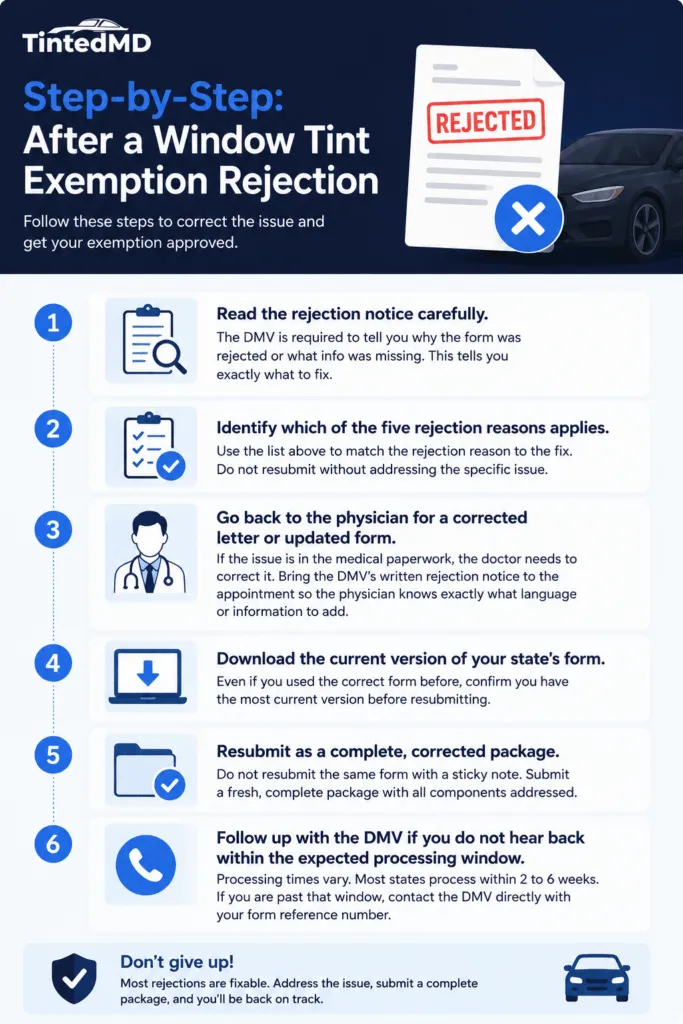
Step-by-Step: After a Window Tint Exemption Rejection
-
Read the rejection notice carefully. The DMV is required to tell you why the form was rejected or what info was missing. This tells you exactly what to fix.
-
Identify which of the five rejection reasons applies. Use the list above to match the rejection reason to the fix. Do not resubmit without addressing the specific issue.
-
Go back to the physician for a corrected letter or updated form. If the issue is in the medical paperwork, the doctor needs to correct it. Bring the DMV’s written rejection notice to the appointment so the physician knows exactly what language or information to add.
-
Download the current version of your state’s form. Even if you used the correct form before, confirm you have the most current version before resubmitting.
-
Resubmit as a complete, corrected package. Do not resubmit the same form with a sticky note. Submit a fresh, complete package with all components addressed.
-
Follow up with the DMV if you do not hear back within the expected processing window. Processing times vary. Most states process within 2 to 6 weeks. If you are past that window, contact the DMV directly with your form reference number.
If the rejection was due to physician paperwork issues, using TintedMD for the corrected letter is often the fastest path forward. Physicians on the platform are familiar with the medical exemption for window tint paperwork standards for each state and can complete a corrected certification quickly, with same-day delivery. Get your corrected exemption letter from TintedMD →
Is a Rejected Window Tint Exemption the Same as a Denial?
Not necessarily. A rejected application may mean the DMV found missing information, an incorrect form, insufficient medical documentation, or another issue that needs to be corrected. It does not automatically mean that you are medically ineligible for a window tint exemption.
Start by reviewing the rejection notice to identify exactly what the state agency found. If the issue is missing or incorrect documentation, you may be able to correct the problem and resubmit. If the state determined that your condition or requested tint level does not meet its requirements, a different process may apply.
The key is to address the specific reason for the rejection rather than submitting the same application again. State requirements vary, so follow the instructions provided by the relevant DMV or motor vehicle agency.
How to Get Your Medical Exemption for Window Tint Approved the First Time
Prevention is faster than correcA licensed physician in your state reviews your information and schedules a brief telehealth consultation,A licensed physician in your state reviews your information and schedules a brief telehealth consultation,tion. Here is the checklist that covers the rules for a complete, first-time-approved medical exemption for window tint form.
Pre-Submission Checklist for Window Tint Exemption Forms
| Requirement | What to Check |
|---|---|
| Physician credentials on letter | Full printed name, state license number, practice address, clear signature |
| Diagnosis specificity | ICD-10 code included, connection to UV sensitivity clearly stated |
| Medical need for tint | Letter explicitly states WHY darker tint is medically necessary for this patient |
| VLT recommendation | Specific percentage stated, above the state’s minimum floor |
| Physician state licensure | Doctor is licensed in the state where the exemption is being filed |
| Form version | Downloaded directly from state DMV website immediately before physician visit |
| Vehicle information | Correct VIN, make, model, year, registration matches |
| Form fee | Included if required by state (varies, typically $0 to $30) |
| Supporting diagnosis records | Some states require attached medical records confirming the qualifying condition |
| Paperwork to keep in vehicle | Know what you need to carry after approval |
Getting the Physician Letter Right the First Time
The doctor letter is the most critical part of the form. Most rejections trace back to it. When you see a physician for your window tint exemption certification, bring these things to the appointment: your state’s current exemption form, any available guidance from your state DMV on what the letter must include, and a note of the state’s minimum VLT floor.
The doctor needs to confirm five specific things in the letter: (1) your diagnosis, stated with the ICD-10 code if possible, (2) how your condition causes sensitivity to sunlight or UV radiation, (3) why this sensitivity creates a specific medical need when driving, (4) the recommended VLT percentage, and (5) the duration of need (permanent or time-limited). A letter that clearly states all five is almost always sufficient for a window tint exemption to be approved.
Qualifying Conditions That Commonly Receive Approval
Not every condition qualifies in every state. But the following conditions are widely recognized as qualifying for a medical exemption for window tint in most states that offer the exemption:
-
Lupus (systemic lupus erythematosus): UV exposure directly triggers flares. One of the most commonly approved conditions.
-
Photophobia: Extreme light sensitivity associated with neurological or ophthalmic disorders. Listed by name in several states including New York.
-
Albinism: Complete or partial absence of melanin, causing extreme UV sensitivity.
-
Photosensitive porphyria: A rare metabolic disorder where UV light causes severe skin damage.
-
Xeroderma pigmentosum: A rare genetic condition causing extreme UV sensitivity and very high skin cancer risk.
-
Melanoma history: Prior skin cancer diagnosis requiring minimized UV exposure.
-
Dermatomyositis and other autoimmune conditions: Where UV light is a documented trigger.
-
Severe drug photosensitivity: Where medication causes prolonged, severe sensitivity to sunlight.
If your condition is not on this list, check the medical window tint exemption eligibility criteria for your state before applying. Some states accept any physician-attested condition. Others have a fixed list.
What Should You Do If Your Doctor’s Letter Is Rejected?
If your medical window tint exemption is rejected because of the physician’s documentation, start with the specific issue identified by the state agency. A missing credential, unclear medical necessity, incomplete diagnosis, or incorrect form may require different corrections.
Ask your physician to review the rejection notice and update the documentation to address the stated requirement. Depending on your state, the corrected paperwork may need to include the physician’s credentials, your qualifying condition, the medical reason for additional protection from sunlight or UV exposure, and any other information required by the state.
Before resubmitting, compare the corrected documentation with the current state requirements and make sure all required forms and supporting documents are included.
A corrected physician letter can address a documentation problem, but it does not guarantee approval. The final decision depends on your state’s eligibility requirements and reviewing agency
Using Your Window Tint Exemption After Approval: What You Need to Know
Getting your window tint exemption approved is not the end of the process. Here is what happens after approval and what you need to keep in order.
Carry Your Paperwork at All Times
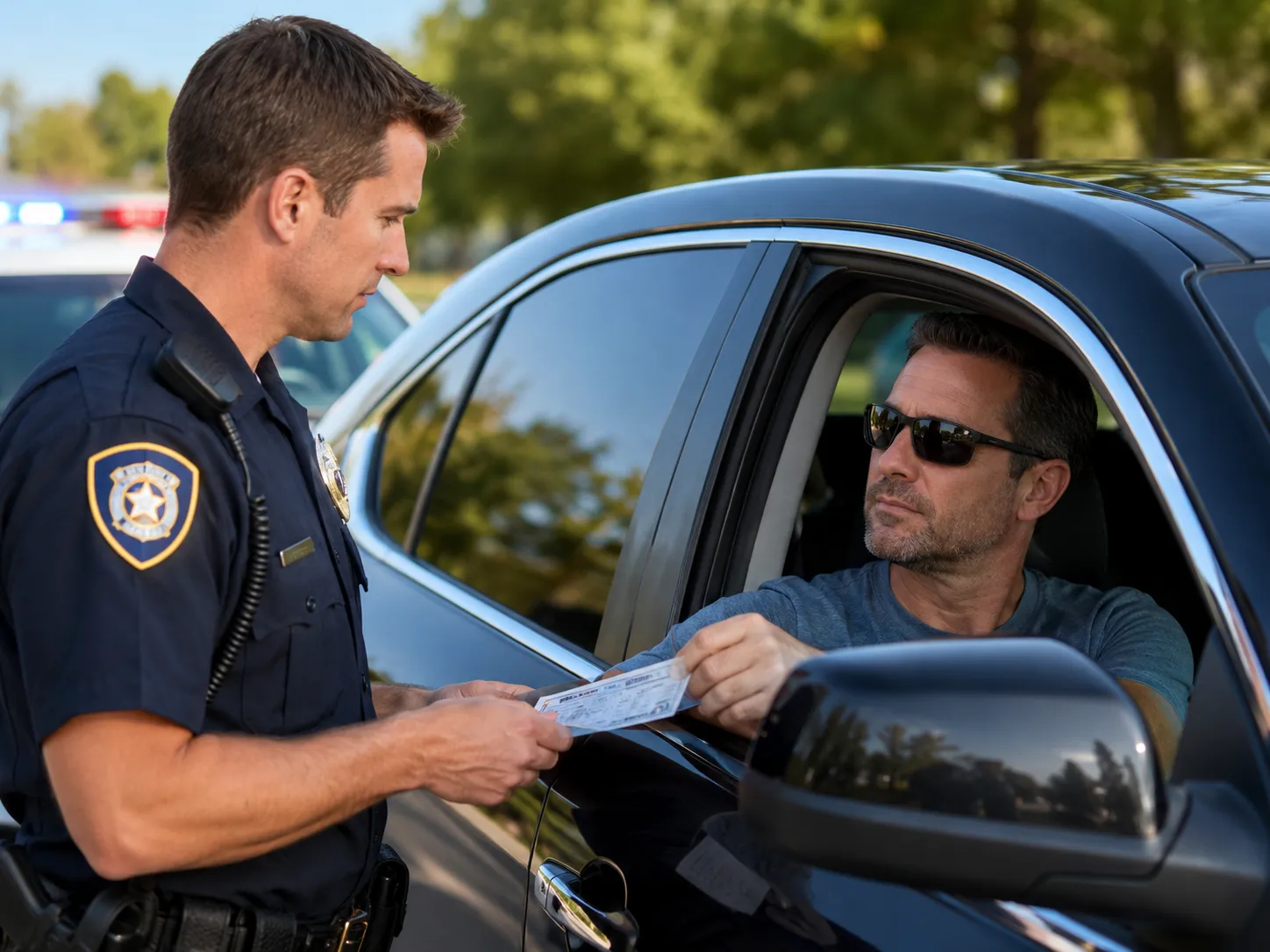
In states that issue a formal permit or sticker, you must have it in the vehicle at all times. In states like California and Washington DC, the signed doctor letter itself is what you carry in the glovebox. An officer who stops you for dark tint can request it on the spot. If you cannot produce it, you may receive a citation even though your tint is legally exempted.
In Florida, the medical exemption certificate is tied to the specific vehicle, not the driver. If you switch vehicles, the exemption does not transfer. You must apply for a new exemption for the new vehicle using Form HSMV 83182. Check the Florida DHSMV disability documentation for the current form. In New York, the same logic applies to Form MV-80W. Always check whether your state’s exemption is vehicle-specific or person-specific.
Renewing Your Exemption
Most state exemptions expire. Common renewal periods are one year, two years, or three years. Florida is an exception for certain conditions, offering non-expiring certificates. Set a calendar reminder at least 60 days before your exemption expires so you have time to get the physician paperwork updated and resubmit before the current one lapses.
TintedMD handles renewals through the same online process as new forms. If you got your original window tint exemption through TintedMD, your physician records are already in the system, making the renewal process faster.
Traveling Across State Lines
Your state’s exemption is valid in your home state. When you drive into another state, that state’s tint laws apply to your vehicle. Most states do not honor other states’ medical tint exemptions. If you regularly drive across state lines, you may need a separate exemption for each state where you spend significant time.
For short trips or vacations, the risk is usually low but not zero. An officer in another state can technically cite you for tint that would be legal under your home state’s exemption. Keeping your home state paperwork in the vehicle at least gives you something to show the officer, even if it is not technically binding in the other state.
What If Your Requested Tint Is Too Dark for a Medical Exemption?
A medical window tint exemption does not necessarily allow any tint darkness you choose. States that permit medical condition-based exemptions may still set a minimum VLT, or Visible Light Transmission, that applies even when additional tint is medically justified.
If your application is rejected because the requested VLT is below your state’s permitted minimum, check the rejection notice and your state’s current exemption requirements. Your physician may need to recommend a VLT that meets the state’s minimum while still addressing your documented medical need.
Do not assume that a medical exemption overrides the state’s VLT limit. The permitted level varies by state, so confirm the applicable minimum before installing or requesting darker tint.
How TintedMD Handles Your Window Tint Exemption Paperwork
The most common reason people get rejected, and the main reason the process takes longer than it should, is the physician paperwork step. Most doctors write general clinical notes. The DMV needs specific, vehicle-context language that most physicians have never written before.
TintedMD was built exactly to solve this problem. Here is how the process works for a medical exemption for window tint through the platform:
-
You answer questions about your condition and your state. The intake form captures your diagnosis, your state of residence, and the specifics of your situation. This takes about 5 minutes.
-
A licensed physician reviews your case. The reviewing physician is licensed in your state and familiar with your state’s specific window tint exemption rules. No in-person appointment needed. Everything is handled securely through telehealth.
-
Your paperwork is prepared to state standards. The doctor completes the certification with the specific language, ICD-10 code, VLT recommendation, and medical necessity statement your state DMV requires. This is the step that catches most of the common rejection reasons before they happen.
-
You receive your paperwork same day. The completed, doctor-signed certification is delivered digitally, ready for submission to your state DMV.
TintedMD has helped over 100,000 patients get their window tint exemption paperwork completed correctly. The platform is HIPAA-compliant, and every form comes with a money-back guarantee if it is not approved.
If you have already been rejected and need a corrected letter, the same process applies. Bring your DMV rejection notice, and the TintedMD physician will address the specific problem in the corrected certification. Check your eligibility at TintedMD.com to get started.
Conclusion
A rejected window tint exemption is almost always fixable. The five rejection reasons covered in this guide account for the vast majority of denials, and every one of them comes down to paperwork. Missing doctor credentials, vague diagnosis language, out-of-state licensure, an impossible VLT request, or an outdated form. Fix the specific issue, resubmit a complete package, and most applicants are approved.
The better path is getting the medical exemption for window tint paperwork right the first time. That means working with a doctor who understands what the DMV actually needs, not just what a standard clinical note says. TintedMD was built exactly for this: physicians licensed in your state, familiar with your state’s exact rules, completing your certification with the specific language that gets forms approved.
The fastest way to get approved after a DMV rejection is to resubmit with a physician-reviewed packet that addresses the exact problem the DMV identified. Not a revised letter. Not the same form with a correction. A complete, DMV-ready package physician letter with the right credentials, current state form, correct VLT, and medical necessity language written specifically for your state.
That is exactly what TintedMD produces. A licensed physician in your state reviews your case, completes your state’s current form with the specific language the DMV accepts, and delivers your signed, complete packet the same day. 100,000+ patients helped. Money-back guarantee if it is not approved.
Take the Guesswork Out of Your Medical Documentation. Start Your Online Medical Evaluation!
Frequently Asked Questions
Why was my window tint exemption rejected?
The five most common reasons a window tint exemption is rejected are: missing or illegible doctor signature and license number, diagnosis language that is too vague (no connection to UV sensitivity or driving), doctor not licensed in the applicant's state, requested VLT darker than the state's absolute minimum floor, and using an outdated or incorrect state form. Read your rejection notice to identify which applies to your situation.
Can I reapply after a window tint exemption rejection?
Yes. A rejection is not a permanent denial. In most states, you can correct the problem and resubmit a complete form. The DMV is required to tell you what info was missing or incorrect. Fix that specific issue and resubmit as a complete, fresh package. There is no limit to the number of times you can apply.
What conditions qualify for a medical exemption for window tint?
Qualifying conditions vary by state but commonly include lupus, photophobia, albinism, photosensitive porphyria, xeroderma pigmentosum, melanoma history, dermatomyositis, and severe drug photosensitivity. Some states accept any physician-attested condition. Others have a fixed list. Colorado and Kansas do not offer a medical exemption for window tint under any condition.
Does my doctor have to be licensed in my state?
Some states require that the signing doctor hold an active medical license in the state where the exemption is being filed. Using an out-of-state provider, including a telehealth service licensed only in another state, can result in rejection. TintedMD matches patients with physicians licensed in their specific state to avoid this issue.
How dark can my tint be with a medical exemption?
Even with a window tint exemption, most states set an absolute minimum VLT that applies to all vehicles, including medically exempt ones. This floor is often 20% VLT, though it varies by state. No state allows 0% (completely opaque) tint even with a medical exemption. Your doctor's VLT suggestion must be at or above your state's minimum floor or the form will be rejected or adjusted.
Does my window tint exemption work in other states?
Usually, no. Your home state's medical window tint exemption is valid in your home state. When you drive into another state, that state's tint laws apply to your vehicle. Most states do not formally honor other states' exemptions. If you regularly commute across state lines, applying for an exemption in both states is the safest approach.
How do I get my window tint exemption paperwork completed without a doctor's appointment?
TintedMD connects you with a licensed physician in your state who reviews your medical information and completes the required window tint exemption certification online. No in-person appointment is needed. The completed, doctor-signed paperwork is delivered same day. Check your eligibility at TintedMD.com.
What should I include in a physician-reviewed packet when resubmitting after a DMV rejection?
When resubmitting after a rejection, your packet should include: (1) the corrected physician letter or state form, on official letterhead, with the physician's full name, state license number, and legible signature; (2) the specific VLT recommendation at or above your state's minimum floor; (3) a vehicle-specific medical necessity statement connecting your diagnosis to the need for darker tint during driving; (4) a copy of your vehicle registration with matching make, model, year, and VIN; (5) any required application fee; and (6) a copy of the original DMV rejection notice, so the reviewer can confirm the specific issue has been addressed. Submitting all components together as one complete package prevents secondary rejections and processing delays.
How long does it take to hear back about a medical window tint exemption?
Processing times vary by state, application completeness, and the reviewing agency. Some DMVs may take several weeks to review medical window tint exemption paperwork. If your application is taking longer than the timeframe provided by your state agency, contact the DMV directly to check its status before submitting duplicate paperwork.
Can I appeal a denied medical window tint exemption?
Appeal or reconsideration options depend on your state and the reason for the denial. Start by reviewing the written decision to determine whether the issue can be corrected through resubmission or requires a formal appeal. Follow your state DMV’s instructions and obtain updated medical documentation from a licensed physician when required.

Meet the author
Nida Hammad
I am a professional writer with over five years of experience creating clear, engaging, and well-researched content. I specialize in medical window tint exemptions and state compliance topics, helping readers understand tint laws and exemption requirements in simple, easy-to-follow language. Currently, I write for TintedMD, where I focus on producing accurate, trustworthy guides to help drivers navigate the medical tint exemption process with confidence.
Get Your Medical Tint Exemption Online in Minutes
Check Your Eligibility